HIGH REPRESENTATIVE’S LEGISLATIVE POWERS HAVE NEVER BEEN VALIDLY ESTABLISHED
USA - Republika Srpska
08/08/2026
09:42
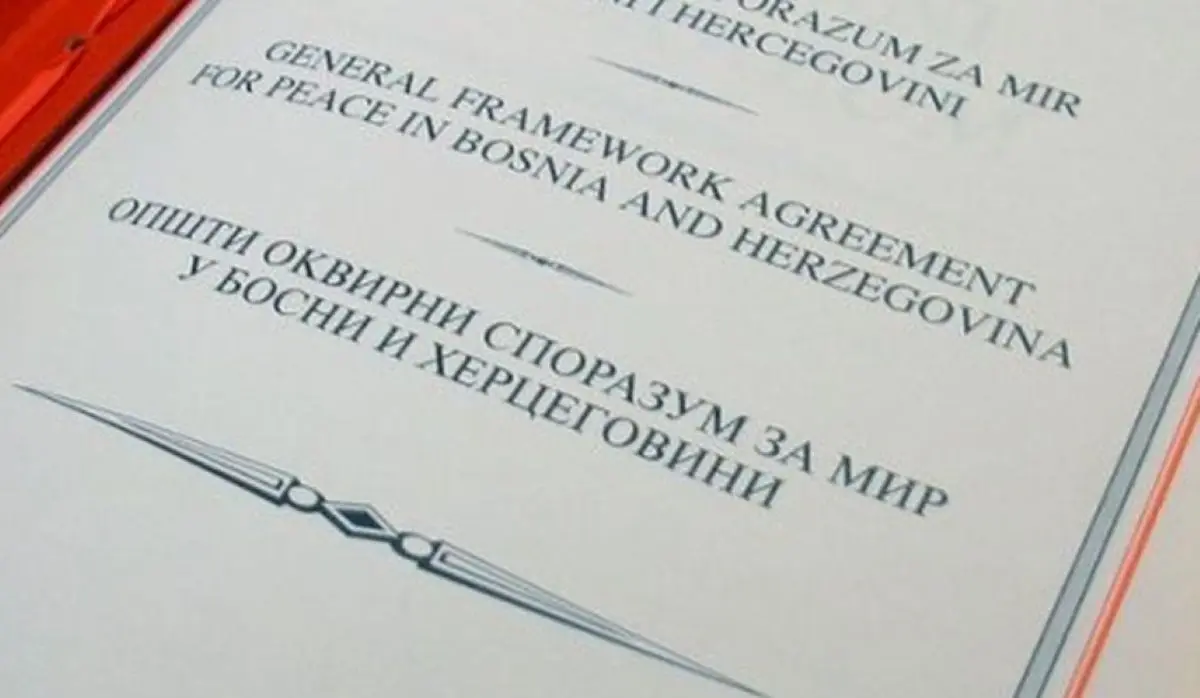
WASHINGTON, AUGUST 8 /SRNA/ – The High Representative in BiH has never been authorized to enact laws, either under the UN Charter, the Constitution of BiH or other legal documents recognizing the right to self-determination. Therefore, all acts imposed by the High Representative, invoking the so-called Bonn powers, are void, according to a paper authored by Joseph Schmit and Brian Kennedy of prestigious Harvard University.
In the paper published in the academic journal "Harvard Journal of Law and International Politics," the authors cite Article 1 of the UN Charter, which defines the right to self-determination as a fundamental principle of a democratic society, as the first example of the alleged illegitimacy of the High Representative's legislative powers.
"The right of peoples to self-determination is one of the guiding principles for the preservation of international peace and security. A fundamental principle of self-determination in any society based on the rule of law is that laws may be enacted only by those authorized to do so," the authors quote the UN Charter as saying.
The paper draws a clear parallel between Article III 3a of the Constitution of BiH and the Tenth Amendment to the US Constitution, which do not explicitly mention the principle of subsidiarity but incorporate it in substance.
The Constitution of BiH, adopted as Annex 4 to the Dayton Peace Accords, explicitly states that "all governmental functions and powers not expressly assigned by this Constitution to the institutions of BiH shall be those of the Entities."
The US Constitution, meanwhile, provides that "the powers not delegated to the United States by the Constitution, nor prohibited by it to the States, are reserved to the States respectively, or to the people."
The authors note that the 2007 Treaty on European Union provides that, in accordance with the principle of subsidiarity, in areas that do not fall within the Union's exclusive competence, the EU shall act only if the objectives cannot be sufficiently achieved by the member states.
The paper reminds the position of English jurist and politician William Blackstone, who wrote in his 1765 work "Commentaries on the Laws of England" that "it is essential to the very nature of a law that it be made by a supreme authority," stressing that sovereignty and legislative power are mutually connected and cannot exist independently of one another.
In his book "The Constitutional Position of Croats in BiH," former President of the Constitutional Court of BiH Mato Tadić specified that High Representatives had imposed a total of 341 laws, most of them concerning judicial reform, state symbols and other matters at the level of BiH.
HIGH REPRESENTATIVE IS NOT SUPREME AUTHORITY
Taking into account all the examples from constitutions and legal documents, the authors concluded that the High Representative is not the supreme authority in BiH and that all laws enacted by him, invoking the so-called Bonn powers, are void, since the signatories to the Dayton Agreement never transferred legislative powers to the High Representative.
According to the authors, based on the facts presented, the head of the Office of the High Representative should, in accordance with the principle of subsidiarity, accept the opinion of the Constitutional and Legal Committee of the Parliamentary Assembly of BiH from Feb. 13 this year, which states that the High Representative has no constitutional authority to enact laws.
The authors note that one possible solution would be for the Constitutional Court of BiH or the European Court of Human Rights to issue a formal ruling establishing that the High Representative "has no constitutional authority to enact laws" and that the Bonn powers from 1997, on which those "laws" were based, are void as though they had never existed.
"Another possible solution regarding the Bonn powers could be for authorized representatives of Serbia and Croatia to issue a joint statement confirming their agreement with the opinion of the Constitutional and Legal Committee of the House of Representatives of the BiH Parliamentary Assembly," the Harvard University authors said.
The paper argues that, following the appointment of Louis Crishock as acting High Representative, the time has come for the tyrannical Bonn powers, under which hundreds of "acts of purported legislation" were enacted, to be declared void from the outset /ab initio/.
"When this happens, the peoples of BiH will be able to decide their own future, while Americans will be able to invest in a friendly European country. Most importantly, if US President Donald Trump reciprocates the support he has repeatedly received from Republika Srpska President Milorad Dodik, America will have a friend and partner in BiH in the global competition for important strategic resources," the paper concludes.


RECORD-FAST SALES OF MEMOIRS BY PRINCESS DIANA'S BROTHER

JAHORINA READY FOR INTERNATIONAL COMPETITIONS
THERE IS ROOM FOR FURTHER IMPROVEMENT OF COOPERATION BETWEEN UNIVERSITIES AND SCIENTIFIC INSTITUTIONS
SRPSKA'S DIPLOMATIC OFFENSIVE GIVES RESULTS