NUŽDIĆ: JUDICIAL PRIORITIES MUST START WITH VICTIM AND CRIME, NOT BE DRIVEN BY POLITICAL INTEREST
BiH - judiciary
09/05/2026
10:02
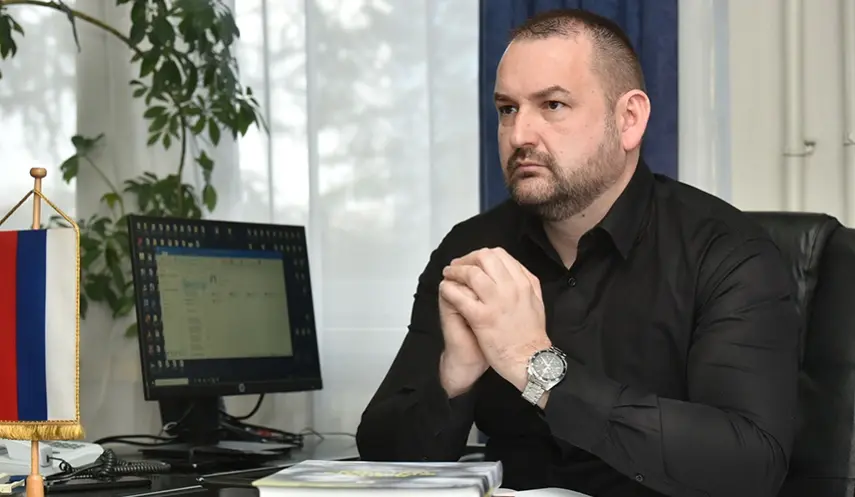
BANJA LUKA, SEPTEMBER 5 /SRNA/ — The key question facing BiH's judicial system is whether its institutions are genuinely committed to delivering justice for all victims, or whether judicial mechanisms are being used to target those who are politically disfavored, Viktor Nuždić, acting director of the Republika Srpska Center for Research of War, War Crimes and the Search for Missing Persons, said in a statement to SRNA.
"If we want justice, then it must be equal for everyone. One crime cannot be prosecuted quickly while others wait for decades. Victims cannot be asked to be patient and understanding about a lack of capacity while time and resources are simultaneously found for other cases. Justice must start with the victim and the crime, not political interest," Nuždić said.
Nuždić stressed that for years it has been repeated that judicial institutions at the BiH level lack prosecutors, investigators, courtrooms and other resources needed to prosecute war crimes, yet the public is now witnessing cases involving the controversial provision of the BiH Criminal Code imposed by Valentin Inzko being initiated and handled swiftly.
"It is as if all war crime cases have been resolved, and the priority now is to prosecute what someone says or how someone speaks about war crimes," Nuždić pointed out.
He said this raises the fundamental question of judicial priorities at the BiH level.
He asked how it is possible for authorities to respond so quickly to cases involving the public approval, denial, minimization or justification of war crimes, while at the same time there has been no judicial resolution for years in numerous crimes committed against the Serb population.
"The case against Đuro Matuzović and others has already gone 10 years without a first-instance conclusion. The case against Atif Dudaković is entering its tenth year. There is still no final judicial outcome for the crimes in Čemerno, Dobrovoljačka, Konjic and numerous other locations," Nuždić reminded.
He added that the question also arises as to whether it is possible for people for whom there is evidence that they committed crimes against Serbs to be celebrated today, while at the same time it is claimed that doing so is not punishable because there is no final conviction.
"And does that then mean that it is permissible to relativize or glorify crimes against Serbs as long as there is no final conviction?" Nuždić asked.
ARTICLE 145A AND THE ISSUE OF SELECTIVE APPLICATION
Nuždić reminded that Article 145a of the BiH Criminal Code, imposed by Inzko, sets out clearly defined conditions and, among other things, criminalizes public incitement to violence or hatred, as well as certain forms of public approval, denial, gross minimization or justification of crimes established by final court judgments.
He added that the law also provides for punishment of certain forms of glorification of persons finally convicted of genocide, crimes against humanity or war crimes, arguing that the problem lies not only in the existence of the provision, but also in how it is applied and the priorities set for judicial institutions.
"If resources, investigative measures and judicial proceedings can be made available for cases under Article 145a, then it is reasonable to ask why the same system has been unable for years to conclude numerous cases involving actual war crimes, such as those in Mrkonjić Grad, Sarajevo, Tuzla, Petrovačka Cesta and other locations. Investigations into many of these crimes are still ongoing, while victims' families have been waiting for justice for decades," he said.
Nuždić also reminds of the case of the Podrinje region, where, two years ago, officials from the State Investigation and Protection Agency /SIPA/ came to the Republika Srpska Center and took possession of all documentation held by the Center concerning crimes against Serbs in Podrinje.
The same documentation, he stated, had previously been submitted on several occasions by the Republika Srpska Ministry of Internal Affairs.
"To this day, we have no information about the status of that investigation. The question is whether it is normal for the Center to spend years collecting testimonies, documentation and data on crimes, while investigative authorities are only now gathering basic operational information that has been publicly available for years," Nuždić said.
SENTENCING POLICY RAISES ADDITIONAL QUESTIONS
Nuždić pointed to a situation in which the minimum sentences prescribed for certain offenses under Article 145a may be higher than sentences handed down to some perpetrators of actual war crimes.
He cited the cases of Sead Velagić, who was sentenced to one year in prison for crimes in Livno; Alminko Islamović, who received a three-year sentence for crimes in Posavina; and Almaz Nezirović, who was sentenced at first instance to two years for 22 counts of the indictment.
"There is a possibility that someone who glorifies one of these criminals could receive a harsher sentence than the criminal himself. That is an incredible legal absurdity," Nuždić said, arguing that the adoption of these amendments to the law was deeply politically motivated.
ELFETA VESELI AND SAKIB MAHMULJIN
In this context, he highlighted cases such as that of Elfeta Veseli, who was convicted of murdering Serbian boy Slobodan Stojanović, as well as the case of Sakib Mahmuljin, who was finally convicted of war crimes against Serbs but has not reported to serve his sentence for some time.
At the same time, Nuždić warned, messages are being sent that further relativize the suffering of Serb civilians.
"We have a situation in which glorification or certain views concerning war crimes are prosecuted, while people who have been finally convicted of war crimes are not serving their sentences and victims' families are still waiting for justice," Nuždić said.
According to him, it is particularly contentious that some senior Bosniak political representatives portray the killing of Serb children in Jošanica as legitimate military targets.
All of this, he said, raises the fundamental question of whether the priority of judicial institutions is truly justice for all victims or whether judicial mechanisms are being used to politically punish those deemed politically undesirable.
Nuždić concluded that the problem is not that the law should protect society against hatred and the glorification of crimes established by final court judgments, but that the same resources are not being applied to all victims and all crimes.
"Because if justice is not equal for everyone, then no legal provision, including Article 145a, can dispel the suspicion that the judicial system has become an instrument of different standards rather than a mechanism for protecting all victims and establishing accountability for all war crimes," Nuždić concluded.

STEVANDIĆ: NATIONAL ASSEMBLY WITHSTOOD PRESSURES AND PRESERVED SRPSKA INSTITUTIONS

PRNJAVOR TEAM CLAIMS WORLD TITLE IN STREET FOOTBALL

TRIŠIĆ BABIĆ: REPUBLIKA SRPSKA MUST HAVE A SAY, NOT HAVE DECISIONS MADE ABOUT IT IN SARAJEVO AND BRUSSELS
NUŽDIĆ: JUDICIAL PRIORITIES MUST START WITH VICTIM AND CRIME, NOT BE DRIVEN BY POLITICAL INTEREST