OSTOJIĆ: THANKS TO THE VRS, THE GENOCIDE AGAINST SERBS IN STARI BROD ON THE DRINA WAS NOT REPEATED
Republika Srpska - Višegrad - remembrance
05/30/2026
16:49
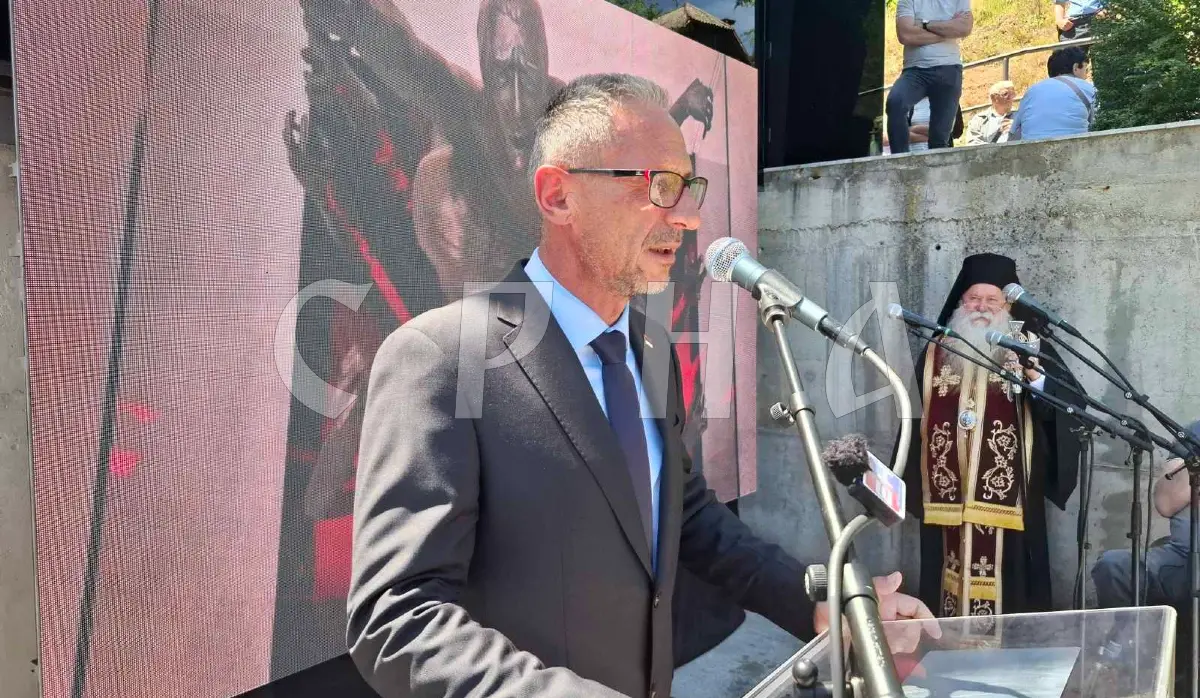
BROD ON THE DRINA, MAY 30 /SRNA/ - The Minister of Labor and Veterans-Disability Protection of Republika Srpska, Radan Ostojić, said in Stari Brod on the Drina near Višegrad that the crime committed 84 years ago at that location was not repeated in the 1990s thanks to the Army of Republika Srpska /VRS/ and the Ministry of Interior /MUP/, who prevented a new genocide against the Serbian people.
"We are all proud of what we did during the Defense-Patriotic War because we prevented genocide, created Republika Srpska, and defended freedom," Ostojić pointed out in his address after the memorial service for more than 6,000 Serbs from the Sarajevo-Romanija region, who were brutally murdered in 1942 by the Ustasha units of Jure Francetić.
He emphasized that it is an obligation today to be in Stari Brod on the Drina and pray to God for the souls of the innocent victims, and that it is very difficult to speak at the place where a terrible crime occurred.
"We are here to testify why this was not repeated in the 1990s of the last century, and it was not because we had the Army of Republika Srpska and the MUP, and because we were taught in our families and churches about what happened to us in the Second World War," said Ostojić.
He pointed out that Serbs grew into a generation that, despite the prohibitions, knew its history and its victims well.
"That is why we realized in those years that only united, under the auspices of the Church, could we prevent genocide, preserve our hearths, and defend freedom. Only on the path we took then could Republika Srpska be resurrected, which happened for the first time in history; the greatest success of the Serbian people was achieved," Ostojić emphasized.
He pointed out that the Drina is quieter than ever today, probably mourning that it was different in 1942, a tomb for a large number of Serbian children, mothers, girls, fathers, and old men, emphasizing that the entire Serbian history is a Golgotha and suffering.
Ostojić noted that a double crime occurred at this place: first when it was committed, and second when it was forgotten.
"Perhaps the greater crime was when the Serbs forgot what had happened to them. We forgot the victims, we did not adequately mark the place where they were killed, and someone forbade us from talking about it," Ostojić recalled.
Today, in Stari Brod on the Drina near Višegrad, the 84th anniversary was marked of the suffering of more than 6,000 Serbs from the Sarajevo-Romanija region, who were brutally murdered in 1942 by the Ustasha units of Jure Francetić.
Actor Aleksandar Stojković, students of the "Ivo Andrić" High School Center from Višegrad, and Deacon Nenad Savić from Pančevo performed in the cultural and artistic program.
The memorial service at the Memorial to the Victims was officiated by His Eminence the Metropolitan of Dabar-Bosnia, Hrizostom, with the concelebration of the clergy of the Serbian Orthodox Church.
Wreaths were laid on behalf of Republika Srpska by Minister Ostojić and the envoy of the Serb member of the BiH Presidency, Maja Gačić, and on behalf of Serbia by the State Secretary in the Ministry of Labor, Employment, Veteran and Social Affairs of Serbia, Zoran Antić, and the Minister-Counselor at the Embassy of Serbia in BiH, Nataša Đorđević.
In the spring of 1942, in Stari Brod and Miloševići, the Ustashas killed more than 6,000 Serbs from the areas of Sarajevo, Sokolac, Olovo, Kladanj, Rogatica, Han Pijesak, and Višegrad, who were trying to cross the Drina and find salvation in Serbia.
The most massive crime was committed on March 22, 1942, while the killings continued until the beginning of May.


SCOTLAND, WALES AND NORTHERN IRELAND CALL FOR INDEPENDENCE REFERENDUM
RELIABLE INFORMATION CRUCIAL TO FINDING MISSING PERSONS
ŠKRBIĆ RECEIVES RECOGNITION IN THE UNITED STATES FOR ACHIEVEMENTS IN SCIENTIFIC RESEARCH

ORBAN: COMMON FOREIGN POLICY MEANS GIVING UP SOVEREIGNTY