OSTOJIĆ: PRESERVE MEMORY OF SARAJEVO SERBS' SACRIFICE
Republika Srpska - Sokolac - culture of remembrance
03/16/2026
11:45

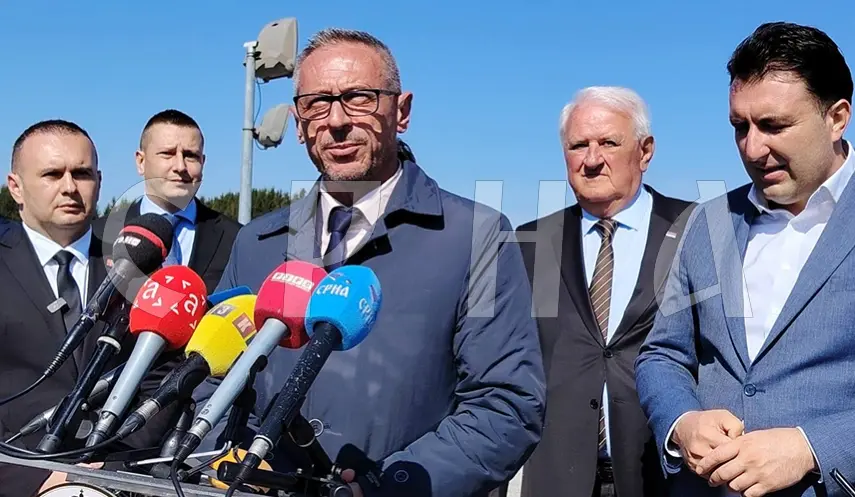
SOKOLAC, MARCH 16 /SRNA/ – The Minister of Labour, War Veterans and Disabled Persons Protection of Republika Srpska Radan Ostojić stated that the Serbs of the Sarajevo-Romanija region made the greatest sacrifice for freedom and Republika Srpska.
Ostojić emphasized that therefore an obligation to preserve the memory of those who gave their lives for Republika Srpska remains.
"The Sarajevo Serbs made an enormous sacrifice to preserve their homes; when freedom came, they had to leave everything behind. Imagine what kind of sacrifice it is," Ostojić told the press in Sokolac, where a memorial service was held today and wreaths were laid at the Military Cemetery Novi Zejtinlik.
He stressed that freedom is the greatest reward for the Serb people.
"The emotions are still strong nowadays. The people will never forget their centuries-old homes, but we are proud for creating Republika Srpska," Ostojić said.
Earlier, a memorial service at the main cross of the Military Cemetery Novi Zejtinlik was officiated by His Eminence Metropolitan Hrizostom of Dabar-Bosnia and Metropolitan Metodije of Budimlja-Nikšić.
A memorial service for the fallen soldiers will also be held at 11:30 a.m. at the Monastery of St. George the Victorious on Ravna Romanija, while a spiritual gathering will take place at 8:00 p.m. in the sports hall at the Republic of Serbia Square in Istočno Novo Sarajevo.
The marking of the 30th anniversary of the exodus of Sarajevo Serbs is organised by the Republika Srpska Government’s Committee preserving tradition of liberation wars and Istočno Sarajevo City.
The mass exodus of Sarajevo Serbs officially began on February 17, 1996, from the Serb-controlled municipalities of Sarajevo that, after the signing of the Dayton Peace Agreement, became part of the FBiH, and lasted almost until the end of March.
It is estimated that between 120,000 and 150,000 Serbs left their homes in the municipalities of Ilidža, Ilijaš, Vogošća, Hadžići, Rajlovac, Grbavica and Novo Sarajevo. One of the most distressing aspects was the exhumation and transfer of the remains of the deceased to the territory of Republika Srpska.