IGOR DODIK ON KEY STEPS WITH THE US: NO MORE IMPOSITION OR COWBOY POLITICS BY MURPHY AND SCHMIDT
Republika Srpska - SNSD
08/24/2026
23:10
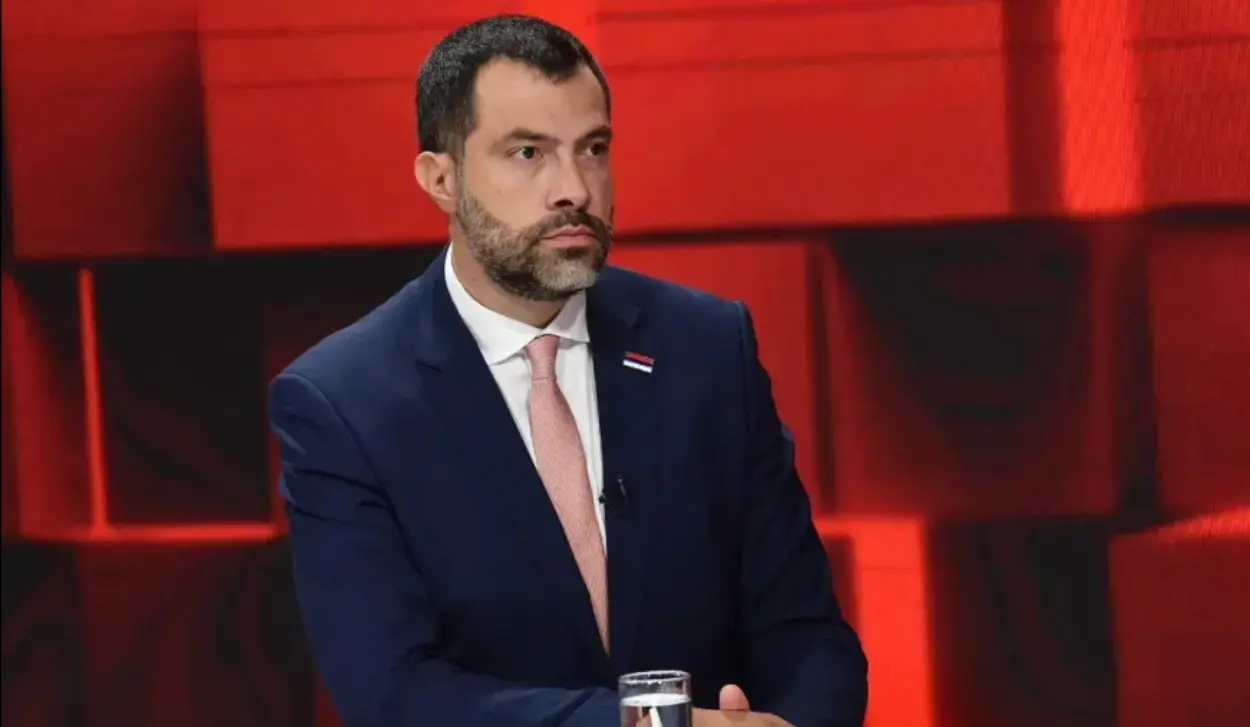
BANJA LUKA, AUGUST 24 /SRNA/ - Milorad Dodik opened the doors of Republika Srpska in the United States through his uncompromising efforts, and Željka Cvijanović and the team involved in the talks worked around the clock to help change the US administration’s approach toward Republika Srpska, SNSD Organizational Secretary Igor Dodik said.
Dodik stressed that, in return for the lifting of US sanctions, Republika Srpska had neither sold nor conceded anything, nor had it given up any part of its territory, but that the new US administration had recognized that an injustice had been done to its representatives.
“I certainly believe that Milorad Dodik, through his uncompromising struggle and persistence in insisting that Republika Srpska be left alone, or rather, be allowed to decide for itself, opened the door. We had previously tried to find interlocutors in Washington and many other places, but there was simply no willingness to listen, and they did not want to hear us,” Igor Dodik told ATV.
According to him, the change came with the arrival of the Trump administration, in which representatives of Republika Srpska found interlocutors who understood their position that peoples should be represented by people elected by the voters.
“We have tried year after year, but simply did not have an interlocutor. Fortunately, and thank God, we have found interlocutors in the new US administration who fully understand us. Their priority is that peoples should decide for themselves in their own country and that representatives elected in legitimate democratic elections should represent the people, rather than illegitimate high representatives imposing laws and some foreigner governing the country,” Dodik said.
He attributed a special role in the talks to Serb member of the BiH Presidency Željka Cvijanović, as well as to the broader team involved in establishing contacts.
“I have to mention President Željka Cvijanović, who worked, negotiated, and held talks around the clock. I say around the clock because the time difference did not always allow this to take place during the day, and I know that we talked at night as well. Ana Trišić Babić, Nemanja Kovačević and a large number of other people who helped make all of this possible also deserve mention,” Dodik said.
He said that following the lifting of the sanctions almost a year ago, there had been widespread speculation about what Republika Srpska had given the US administration in return.
“No matter how much we said at the time that we had made no concessions and that an injustice had simply been corrected, there were people who did not believe us. Time has shown that we made no concessions and that people on the other side realized that an injustice had been done. We have absolutely not given up any part of Republika Srpska,” Dodik stressed.
He singled out the end of political pressure and the imposition of decisions as the biggest change in relations with the US administration.
“The approach and attitude toward us have fundamentally changed. There is no longer any imposition of decisions, no more, as I have to put it, cowboy politics by Murphy and Schmidt, who exerted enormous pressure on the leadership of Republika Srpska simply because we thought for ourselves rather than the way they wanted us to,” Dodik said.
As evidence that, in his view, the aim of the previous sanctions was not to combat corruption, he cited the fact that the US blacklist included the president of the Academy of Sciences and Arts of Republika Srpska, the head of the Constitutional Court of Republika Srpska and the director of Radio-Television of Republika Srpska.
“When you see that they were sanctioned simply because they were members of the committee organizing Republika Srpska’s Day, you realize that their goal was not to target individuals for corruption or illegal activities. They wanted to cripple the system and leadership, strip Republika Srpska of its powers, and transfer those powers to Sarajevo,” Dodik stressed.
Speaking about the period when he was on the US blacklist, Dodik said that the personal sanctions did not affect him as much as the measures imposed on his friends and other people close to him.
“The sanctions against me did not upset or hurt me that much, but the sanctions against my friends, close associates and relatives who were placed on the list simply because they were connected to me as friends, godparents or relatives did hurt me. Everyone with the surname Dodik was placed under sanctions,” Dodik said.
He said that some people who were solely focused on their own work ended up on the blacklist simply because they knew him or his father.
“When you know what you are doing, where you are headed, and that you are doing the right thing, you somehow put it aside because you know that the injustice will eventually be corrected. But people who were simply doing their jobs ended up on the blacklist because they knew us. That hurt me the most,” Dodik said.
According to Dodik, the change in political relations also opened up financial opportunities that had previously been completely closed off to Republika Srpska. He said that Republika Srpska had issued bonds twice and that a significant portion of the funds for investment had been secured from American, European, and other global funds and banks.
“Until a year ago, this was completely halted. Every form of financial flow to Republika Srpska was blocked. Today, we have well-intentioned investors who want to invest here and create new jobs,” Dodik said.
He identified Republika Srpska’s proximity to the European Union, electricity prices, an educated workforce and natural resources as its key advantages.
“When investors see our conditions — that we are on the border of the European Union, that we have cheap energy and an educated workforce — they really want to invest. Today, we are recognized by American funds and investors, and the result of that is an investment cycle the likes of which Republika Srpska has never seen before. While we were under sanctions, we simply could not reach them, but now that has completely opened up and changed,” Dodik said.
Speaking about Donald Trump Jr.’s visit to Banja Luka in April this year, Dodik said it had put Republika Srpska in the spotlight of numerous international media outlets and increased interest among foreign investors.
“The very fact that he came to Banja Luka was truly significant. We had met several times before his arrival, and the last time, in Budapest, we discussed the energy potential of Republika Srpska. Since he is very interested in artificial intelligence, he recognized Republika Srpska as a base that American and global investors could use,” Dodik said.
His idea is to harness Republika Srpska’s energy potential to build data centres that would be leased by the world’s largest technology companies.
“We can build data centres and have companies such as Meta, Google and others come here and lease space. I would like Republika Srpska to build data centres and lease them to American and global companies for data storage. This would generate enormous revenues for us, which would flow into the Republika Srpska budget,” Dodik stressed.
He assessed that such investments would, in addition to providing financial benefits, contribute to the political and security stability of Republika Srpska, as major global companies would have an interest in ensuring that the area where they store their data remains peaceful and secure.
According to him, following Donald Trump Jr.’s visit, other investors interested in investing in energy, data centres and artificial intelligence also came to Republika Srpska.
Dodik said that his American counterparts had been asked to help resolve disagreements between Republika Srpska and Sarajevo in order to unblock energy and technology projects.
According to him, the development of artificial intelligence and new technologies does not mean that every citizen needs to understand algorithms, but rather that technology should make everyday life easier.
“I do not believe that each of us needs to know how an artificial intelligence algorithm works; I don’t know it either. What will help us is digitalization, greater efficiency in procedures, and reducing bureaucracy and corruption. Above all, there will no longer be any service counters,” Dodik said.
As an example, he cited certain digitalization processes in the local administration in Gradiška, which he discussed with Mayor Zoran Adžić.
“People can now obtain a certificate of no criminal record, a citizenship certificate or a birth certificate with a single click, without having to go from one counter to another and waste time. We need to introduce this throughout Republika Srpska, and I believe it will help our people,” Dodik said.
Dodik also addressed years of speculation about his ties to the IT company “Prointer”, which was shut down after its bank accounts were closed due to US sanctions. He said he had never been the owner of or employed by the company, but confirmed that he had supported its establishment and participated in developing the project.
According to him, the idea emerged more than a decade ago after, while taking an interest in digitalization initiatives, he established contacts at major international IT conferences.
“Friends and enthusiasts came to me who wanted to set up another company because they believed we had a large number of engineers and talented people whose knowledge could be put to use. The idea was to create an IT company that would operate not only in Republika Srpska but beyond. I supported the idea, participated in developing the project, and connected them with global companies with which they established significant partnerships,” Dodik said.
He said that he later stepped back so that media pressure and the association of his name with the company would not harm his family or the company, which employed more than 500 people.
“Of course, I am sorry today that all of this happened. I believe it was a crime against the intellect of Republika Srpska. Skilled engineers and other employees worked at the company for more than ten years. What pleased me was that, despite all the problems, the management decided to pay all employees two months’ salary in advance to give them time to get back on their feet and find new jobs,” Dodik said.
He added that former employees of the company later found jobs at other firms thanks to their knowledge, certifications, licenses and experience.
“I was neither the owner nor an employee of that company, but I supported it in the beginning because I believed that, alongside ‘Lanaco’, there should be another strong IT company. They operated in Sarajevo, Skopje, Ljubljana, Belgrade and Podgorica. They did not get contracts because I opened doors for them; they grew into a major company on their own,” Dodik said.
Asked whether there was room in Republika Srpska for a young, educated and capable person without a party membership card, Dodik said that in the private sector, particularly in the IT industry, no one looks at political affiliation.
“What is a problem today in the public administration is that, in some cases, people are hired with political affiliation being given priority. But I must mention Prime Minister Savo Minić, who, when forming the Government, asked for the freedom to choose his associates based on their expertise and knowledge,” Dodik said.
As examples, he cited ministers who are not SNSD members, including Minister Draga Mastilović, Minister Radan Ostojić, who came from the Veterans’ Organization, and Radenko Bubić, who came from the private sector.
“This shows openness and that we want to make progress, and that we must put knowledge and professional expertise first and make them our priority. Political affiliations and loyalties will always exist, and I think it would be difficult to eradicate them completely, but these examples show that we are making progress in that regard,” Dodik stressed.
Speaking about speculation that he was behind certain media outlets, such as UNA Television, Dodik said the project was launched by Serbian citizens from Germany, who were backed by German funds interested in investing in a new regional television network.
“When you had Western capital channelled through regional TV stations into propaganda against Republika Srpska, as well as capital from Qatar through Al Jazeera, I believed there should be a platform where Republika Srpska could put forward its position. I asked and insisted that the project be launched from Banja Luka, so that voices from Bijeljina, Brčko and Doboj could also be heard in Skopje and Ljubljana,” Dodik said.
He said his involvement was limited to insisting that the television station’s headquarters and the majority of its jobs be based in Banja Luka, rather than Republika Srpska being given only a small correspondent office.
He said that in Croatia, the project was labelled “Dodik’s television” and “Serbian propaganda”, which is why it was not granted a broadcasting license.
“More than 70 people worked in Zagreb and were paid for 12 months, while the television station was unable to obtain a broadcasting license. They did not want to issue one because they believed that Igor Dodik was behind the television station,” Dodik said.
He rejected claims that UNA Television was an SNSD project, noting that both government and opposition representatives were featured on its programmes.
“My only request and involvement in the project was to ensure that the voice of Republika Srpska was heard, nothing more. Unfortunately, even that did not succeed,” Dodik concluded.
IGOR DODIK ON KEY STEPS WITH THE US: NO MORE IMPOSITION OR COWBOY POLITICS BY MURPHY AND SCHMIDT
ZAFRANOVIĆ: FILM THE CHILDREN OF KOZARA – A CRY THAT THE EVIL OF JASENOVAC MUST NEVER HAPPEN AGAIN
BESSENT: MORE THAN 60 OF TEHRAN’S ASSOCIATES TARGETED BY SANCTIONS
IGOR DODIK: REPUBLIKA SRPSKA MORE INTERNATIONALLY RECOGNIZED THAN EVER, INVESTMENT CYCLE THE LARGEST TO DATE