MEMORIAL SERVICE HELD FOR SERB VICTIMS OF USTASHA CRIMES IN SREBRENICA REGION
Republika Srpska - Srebrenica - remembrance
06/01/2026
11:30
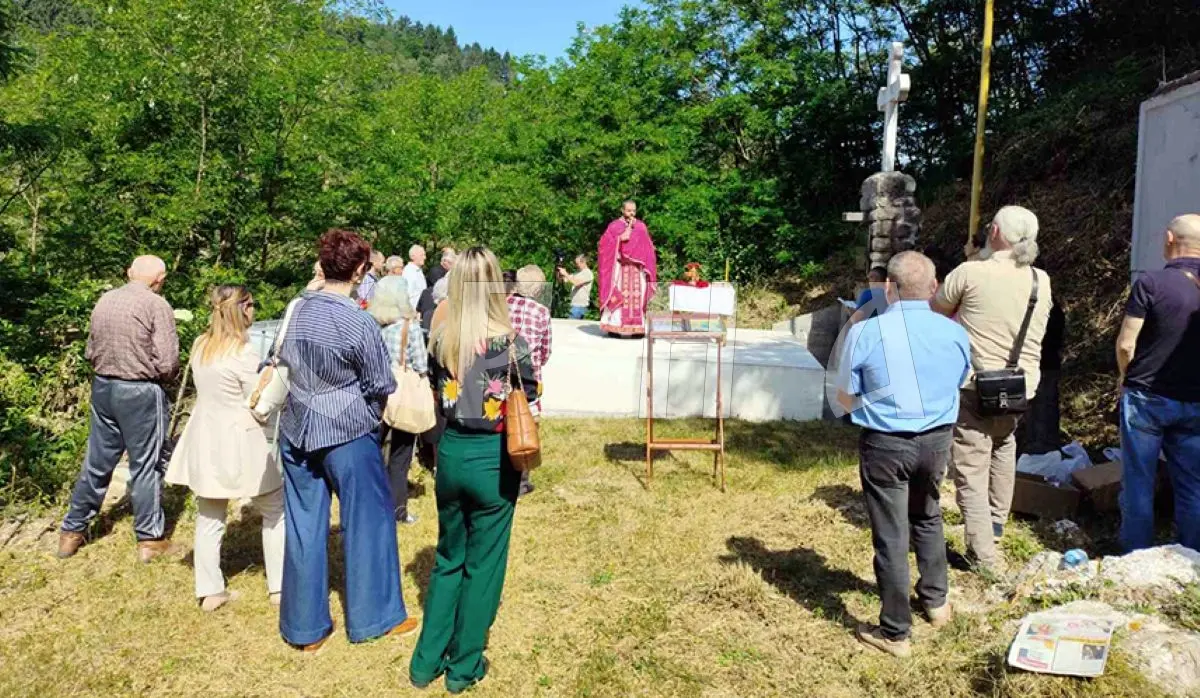
SREBRENICA, JUNE 1 /SRNA/ – A commemoration was held today in Srebrenica marking 83 years since the Ustasha forces brutally killed more than 250 Serb civilians on the second day of the Orthodox feast of the Holy Trinity in 1943 in Srebrenica, and on the third day of the Trinity celebrations in the nearby villages of Zalazje and Vitlovci.
On this occasion, Archpriest Aleksandar Mlađenović served a memorial service at the memorial cross erected in 2019, 76 years after the crime, above the ossuary where parts of the remains of the martyrs, brutally murdered solely because they were Orthodox Serbs, are buried.
Those present lit candles in memory of the victims, while a municipal delegation laid flowers at the cross and memorial plaque installed in 2015 above the recently restored ossuary.
According to the inscription on the tombstone, the memorial ossuary contains the remains of some of the victims who were brutally killed by members of the 29th Battalion under NDH /Independent State of Croatia/ Lieutenant Josip Kurelec during their advance toward the Drina River, committing genocide against the Serbian population of Srebrenica and its surroundings, during which 2,262 Serbian civilians were killed, including 430 children.
The exact number of victims buried in the ossuary has never been established. However, the commission that conducted the post-war investigation identified the remains of 229 individuals, while many others could not be identified.
Among those killed were 80 children.
President of the Srebrenica Municipal Organization of Families of Captured and Fallen Soldiers and Missing Civilians Branimir Kojić stated that no one has ever been held accountable for this crime against Serbs, which, he said, encouraged the descendants of the perpetrators to repeat similar crimes on an even larger scale during the war in BiH in the 1990s.
"This ossuary is one of the proofs that the Serb people were among the most heavily victimized nations of the 20th century. We must preserve the culture of remembrance, honor the victims, and pay them due respect so that such crimes are never repeated, as happened again in 1992. We hope our people will not suffer similar tragedies in the 21st century," Kojić said.
He stressed the importance of keeping the memory of the victims alive and passing it on to younger generations.
The memorial ossuary, built during the communist era, does not contain the names of the victims whose remains lie there. Instead, it features a relief depicting Germans executing Partisans, which, according to local accounts, does not correspond to what happened, since Ustasha forces killed innocent Serb civilians, including many children, while no German forces were present in the area at that time.
A resident of Srebrenica Boban Blagojević said that for three generations of his family he does not know where they are buried or whether they ever had graves at all.
"My great-grandfather Blagoje was captured by Austrians in 1918, and it was never discovered where he was killed or buried. The same happened to my grandfather Slobodan, whose name I bear, who was taken away by the communists in 1948. My father Dušan disappeared in Zalazje in 1992, and his remains have still not been found," Blagojević said.
He paid tribute to his father's uncles Rajko and Todor, whose remains are believed to be in this ossuary, as well as to all the other victims and his ancestors whose burial places remain unknown.
The fate of 12 members of the Blagojević family who died in the wars of the last century remains unknown, including where they perished and where their remains are located.
The family is only one example among thousands of Serb families that suffered similar or even greater losses for which, according to participants in the commemoration, no one has been held accountable.
It was only about a decade ago that the anniversary of this major Serbian tragedy, which occurred on the second day of the Trinity celebrations in 1943, began to be officially commemorated in Srebrenica.
In this way, Christian tribute is paid to the innocent Serbian victims through memorial services and the lighting of candles for the repose of their souls, something that had not been done for nearly seven decades, nor had these victims been publicly remembered or discussed.
The communist authorities prohibited and sanctioned any mention of the crime, particularly the names of the victims.
Memorial plaques bearing the names of those killed were once located in the Srebrenica church, but they were later destroyed by the Muslims.
According to accounts presented at the commemoration, the fact that no one was prosecuted for these mass crimes against Serb civilians encouraged the descendants of the perpetrators to continue similar acts during the last war in BiH, committing numerous massacres against Serbs in villages around Srebrenica and Bratunac.
No one has been held accountable for those crimes either, and the perpetrators live freely because both the International Criminal Tribunal for the former Yugoslavia and the judiciary of BiH failed to prosecute those responsible, de facto legalizing the crimes against the Serbs, which is a precedent in modern jurisprudence.
Historian Draga Mastilović, currently Minister for Scientific and Technological Development and Higher Education of Republika Srpska, stated in 2021 while presenting the collection of documents "The Crime of Genocide Against the Serbs of Srebrenica in World War II" that the authors concluded genocide had been committed against Serbs in the Srebrenica district.
"There was a clear intention to completely exterminate the Serb population from this area, which is confirmed by the fact that 430 children were killed, showing that the goal was the biological disappearance of the Serbs," Mastilović said at the time.
Records of the Trinity Day massacre in Srebrenica include reports from the forensic commission of the then Ustasha authorities, led by Judge Vejsil Hadžibegić, which carried out exhumations, identified bodies, and documented members of the 29th Battalion who committed the crime. However, the perpetrators were never prosecuted.
Only Lieutenant Kurelec was reportedly sentenced in Zagreb to a symbolic punishment for the crime, but even that sentence was later mysteriously revoked.
Mastilović noted that the conclusion of the court in Sarajevo, which had initiated proceedings regarding the crime against the Serbs of Srebrenica during the Trinity celebrations of 1943, was that the "case should be left to oblivion," adding that, in his view, a similar approach continues today when dealing with Serb victims of the wars of the 1990s in the territory of the former Yugoslavia.