DODIK: GARAVICE - ONE OF THE LONGEST-CONCEALED AND LAST ACKNOWLEDGED EXECUTION SITES OF SERBS
FBiH - Garavice - Culture of Remembrance
07/26/2026
19:07
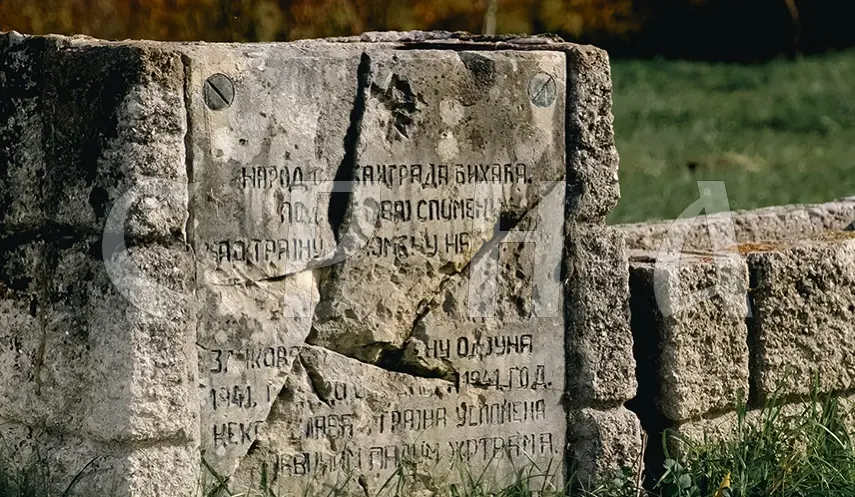
BANJA LUKA, JULY 26 /SRNA/ – Garavice, outside Bihać, is one of the largest, but also one of the longest-concealed and least acknowledged execution sites of Serbs during the Second World War, President Milorad Dodik stressed.
Ahead of tomorrow's commemoration marking the 85th anniversary of the killing of 12,000 Serbs, including a large number of children, in Garavice near Bihać, Dodik told SRNA that the atrocity committed against the Serb population by the Ustasha forces of the Independent State of Croatia /NDH/ was part of systematic monstrous plan to completely exterminate or expel Serbs from the region.
"The scale of the crime is best illustrated by historical records showing that entire Serb - populated villages in and around Bihać were destroyed, while whole families were erased from birth registers in an effort to eliminate every trace of the Serbs’ presence.
The brutality and magnitude of this horrific crime against the Serbs in Garavice are further evidenced by the fact that, within just a few weeks, the entire area was left without its Serb population," Dodik stressed, adding that even German soldiers were appalled by the Ustasha’s brutality and willingness to carry out savage torture and killings of innocent Serb civilians, particularly children.
He added that the executioners forced their victims to dig their own graves before being executed, tortured and slaughtered children in front of their mothers, murdered parents in front of their children, demonstrating that nothing was sacred to the killers, who even took pleasure in the mass torture and killing of Serb children, women, and the elderly.
"After the Second World War, decades and decades passed in silence and concealment of this crime. The scale of this terrible tragedy inflicted on the Serb people was hidden in the name of the so-called 'Brotherhood and Unity', the Yugoslav ideology that concealed and minimized Serb victims," Dodik said.
Once again, he says, the Serbs were naïve and remained silent, accepting the version of history written by the communists, which never clearly stated who the victims were and who the executioners were. Instead, everything was simply categorized as "victims of fascist terror", "those killed in the National Liberation Struggle" or "those who died for freedom"…
Those who suffered were Serbs, Dodik says, whose identity was concealed. It was precisely because of that identity that they were killed, tortured, slaughtered, and burned alive.
"The real truth was suppressed, history was falsified, and Serb victims were neglected. And this was not the case only in Garavice, but in every place where the victims were Serbs - in Jasenovac, Stari Brod, Jadovno, Prebilovci… All of these places, which we have today restored to public memory and rescued from oblivion, are Serb graves of the innocent, sites bearing the gravest and most harrowing testimony to the suffering of our people solely because of their identity. They were guilty of nothing except being Christians, Orthodox Serbs," Dodik stressed.
He emphasized that no Serb has the right to forget their ancestors who suffered, because forgetting means killing them a second time and accepting that crime triumphs over life.
"We must preserve remembrance, we must visit the places of suffering and keep their memory alive. Christians do forgive, but do not forget. The Serb people has suffered greatly throughout the centuries and has lost so much, therefore we must and can keep their sacrifice from oblivion. We must not kill them a second time, because they are our eternal warning to safeguard Republika Srpska, which is the guarantor of our future.
"Whenever the Serbs did not have their own state, they were easy targets and prey for criminals. We must not be naive, because that naivete has cost us dearly, both in the distant past and in more recent times. Therefore, today we must understand that only by being strong and united can we resist every evil. We must safeguard our homeland, Republika Srpska, and its institutions, and nurture the culture of remembrance so that we may build a bright future for ourselves and for the generations yet to come, proving ourselves worthy of the sacrifice that was made for freedom," Dodik said.