PROTECTION OF PATRIARCH PORFIRIJE URGED AMID WARNINGS OF REPEATING TRAGIC PATTERN
Serbia - Serbian League - Đurđev
03/29/2026
15:58

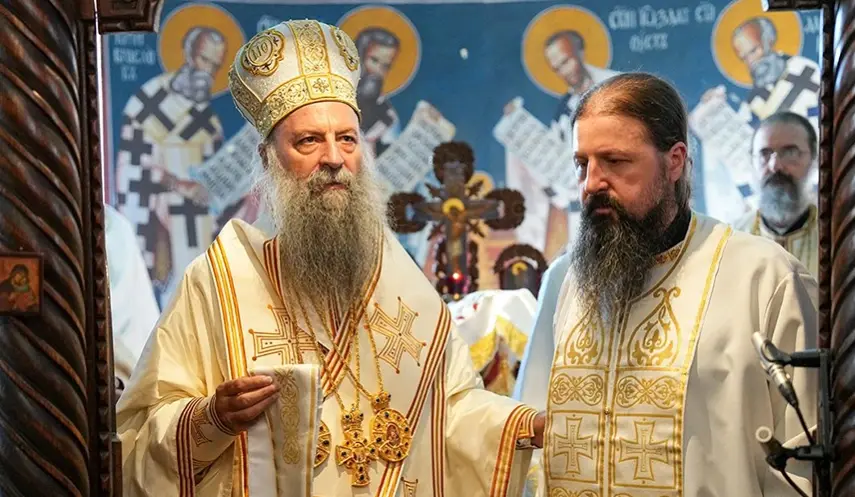
BELGRADE, MARCH 29 /SRNA/ – The Serbian League has called on the Government of Serbia to urgently conduct a serious assessment of security risks facing His Holiness Serbian Patriarch Porfirije, on introduction of enhanced physical and operational protection, safeguarding his closest associates, clergy, deacons and active lay members and involvement of all security structures in preventive action, said Serbian League president Aleksandar Đurđev.
SRNA carries Đurđev’s written statement in full:
At this moment, the issue in Serbia is not the interpretation of a controversial text or media freedom, but the security of Serbian Patriarch Porfirije.
A text published as a headline story on portals financially supported by Western governments is problematic not because of the views it expresses, but because of the context it creates.
Placing His Holiness Patriarch Porfirije, as well as his closest associates, clergy, deacons and lay members, within a narrative involving criminal structures, foreign influence and security risks represents dangerous positioning.
Not because it proves anything, but because it prepares something. That is precisely where the core of the problem lies. In the history of the Serbian people, attacks on the Church have never begun with force, they have begun with a narrative.
When Serbian Patriarch Lukijan Bogdanović disappeared in 1913 and was later found beheaded in a river in Austria, the official version never convinced the Serbian public.
What remained was the belief that the removal of the head of the Serbian Church was part of a broader plan to destabilize the Serbian people ahead of the First World War. The history that followed gave weight to that belief.
When Serbian Patriarch Vikentije II died suddenly and under suspicious circumstances in 1958, amid pressure from the Titoist dictatorship, there was neither an investigation that would reassure the public nor an explanation that would remove doubts.
What remained was the fact that the Church at the time was under strong pressure from the regime, and that its head died at a moment when that control could not be fully established.
These two events share one thing in common - the head of the Serbian Church becomes a target when broader pressure on the Serbian people is being prepared. This is not history. This is a warning.
Additional weight to the situation is given by the fact that all this is happening at a time when there is already talk in the region of coordinated operations.
Zoltan Kovacs, one of the closest associates of Hungarian Prime Minister Viktor Orban, issued a public statement following a session of Hungary's National Security Council, referring to an "unprecedented intelligence operation" lasting for months, involving foreign services, media actors and networks across several countries, with effects already visible in the public sphere.
Kovacs is Hungary's Secretary of State for Public Diplomacy and Relations and official government spokesperson. His statements, often issued after institutional meetings, reflect the positions of the state leadership rather than personal views, giving them significant political weight.
When such a statement is placed in the context of developments in Serbia, the question is no longer whether there is a connection, but whether there is awareness. The mechanism is the same, first a narrative, then pressure, and finally tragic consequences.
For this reason, we address the Government of the Republic of Serbia and all competent authorities. This is not a situation for waiting. This is a situation for action.
We demand an urgent and serious assessment of the security risks to Patriarch Porfirije, increased physical and operational protection, protection for his closest associates, clergy, deacons and active lay members, and the engagement of all security structures in preventive action. In such situations, failure is not neutral - failure is a decision.
The Serbian people have already twice witnessed the creation of an environment in which the head of the Serbian Orthodox Church becomes a target. The first ended in tragedy. The second in suspicion that was never dispelled. Today, we are in the third moment.
The only difference is whether this time we will recognize the pattern or ignore it again. Therefore, this is not an appeal. It is a warning. And a question that remains: will the state react in time, or once again only after the consequences?