ĐURIĆ: JUSTICE MUST BE EQUAL FOR ALL VICTIMS
UN - Security Council - Serbia
10/20/2026
22:14

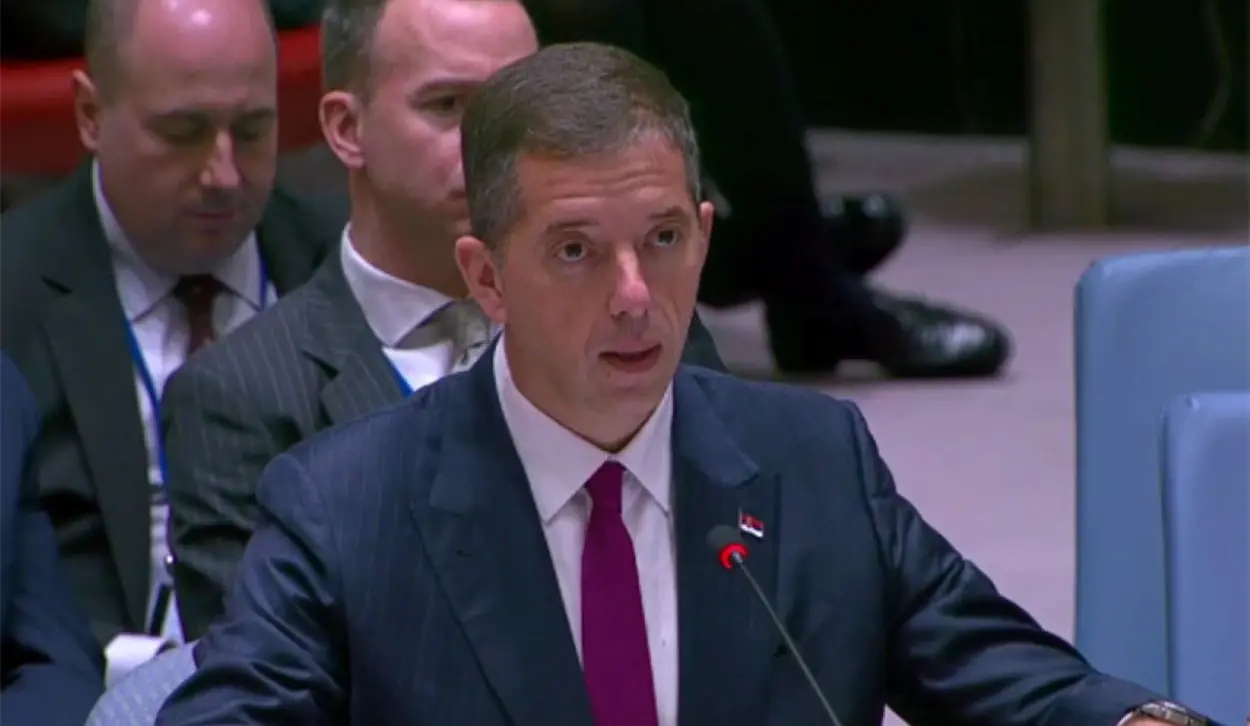
NEW YORK, OCTOBER 20 /SRNA/ – Serbian Foreign Minister Marko Đurić said Serbia was seeking justice for every victim, emphasizing that those who suffered crimes at the hands of the Kosovo Liberation Army /KLA/ were still waiting for justice.
Addressing a UN Security Council meeting in New York, he reminded that former KLA leaders were found guilty of war crimes in The Hague on September 16, noting that those same individuals had for years been key figures in the provisional institutions in Priština.
Although they were found guilty of murder, torture and other crimes against Serbs and Albanians, Đurić stressed that justice should have gone further, as they had not been convicted of crimes against humanity or numerous other crimes they had committed.
"Victims are still waiting for justice. The pain of victims' families cannot be reduced to a single narrative," Đurić said.
He reminded that numerous churches, monasteries and sites representing important Serbian heritage in Kosovo and Metohija had been destroyed, adding that the suffering of Serbs in Kosovo and Metohija could not be erased from history simply because it did not fit a "convenient narrative."
"For many Serbian families, September 16 was not just another day in legal proceedings. It was a moment when their suffering could no longer be ignored," Đurić said.
He noted that, following the verdict, officials in Priština had attacked the Kosovo Specialist Chambers in The Hague and celebrated those convicted of crimes.
Đurić said there was a vast difference between defending the right to a fair trial and promoting a narrative in which Albanians claimed the court had no right to convict their "heroes."
"If we follow that logic, we must accept that justice applies only to the powerless," he said.
He reminded that, following the verdict, lawmakers in Priština had called for the suspension of the Kosovo Specialist Chambers in The Hague, while the EU described the accusations against the court as "contrary to the international obligations of the provisional institutions in Priština" and called for respect for judicial independence and witness protection.
"This shows that, after the court delivers its findings, political leaders condemn them and then try to change the rules. How can a witness who risked their own life and the lives of their family members trust such a judicial system?" Đurić asked.
He noted that Aljbin Kurti had called the verdicts an unacceptable injustice, while Albanian President Bajram Begaj had said that nothing could tarnish the KLA and reiterated the slogan "Freedom Has a Name."
"The victims had names. They were not footnotes in someone else's national narrative. They were not an inconvenience whose responsibility should be avoided. They were human beings - Serbs, Albanians and others, whose rights and lives mattered," Đurić said.
Đurić stressed that the verdict established individual responsibility.
"It does not declare the Albanian people collectively guilty," he said.
According to Đurić, responsibility lies with those who established the Specialist Chambers, as they must ensure that the provisional authorities in Priština do not interfere in the judicial process.
"Victims must not be sacrificed for political interests. We seek justice for every victim - justice that is equal for all," Đurić stressed.
Đurić said a report by UNMIK chief Peter Due documented the demolition of houses and other property owned by Serbs near Lake Gazivode, as well as serious allegations of police abuse.
"For those Serbian families, the message is devastating: their homes, their property and their future can be taken away from them at any moment. Following the Vidovdan commemoration at Gazimestan, 37 people were arrested, including one minor," Đurić said.
He said northern Kosovo and Metohija had become a police protectorate for Serbs, where intimidation and violence against civilians had become part of everyday life.
"During the reporting period, 47 members of non-majority communities returned voluntarily. Not one of them was a Serb," Đurić added.