BELT AND ROAD INITIATIVE CONTRIBUTES TO BETTER LIFE FOR PEOPLE
China - initiatives
08/18/2026
10:06
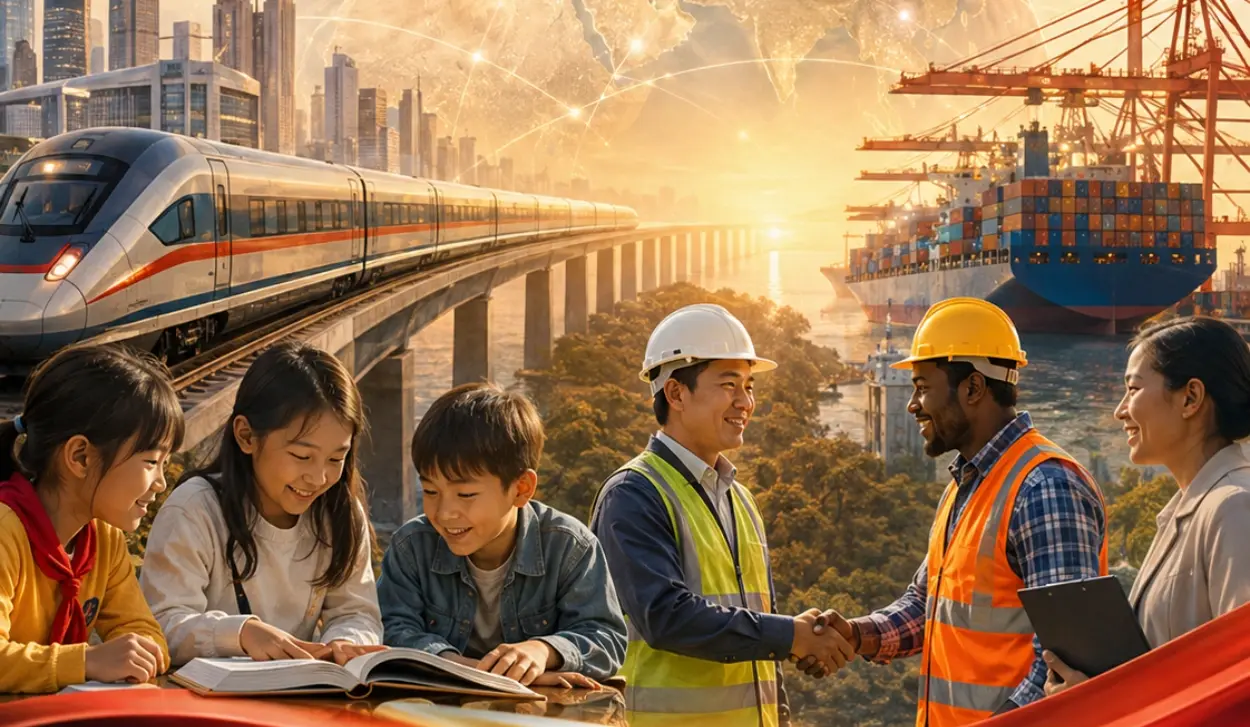
BEIJING, AUGUST 18 /SRNA/ - Vuk Jeremić, president of the Center for International Relations and Sustainable Development /CIRSD/, says that the most important value of China's Belt and Road Initiative lies in its cooperative logic, as infrastructure is merely a means, while human well-being is the ultimate goal.
He believes that the Belt and Road Initiative is one of the most ambitious efforts of modern times to promote development through connectivity - bringing together people, economies, infrastructure, and cultures - and that the ultimate measure of the project’s success will continue to be the number of people whose lives it has improved.
In an article published by the China Media Group, Jeremić writes that ten years is a sufficiently long period to assess a major idea not only by analyzing the intentions behind its launch but also by examining its impact on the world.
"For me, however, this issue is not merely a subject of geostrategic analysis. I also have a personal connection to it, as I had the privilege of witnessing and participating in its first international steps," said Jeremić, who also served as President of the 67th session of the UN General Assembly.
Even before the name Belt and Road entered the global diplomatic lexicon, Jeremić recalls, there was talk of the One Belt, One Road initiative and the revival of the ancient Silk Roads.
"From the very beginning, I recognized in this vision something the world desperately needed: connectivity instead of division, and the pursuit of common interests instead of insisting on differences," Jeremić said.
He says that after serving as President of the UN General Assembly, he founded CIRSD, which, together with the DRC, organized the joint conference Silk Roads: Inspirations and Opportunities in Istanbul in December 2014, effectively the first major international presentation of this new vision outside China.
Jeremić recalls that representatives of governments, international organizations, academia and leading think tanks gathered at the time to discuss what the new Silk Roads could mean for the countries connecting Asia and Europe.
"I remember that gathering as a moment when a historic idea began to take on an international dimension. The discussion was not only about railways, ports, roads and investment. It was about connecting people and how economic interdependence can become the foundation for more stable international relations," Jeremić said.
He points out that 12 years later, CIRSD returned to the subject, this time in Belgrade, where the Horizons Forum on sustainability and connectivity was held at the Sava Centre in June. The forum brought together prominent representatives of the business community, technology, finance, academia and international politics, with discussions focusing on the energy transition, sustainable infrastructure, artificial intelligence, finance and the future of connectivity between Europe and Asia.
"Almost everything has changed between Istanbul in 2014 and Belgrade in 2026 - the international environment, technology, geopolitical relations, and even the scale of China's presence in the world. But the fundamental question remains the same: can we create greater prosperity and more room for cooperation through connectivity? I believe we can," stressed Jeremić, a former foreign minister of Serbia.
He points out that the most important value of the Belt and Road Initiative lies precisely in its cooperative logic.
"Development does not have to be a zero-sum game. A road, railway, energy network or digital link makes sense only if it enables people to live, work, trade, travel and communicate better. Infrastructure is a means; human well-being must be the goal," Jeremić said.
In this regard, he believes that the Belt and Road Initiative should still be viewed in the context of the four major global initiatives China has put forward: the Global Development Initiative, the Global Security Initiative, the Global Civilization Initiative and the Global Governance Initiative.
"Development, security, intercivilizational understanding and fairer global governance are not separate issues. They are parts of the same whole," Jeremić said.
Jeremić says that the world is entering a period of increasingly pronounced divisions and that, therefore, what is needed is more dialogue and connectivity, not new walls, as well as greater mutual respect rather than imposition.
"If there is one thing I have learned from Istanbul in 2014 to Belgrade in 2026, it is that major international initiatives prove their lasting value not only through the scale of their ambitions, but through the number of people whose lives they have improved. That should remain the most important measure of the success of the Belt and Road Initiative in the decades to come," Jeremić said.