KARAN: TENTH ANNIVERSARY OF REFERENDUM - REMINDER OF OBLIGATION TO PRESERVE SRPSKA’S COMPETENCIES
Republika Srpska - President
09/25/2026
10:42
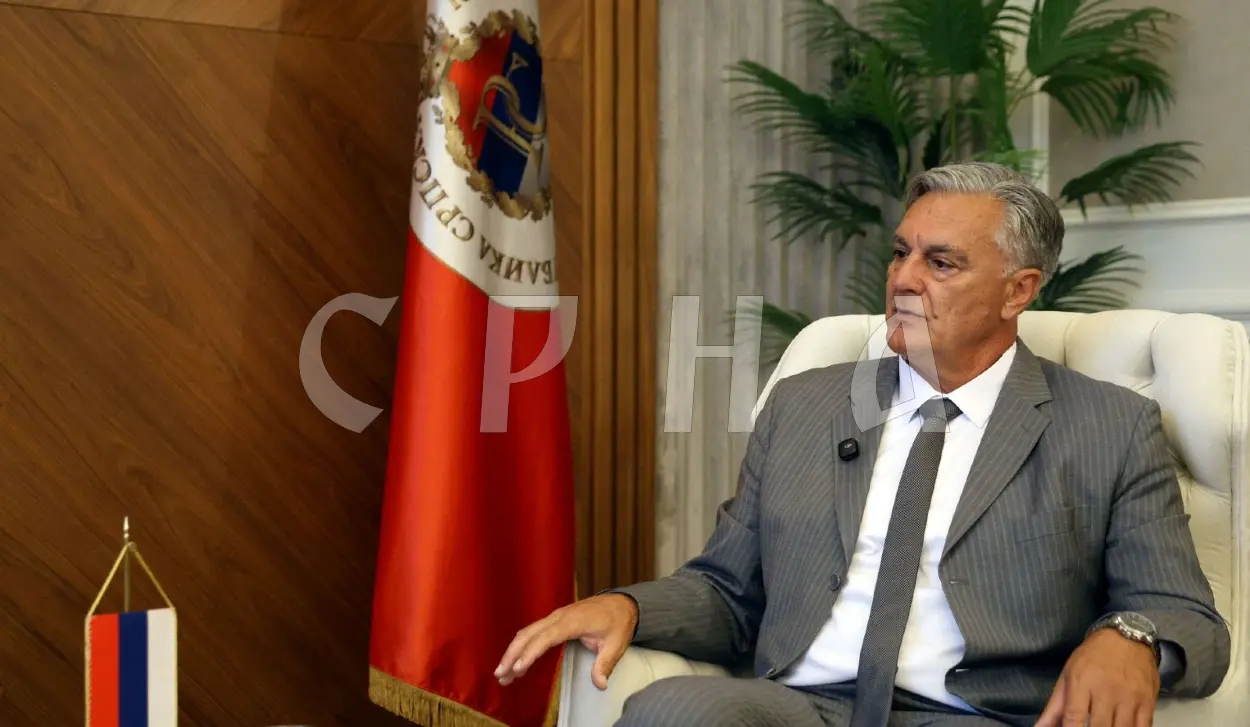
BANJA LUKA, SEPTEMBER 25 /SRNA/ – 10th anniversary of the referendum in which majority of voters confirmed January 9 as Republika Srpska Day, is not only a reminder of a successfully organised voting day, but also of the obligation for Republika Srpska to preserve its constitutional powers, strengthen its institutions, and have confidence in its people, Republika Srpska President Siniša Karan said.
"The Dayton-based constitutional position of Srpska will not be preserved through suitable statements. It is preserved through knowledge, perseverance, responsible decisions, and a willingness to discuss and reach agreements directly with the people on the most important issues," President Karan said in a column for the Republika Srpska Media System – SRNA, on the occasion of marking the 10th anniversary of the referendum, whose question was: "Do you support January 9 being marked and celebrated as Republika Srpska Day?," which received a positive response from 99.81 percent of citizens who voted.
SRNA is publishing President Karan's column in full:
PEOPLE'S WORD ON REPUBLIKA SRPSKA DAY
On September 25, 2016, the Republika Srpska citizens answered the question: “Do you support January 9 being marked and celebrated as Republika Srpska Day?” Ten years later, that referendum remains one of the most significant events in the recent political history of Srpska.
At that time, Republika Srpska, through its institutions and the direct expression of its citizens’ will, demonstrated that it was capable of asking the people to decide on an issue of the greatest public importance, while the people demonstrated maturity and determination to defend their identity.
I was honoured to serve as chair of the Republika Srpska Commission for Conducting the Referendum, therefore I do not speak about it merely from the perspective of time as a professor of constitutional law. I remember the responsibility assumed by people in the institutions, the work involved in preparing the vote, and the awareness that every step would be judged both in Republika Srpska and beyond.
The referendum was held. People went to the polling stations. A total of 677,771 voters answered "yes" to the question, according to the results established by the Republika Srpska National Assembly. These facts are important in themselves. But to understand why that day became a turning point, we must return to the constitutional position of Republika Srpska.
Under the Dayton-based constitutional order, the BiH Constitution is Annex 4 of the Dayton Peace Agreement. Article I/3 explicitly establishes that BiH consists of two entities: Republika Srpska and the Federation of BiH. This is not a subsequent political interpretation of the Dayton, but the text of the Constitution itself. Republika Srpska is one of the two constitutionally designated entities that make up the internal structure of BiH.
The equality of the entities within the Dayton-shaped structure means that the constitutional position of one entity cannot be treated as less important or temporary compared with that of the other, or compared with BiH in general.
The existence of Republika Srpska, its name, institutions, and constitutional powers are part of the order established by the Dayton Accords. Anyone who wants to understand BiH must start with its Constitution, rather than with a political desire for that Constitution to look different.
The distribution of powers also confirms the importance of the entities. Article III/3(a) of the Constitution of BiH provides that all functions and powers not expressly, which the Constitution did not explicitly assigned to the BiH institutions, belong to the entities.
The Dayton order must therefore be read as a whole: it establishes both the joint institutions and the constitutional space of Republika Srpska. Preserving that space means the request for implementing the Dayton as it was written.
The Preamble of the BiH Constitution identifies Bosniaks, Croats, and Serbs as constituent peoples, together with Others and citizens. This constitutional formula requires respect for the equality of peoples and the rights of every individual.
For the Serb people, Republika Srpska represents their most important institutional framework in BiH. At the same time, it is home to all of its citizens, and its institutions have a responsibility to protect its constitutional position and the equal rights of the people who live there.
WHY JANUARY 9 BECAME REFERENDUM ISSUE
January 9, 1992, is the date of the establishment of Republika Srpska. For the Serb people, it has decisive historical and political significance. The different views of that date among the peoples of BiH are a fact that a serious constitutional and legal debate cannot ignore.
But that difference cannot erase the fact that Republika Srpska was established and that, as one of the two entities, it is explicitly named in the Dayton Constitution. Srpska was established before the outbreak of the war. Srpska was formed so that genocide against the Serb people would not be repeated.
The 2016 referendum question was clearly defined. Citizens were asked whether they supported January 9 being marked and celebrated as Republika Srpska Day. When discussing the referendum today, we should discuss the question that was actually asked. Constitutional and political disputes are serious enough without attributing to the referendum content that it did not have.
The Constitution of Republika Srpska gives the National Assembly the authority to call a republican referendum. Article 77 provides that the Assembly may decide on certain matters within its jurisdiction following a prior expression of the citizens’ will. In this way, the referendum is established as a constitutional form of direct public participation in decision-making.
It is not a substitute for the National Assembly, but rather a means for the Assembly, before acting on a matter within its jurisdiction, to seek a direct response from the citizens.
That is where I see the lasting value of the 2016 referendum. Republika Srpska demonstrated that people’s will can be expressed through an organised, public, and institutional process.
Citizens were given the opportunity to express their position by voting, while the institutions assumed responsibility for preparing and conducting the process. That is a serious democratic capacity. It is not demonstrated by words about the people, but by a willingness to ask the people and allow the people to decide.
DISPUTE THAT MUST BE DISCUSSED OPENLY
The referendum anniversary also requires presenting the constitutional dispute that accompanied it. In 2015, the Constitutional Court of BiH determined that the provision of the Law on Holidays of Republika Srpska under which January 9 was designated as Republika Srpska Day was not compatible with the Constitution of BiH.
In September 2016, the Court issued an interim measure suspending the implementation of the decision to call the referendum. After the vote was held, it determined that the decision to hold the referendum was not compatible with the Constitution of BiH and annulled its results.
My disagreement with the approach taken by the Constitutional Court of BiH at that time does not require these decisions to be ignored. On the contrary, the dispute can only be understood if it is clearly presented - on one side, Republika Srpska proceeded from its constitutional authority to seek a vote by citizens on a matter within the jurisdiction of the National Assembly, while on the other, the Constitutional Court of BiH concluded that the specific referendum question involved deciding again on an issue on which it had already issued a final and binding decision.
However, what no subsequent decision can change is the fact that the vote took place and that citizens gave a clear answer to the question that was put before them. The referendum was held, and the people’s will stands above every institution, including the Constitutional Court of BiH.
FOUNDATION FOR FUTURE VOTES
The 2016 referendum did not itself create a new constitutional power for Republika Srpska. The right to hold a referendum already existed in its Constitution before that day. What 2016 created was institutional experience - it demonstrated that Republika Srpska could prepare and conduct a republican vote even when subjected to exceptional political attention and pressure.
In debates over issues falling within the jurisdiction of Republika Srpska's institutions, where it is necessary to hear the direct views of citizens, institutions have their constitutional duties, while citizens have the right to have their voices heard. A referendum is one way for that voice to be direct, measurable, and publicly expressed.
The will of the people then takes on a democratic form, while the institutions remain responsible for acting upon it within the scope of their competencies.
The tenth anniversary of the referendum is therefore not merely a reminder of one successfully organised day of voting. It is a reminder of the obligation for Republika Srpska to preserve its constitutional powers, strengthen its institutions, and have confidence in its people.
Srpska's Dayton-based constitutional position will not be preserved through suitable statements. It is preserved through knowledge, perseverance, responsible decisions, and a willingness to discuss and reach agreements directly with the people on the most important issues.
Ten years ago, Republika Srpska demonstrated that it was capable of organising and carrying out a referendum. Its citizens demonstrated that they were ready to use their vote to defend what they considered inseparable from its name and existence. That is the legacy of September 25, 2016. Republika Srpska has the constitutional voice of its institutions; when there is a basis and a need, it also has the direct voice of its people.

GOGANOVIĆ: OIL THEFT FROM BARRACKS STORAGE FACILITY AGAIN HIGHLIGHTS PROBLEMS IN DEFENCE SYSTEM
WARNING TO SERBS ABOUT DOUBLE PUNISHMENT OVER SOCIAL MEDIA POSTS
KARAN: TENTH ANNIVERSARY OF REFERENDUM - REMINDER OF OBLIGATION TO PRESERVE SRPSKA’S COMPETENCIES
DODIK: WE DO NOT WANT TO LIVE UNDER MUSLIM RULE, TRUMP IS WINDOW TO FREEDOM