FACT-BASED RESPONSE TO HISTORICAL REVISIONISM
Republika Srpska - Donja Gradina Memorial Area - scientific conference
04/22/2026
12:29
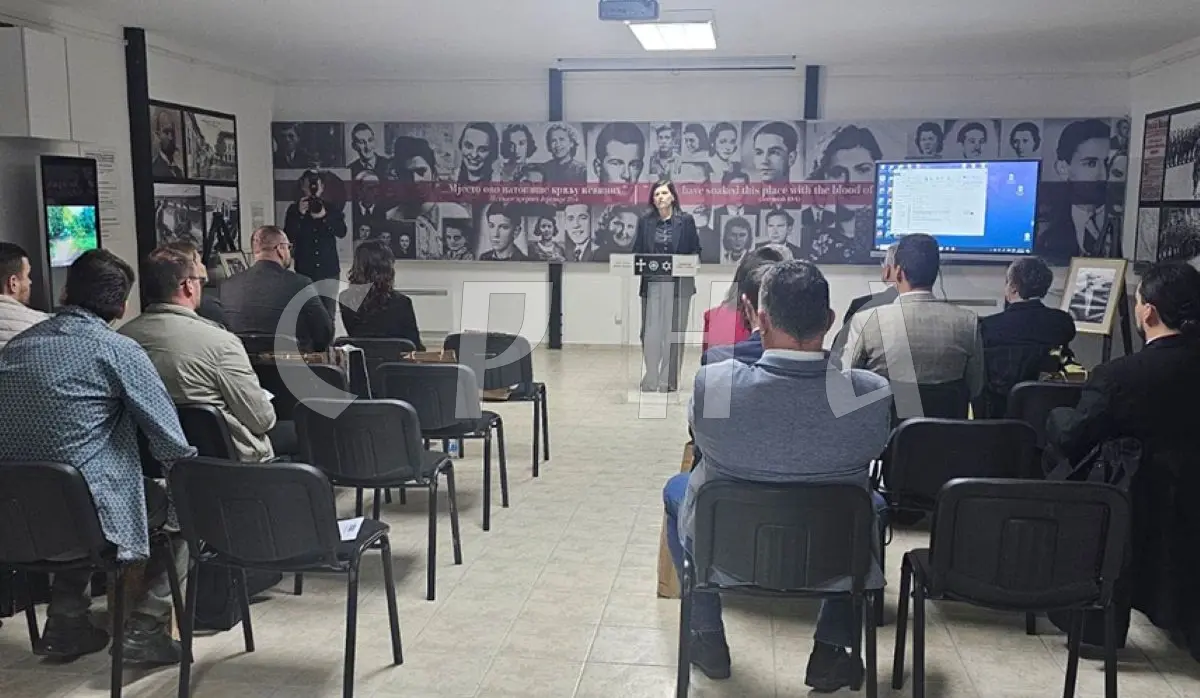
KOZARSKA DUBICA, APRIL 22 /SRNA/ – Historical revisionism regarding events in the Independent State of Croatia /NDH/ is becoming increasingly frequent and can only be countered through a professional, fact-based approach to ensure that Ustasha crimes are neither forgotten nor repeated, it was emphasized at a roundtable in the Donja Gradina Memorial Area on the systematic destruction of Serbs, Jews, and Roma in the NDH.
"Our intention is to present all arguments factually and scientifically so that the genocidal Ustasha crimes committed in the NDH are never forgotten or repeated", said Donja Gradina Memorial Area Director Tanja Tuleković.
She noted that on April 22, 1945, the final group of inmates carried out the breakout from Jasenovac with a single goal - that at least one of them would survive to tell the world about the horrors experienced by Serbs, Jews, and Roma.
"Our task today, 81 years later, is not to speak only about the last day of the camp's existence, but about every moment of it, and to present as many facts as possible", Tuleković added.
She added that the conference covers numerous topics addressing each phase of the Jasenovac camp's existence.
The Acting Director of the Republika Srpska Center for Research of War, War Crimes and Missing Persons Viktor Nuždić warned of the growing presence of historical revisionism concerning the NDH, aimed at diminishing and trivializing the suffering.
"We are witnessing revisionism moving in several directions - through the glorification of individuals who were undoubtedly war criminals during World War II, as well as through minimizing the number of victims and altering the character of wartime events. This must not be allowed", Nuždić stressed.
He added that the gathering is expected to produce new findings to preserve the truth for future generations, especially in a time of misinformation and partial information in media and on social networks.
Republika Srpska Assistant Minister for Culture Tanja Đaković said that events bringing together experts from various fields and encouraging dialogue are crucial in countering interpretations that lead to relativization and minimization of suffering in the Jasenovac camp.
She emphasized that only a serious scientific approach can stop historical revisionism and preserve the dignity of victims, adding that the Ministry of Education and Culture recognizes the importance of systematic and continuous research and its role in fostering a culture of remembrance.
"Our task, a moral and social obligation, is to nurture a culture of remembrance and to pass on to younger generations the truth based on facts, while also teaching empathy, understanding, and respect for every human life, so that such suffering never happens again", Đaković told reporters.
Museum scientific advisor from Novi Sad Drago Njegovan said he would speak about the suffering of his family on St. Elijah's Day in 1941 near Sanski Most, when seven members of the Njegovan family, aged 17 to 82, were killed on their doorstep.
"I structured my presentation to demonstrate that genocide was committed against my family, and then against thousands of others. The men were killed, while women and children were forced to convert to Catholicism", Njegovan said.
He added that genocide also includes the economic destruction of a people, as properties and villages were completely burned and destroyed.
Historian Milan Koljanin from the "Staro Sajmište" Memorial Center said he would present a report on the release of two groups of inmates from Jasenovac.
He explained that he had researched a topic related to political pressure exerted by Nazi Germany in 1941 and 1942 on the NDH to moderate or redirect its genocidal policies in line with German interests.
The Donja Gradina Memorial Area is hosting a roundtable today on the systematic destruction of Serbs, Jews, and Roma in the NDH. Topics include "New Contributions to Research on Ustasha Genocidal Crimes in the Independent State of Croatia - Local Execution Sites", "The Holocaust and Porajmos" and "Testimonies of Surviving Camp Inmates".
The event is organized by the Donja Gradina Memorial Area to mark 81 years since the Jasenovac inmates' breakout, as a continuation of last year's international scientific conference.
Following the event, a collection of papers featuring presentations and scholarly works by participants is planned to be published.