DEMOCRACY, SOVEREIGNTY AND RULE OF LAW MUST BE RESTORED IN BiH
Republika Srpska - UN Security Council - report /3/
10/29/2026
18:04

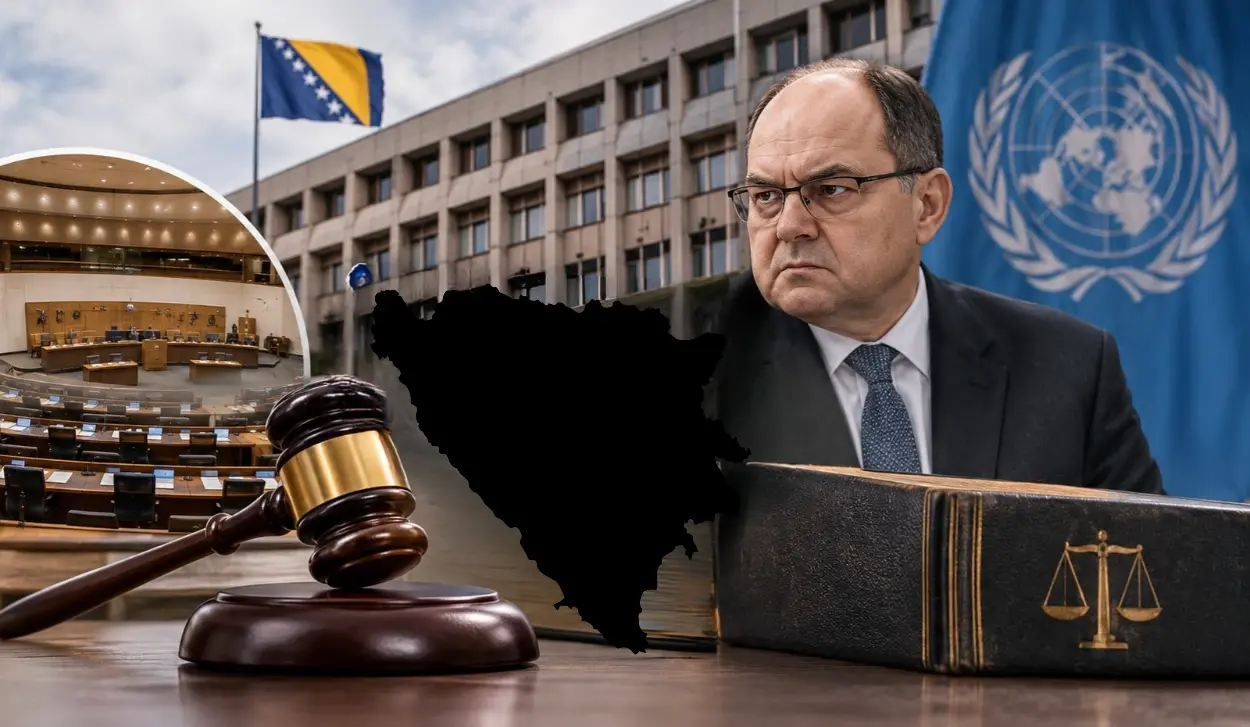
BANJA LUKA, OCTOBER 29 /SRNA/ – Democracy, sovereignty and the rule of law must be restored in BiH, stresses a report submitted by the Republika Srpska Government to the UN Security Council.
The report states that, for a number of years, High Representatives, including Christian Schmidt, who assumed the position without proper authority, have imposed laws in BiH through their own decisions, despite having no legal authority to do so, notwithstanding the provision of the BiH Constitution stipulating that all laws must be adopted by the legislative authority.
It points to Schmidt's unilateral decision declaring failure to comply with the High Representative's decisions a criminal offence as a particularly egregious example, completely bypassing BiH's democratic constitutional institutions.
"This unlawful decision was subsequently implemented through the judicial institutions at the BiH state level, which are under Bosniak control, in order to prosecute the democratically elected Republika Srpska President Milorad Dodik for fulfilling an explicit constitutional obligation to promulgate laws adopted at entity level," the report states.
It recalls that, following the sentencing, the Central Election Commission of BiH implemented amendments imposed by Schmidt, revoked President Dodik’s mandate and compelled calling the snap elections.
"Through a coordinated sequence of unlawful decisions by a foreign individual, instrumentalised judicial activism and actions by administrative bodies at the BiH level, the domestic constitutional order has effectively been suspended, while BiH's democratic institutions have been reduced to mere observers of the implementation of externally imposed decisions," the Republika Srpska Government states.
The report stresses that an unelected foreign official has been allowed simultaneously to define criminal offences, impose bans on holding political office and overturn the electoral will of citizens, thereby violating the fundamental democratic principles of popular sovereignty and the division of powers.
It emphasises that an increasing number of informed observers recognise that the era of a High Representative who believes he has the right to govern through decisions must come to an end.
"Since Schmidt's `resignation` in May, key policymakers and many other observers around the world have finally begun to acknowledge more openly that the dictatorial rule of the High Representative must end without delay," the report states.
The Republika Srpska Government says the most significant development is that the United States has clearly indicated that it now supports the sovereignty of BiH, which means insisting that decisions be made by the democratically elected institutions of BiH rather than imposed by the High Representative.
It recalls that, at the UN Security Council session on BiH held on May 12, U.S. Deputy Ambassador to the UN Tammy Bruce stated that the OHR "was never intended to be a permanent institution," making it clear that "a sovereign BiH is one in which decisions are made by local leaders who find pragmatic solutions for their country, with the support of international representatives, rather than at their dictation".
Serb BiH Presidency member Željka Cvijanović warmly welcomed the new US approach, stating that she fully supported the American administration's efforts to reaffirm BiH's sovereignty.
"We are grateful to US officials for their efforts to promote local solutions, internal dialogue among the constituent peoples, and the full accountability of democratically elected institutions at all levels of government in BiH," Cvijanović said at the time.
The report also recalls that, in May, two former High Representatives, Carl Bildt and Wolfgang Petritsch, responded to Schmidt's announcement of his "resignation" by reiterating their calls for the closure of the OHR.
The report reads that Bildt posted on X that, after 30 years, the OHR had lost its purpose and that a new initiative was needed.
In May, Adnan Ćerimagić, a senior analyst for the Western Balkans at the European Stability Initiative, stated that the OHR was incompatible with the rule of law because it failed to meet even basic democratic criteria.
Sabine Beppler-Spahl, president of the FreieBlick Institute, the German liberal centre, wrote in May that the withdrawal of U.S. support for Schmidt was a step that should be welcomed.
"Let his removal mark the beginning of an era in which democracy and freedom are given a chance," she wrote at the time.
The Sarajevo Times reported in June that the largest Croat political parties in BiH were unanimous in their view that the OHR’s mandate should come to an end.
HDZ BiH Leader Dragan Čović reiterated his position in July that the OHR must be closed for BiH to make progress. Regional experts share this view, the report states.
Marko Prelec of the International Crisis Group told Deutsche Welle in August that the US position on the High Representative was correct.
"Thirty years after the end of hostilities, it is very difficult to explain why an internationally appointed official with the kind of powers that High Representatives have exercised in BiH should still exist," Prelec said at the time.
In an article published in August in the Harvard Journal of Law and Public Policy, Joseph E. Schmitz and Brian T. Kennedy wrote that the appointment of an American as acting High Representative on July 1, 2026, meant that the time had come for the Office of the High Representative's tyrannical Bonn powers, under which hundreds of "purported legislative acts" had been adopted, to be declared null and void ab initio, i.e. invalid from the outset, as though they had never existed.
Those international stakeholders who genuinely support BiH's sovereignty and advocate its stability and prosperity, particularly those who claim to respect democracy and the rule of law, should call for an end to the unlawful exercise of the High Representative's "executive" powers, as many other countries have already done, which would allow BiH's democratically elected institutions to assume full responsibility for governing the country.
The activities of a bureaucratic apparatus administered by foreign officials and subject to no genuine oversight undermine BiH's sovereignty and contradict European standards and fundamental democratic principles.
The European Commission’s 2019 Opinion on BiH's application for EU membership, which states, in reference to the OHR, that such extensive international supervision is incompatible with BiH's sovereignty and, consequently, with EU membership.
Former High Representative Wolfgang Petritsch has emphasised that BiH will have no European future until all external interventions come to an end.
The report stresses that the balance established by the Dayton Constitution is increasingly threatened by the centralising political agendas of Bosniak parties, which have relied on the OHR for decades to circumvent mandatory constitutional mechanisms and interfere, directly and indirectly, in democratic and judicial processes in BiH.
"Bosniak political parties are even obstructing the reform that would replace the three foreign judges on the Constitutional Court of BiH with citizens of BiH. The EU included this reform among the 14 `key priorities` for BiH," the report states.
It notes that the largest Serb and Croat parties in BiH strongly support replacing the foreign judges on the Constitutional Court with local judges, while Bosniak parties refuse even to consider adopting such legislation, thereby preventing BiH from achieving full sovereignty and making progress towards European integration.
The report states that legislation implementing judicial reform must be adopted urgently, as the current composition of the Constitutional Court of BiH, with only seven judges, directly contradicts the provision of the BiH Constitution stipulating that the Court must have nine members.
"Such reforms are necessary to ensure the independence and legitimacy of the Constitutional Court of BiH, which is itself currently acting contrary to constitutional provisions," the report states.