ANTI-DAYTON ACTIVITIES OF COMMISSION TO PRESERVE NATIONAL MONUMENTS HALTED
Republika Srpska - National Assembly - Cvijanović
07/07/2026
12:06
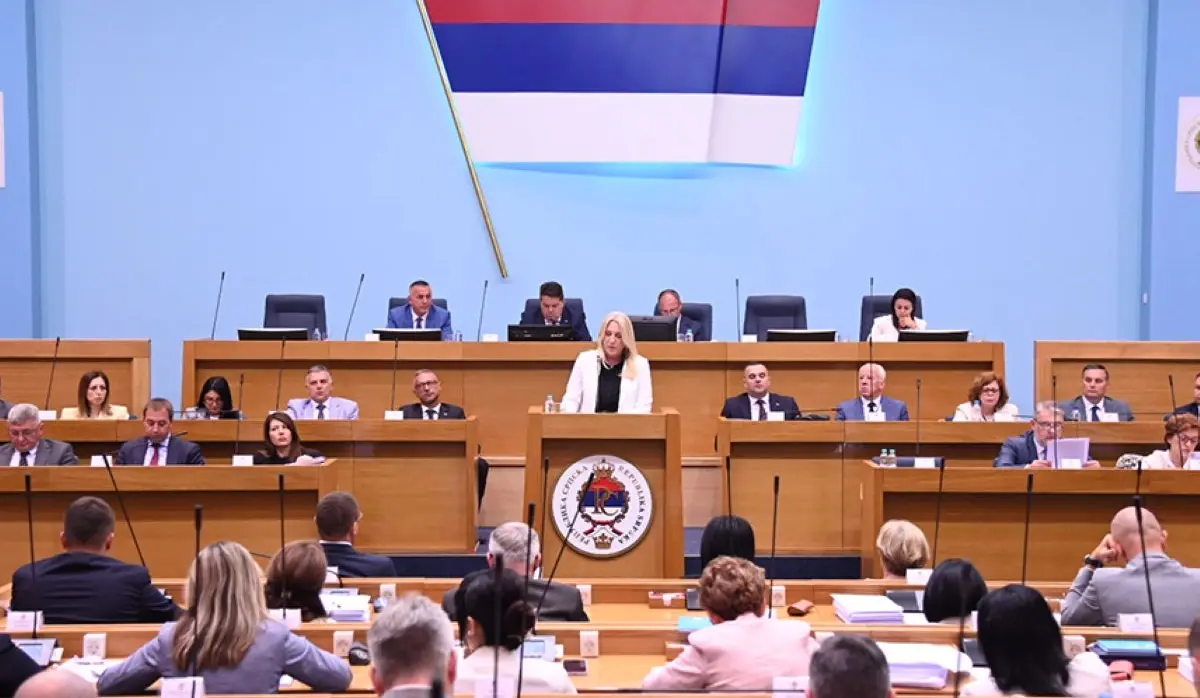
BANJA LUKA, JULY 7 /SRNA/ - The Serb member of the Presidency of BiH Željka Cvijanović said today in Banja Luka that, over the past four and a half years, the member of the Commission to Preserve National Monuments from Republika Srpska had halted all anti-Dayton activities of the Commission that involved expanding the institution's powers.
"This also involved the transfer of powers of the Ministry of Culture of Republika Srpska to the Commission in the field of cultural and historical heritage, as well as the control of property through the Commission. The member of the Commission from Republika Srpska established the prescribed regulation of the Commission's procedures and activities, in accordance with Annex 8 of the Dayton Agreement. It was precisely because of this that members from the Federation of BiH /FBiH/ created a crisis by refusing to participate in Commission sessions and brought the entire institution to a standstill," Cvijanović said at a special session of the National Assembly of Republika Srpska.
She stressed that problems with the Commission's functioning and constant complaints about its work had been repeatedly brought to the attention of Presidency members throughout their terms in office.
"Therefore, a serious question arises as to whether the decision-making by outvoting in the Presidency of BiH, insisted upon by the Bosniak member of the Presidency, was aimed at concealing the unlawful actions of the members of the Commission to Preserve National Monuments from the FBiH and, of course, preventing the Serb member of the Commission from continuing to diligently carry out his duties," Cvijanović said.
She recalled that, at the proposal of the Bosniak member of the Presidency of BiH, the Presidency discussed the decision on the Commission to Preserve National Monuments at its 27th regular session, held on January 12, and adopted it by outvoting the Serb member of the Presidency.
She said that Denis Bećirović and Željko Komšić had originally placed the Commission's decision on the agenda for the 20th regular session of the Presidency, when, at the request of the Serb member, it was removed from the agenda, and the vote was postponed.
"The draft decision was extremely poor. It envisaged monuments being designated as `national monuments of BiH` and demonstrated a desire to further expand the Commission's powers in the areas of construction and planning," Cvijanović said.
She said that she had been aware of all the risks, as well as the abuses committed by the Commission, and that at the 21st regular session of the Presidency she had voted in favour of establishing a working group to draft the decision on the Commission. She added that she had made it clear that she would support only a decision that returned the Commission to the mandate assigned to it under Annex 8.
"From the very first meetings of the working group, it became clear that representatives of the other two offices were there only formally, while representatives of the Office of the Serb member were putting forward proposals and suggestions that were partly accepted, but only until the point when it was necessary to agree on the voting procedure, regulate proceedings before the Commission and define the mandate of the executive official," Cvijanović said.
She said that, after the listed proposals were rejected, representatives of the Office of the Serb member of the Presidency concluded that the decision had not been harmonised, while representatives of the other two offices said they had no problem with the decision that was placed on the agenda of the 27th regular session.
"After the Presidency of BiH discussed the draft decision on the Commission at its 27th regular session, held on January 12, 2026, Komšić concluded the item in such a way that he never said it had been adopted. This item had to go to a second round of voting for the procedure to be completed, which never happened," Cvijanović explained.
Instead, she recalled, immediately after the end of the session, pressure from Bećirović began through the media, along with threats of criminal charges against employees and the Secretary General, and eventually Komšić signed such a disputed decision 20 days after the session, on February 2 this year, even though, according to the Rules of Procedure of the Presidency of BiH, it should not have been signed.
"From the end of the 27th regular session until the day of the unlawful signing of the decision and its submission for publication in the Official Gazette of BiH, the Office of the Serb member of the Presidency of BiH sent four letters requesting that the decision be included as a mandatory item on the agenda of the next session, given that it concerns foreign policy, but also because the content of the decision was disputed and objections had been submitted to the minutes," Cvijanović said.
Therefore, she said, the Office of the Serb member of the Presidency was seeking to restore normal procedures and processes, in accordance with the rules and regulations.
She noted that, however, none of the requests had been accepted, that the matter was pushed through by force, with complete disregard for both the importance and sensitivity of the issue, as well as the procedural aspects involved in adopting such decisions.
"In short, instead of that, amid threats against subordinate officials, practically behind the back of the Office of the Serb member of the Presidency and with complete disregard for our requests, through a forced, unconstitutional and rule-of-procedure-violating process, this disputed decision was signed and sent on February 3 for publication in the Official Gazette of BiH, where it was ultimately published," Cvijanović said.
She noted that, at the session of the Presidency of BiH, it was announced that Komšić would address the OHR before the continuation of the procedure and further consideration of the matter, but that the disputed decision was first kept unsigned, then signed, and finally published in the Official Gazette of BiH.
"Therefore, everything was manipulative in nature – from the consultations and the working group, which were supposedly intended to find a solution, to the incomplete act of voting, then the disregard for the need to proceed to a second round of voting, and finally the signing and publication instead of continuing the vote," Cvijanović said.