SLANA COVE IS A REMINDER OF SUFFERING OF SERBS AND JEWS IN THE NDH
Croatia - SNV - anniversary
06/25/2026
10:40

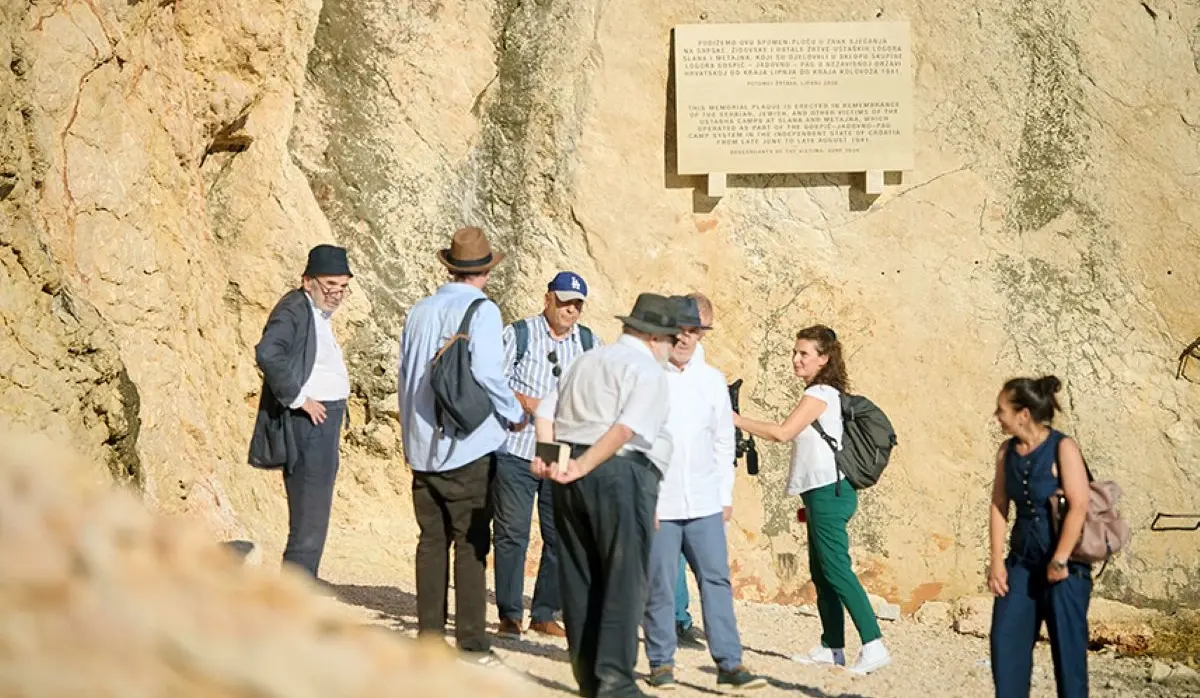
ZAGREB, JUNE 25 /SRNA/ - Uvala Slana /Slana Cove/ on the island of Pag serves as a reminder that in the Independent State of Croatia /NDH/, Serbs and Jews - men, women, and children - were killed on this barren rocky terrain solely because of their ethnic affiliation, it was stated at a commemoration for the victims of Ustasha camps that were part of the Gospić–Jadovno–Pag concentration camp system.
Milorad Pupovac, president of the Independent Democratic Serb Party /SDSS/ and member of the Croatian Parliament, recalled that the top leadership of the Ustasha authorities decided that this cove would become a camp, a place for men - Serbs, Jews, and left-leaning Croats, while Metajna was designated as a women’s camp, mainly for the wives and children of imprisoned men.
He said that when many graves were opened in the late 1980s, what happened was precisely what should not have happened: the dead were turned into an argument for new deaths, new hostilities, and new suffering.
He also cited testimonies of the few survivors of Slana and Metajna, describing them as "hell on earth," and expressed gratitude for the installed memorial plaque, specifically thanking the president of the Jewish Community of Zagreb, Ognjen Kraus, as well as the Mayor of Novalja, Ivan Dabo.
Kraus stated that during the summer months of 1941, people were killed in this place not because of their political or any other views, but because of their religious or national identity, under the racial laws of the then Independent State of Croatia /NDH/, a distorted entity that existed until 1945.
"The prisoners themselves built the huts in which they would be kept under this sun, in this abyss without food and without water," Kraus said.
He thanked the mayor of Novalja Ivan Dabo for the installation of the memorial plaque, expressing hope that it will no longer be forcibly removed.
Vesan Teršelič from the Documenta Centre for Dealing with the Past said that Uvala Slana, with the newly restored memorial plaque, has become a space of genuine confrontation with the past, where new generations can learn about acknowledging the suffering of others and about the atrocities committed during World War II in the time of the Ustasha NDH.
"Those who survived the Slana and Metajna camps, after fifty-five days, were taken from this place, after which they actually became the first to erect barracks in the Ustasha Jasenovac camp," Teršelič emphasized.
The Mayor of Novalja, Ivan Dabo, assessed that Uvala Slana is a true place of remembrance and that it continues to serve as a warning about the dehumanization of those who are different, so that such atrocities would never be repeated.
The commemoration was held yesterday at the memorial plaque, which has been restored for the fourth time thanks to the efforts of the Serb National Council /SNV/, the Coordination of Jewish Communities, and the “Documenta” Centre for Dealing with the Past, in cooperation with the mayor of Novalja.
The memorial plaque was destroyed in the early 1990s. The SNV reinstalled it in 2010 and 2013, but it was destroyed on both occasions. The first plaque in Uvala Slana was installed in 1975.
The Ustasha camp Slana covered an area of about five hectares and was located roughly five kilometres from the nearest hamlet of Metajna on the island of Pag.
On that barren rocky terrain, directly exposed to the strong Velebit wind, with no drinking water or vegetation, there were no conditions for normal life.
The first prisoners were Jews arrested in Zagreb on June 20, 1941, and four days later, they were brought to Slana. That date can be considered the beginning of the camp’s operation.
The first group of detainees consisted of 30 Jews from Zagreb. At the time of their arrival in Slana, there was nothing there except bare rock. Later, Serbs were brought in, along with a smaller number of Croats, mostly communists, the Serb National Council /SNV/ stated.
From July 10, the number of Serbs increased significantly. In the northern part of the camp there were mostly Serbs and, to a lesser extent, Croats, while in the southern part there were exclusively Jews.
After the reoccupation by Fascist Italy, the area of Velebit and the island of Pag were placed under Italian control in mid-August 1941, which led to the closure of the camp, while the remaining prisoners were either killed or transferred to other detention sites in the NDH at the time.
The fascists, specifically a sanitary and disinfection commission of the Italian army, were appalled by the brutality of the crimes committed.

EXPLOSION AND MAJOR FIRE AT CANADIAN MILITARY BASE

LECORNU: 1,200 PROTESTERS ARRESTED FOR VIOLENCE, 150 POLICE OFFICERS INJURED

TRUCK CRASHES INTO PLAYGROUND, KILLING TWO PEOPLE

DODIK: SNSD AND HDZ BiH WANT INSTITUTIONS TO FUNCTION IN ACCORDANCE WITH CONSTITUTION AND PRINCIPLE OF CONSTITUENT STATUS