FORCE AS A POLITICAL ARGUMENT OF POLITICAL SARAJEVO
Republika Srpska - Trišić Babić
06/25/2026
09:44
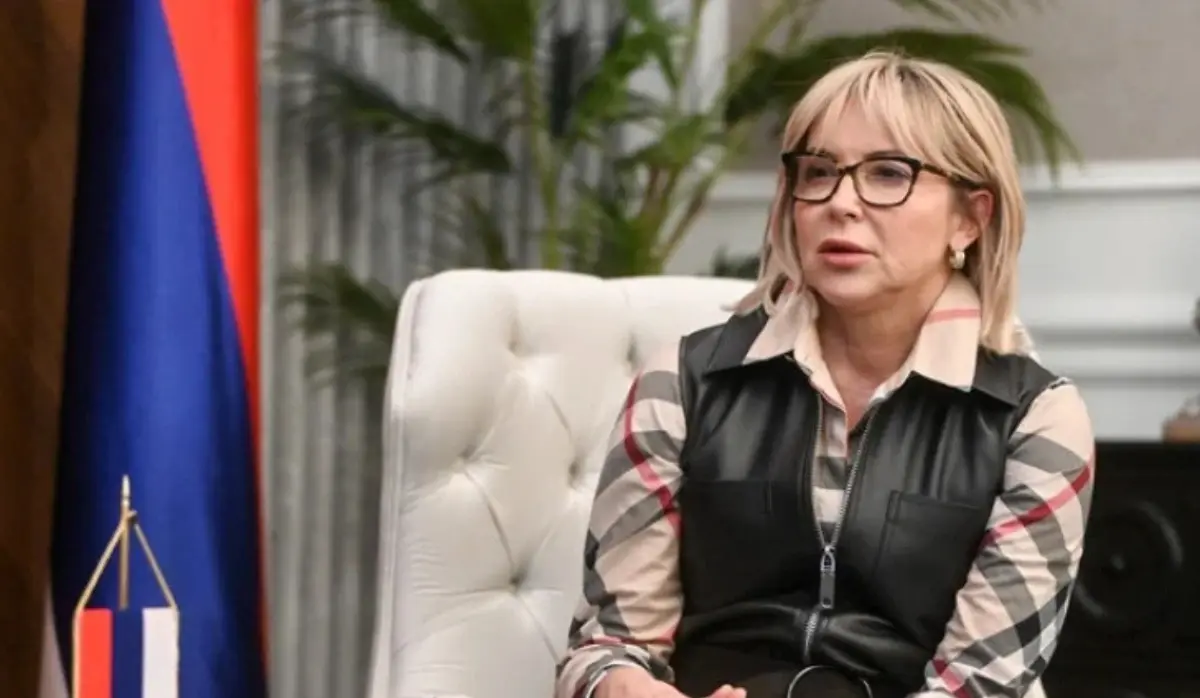
BANJA LUKA, JUNE 25 /SRNA/ - Ana Trišić Babić, acting director of the Office for International Cooperation of Republika Srpska, said that Bakir Izetbegović’s statement that SNSD leader Milorad Dodik “must be dealt with by some kind of force” showed the world what Republika Srpska has been facing for years.
She assessed that this was a call for the use of force against a man who has the highest political legitimacy and legality in post-war BiH.
Trišić Babić added that Izetbegović is also aware of this, and that this is precisely why he and Christian Schmidt were planning to have an illegitimate actor remove the legitimate and lawful president of Republika Srpska.
“In political philosophy, there is something that has long been known to political thinkers, but which politicians try to forget, and that is that force is not the pinnacle of power. It is its substitute. When argumentation no longer works, when the ability to persuade is lost, force is resorted to. Not as proof of strength, but as confirmation of its loss,” Trišić Babić stated in an opinion piece for Glas Srpske.
She stated that the Dayton Peace Agreement was not perfect, but was wise in the only possible way under such circumstances.
“It accepted reality instead of forcibly reshaping it. It recognized that BiH can only survive in its complexity and diversity. Otherwise, it will not survive,” Trišić Babić said.
She added that Izetbegović and the SDA have never accepted this, and that for decades they have treated Dayton BiH as a temporary framework, something to be eroded from within, bypassed externally, or, as heard yesterday, removed by force.
Trišić Babić pointed out that the Office for International Cooperation of Republika Srpska was not established to wage diplomatic battles, but out of the practical understanding that there is a significant gap between how Republika Srpska is portrayed in certain circles in Sarajevo and what it actually is.
“For years, we have been speaking with international actors, political representatives, and diplomatic communities in Europe, America, Russia, and beyond. We were not seeking sympathy. We were only seeking understanding for one simple thing: that in a democracy, argument and the electoral will of the citizens must be stronger than force and imposition,” Trišić Babić added.
She stressed that the international community is increasingly recognizing this, not because Republika Srpska representatives are loud, but because they are consistent.
Trišić Babić said that truth does not require noise.
"And then Mr. Izetbegović, in a single statement during prime time, did what no diplomatic note could have achieved. He himself showed the world what Republika Srpska has been facing for years. A political culture that calls for force has no moral authority. It only has a claim to power. And that is precisely why it is dangerous, not as strength, but as a political culture that sees violence as its only value," Trišić Babić stated.
She assessed that BiH is possible, but only as a community of entities and three constituent peoples.
Trišić Babić added that Republika Srpska has chosen that path, with arguments, institutions, and the belief that history knows how to distinguish builders from destroyers.
“In the end, thank you to Bakir Izetbegović. In just a few minutes, he demonstrated to the entire civilized world what we from Republika Srpska have been explaining for a long time,” Trišić Babić concluded.