DESPITE EVIDENCE, CRIME IN DOBROVOLJAČKA STILL WITHOUT A JUDICIAL EPILOGUE AFTER 34 YEARS
BiH - war - anniversary - Nuždić
05/02/2026
10:46
BANJA LUKA, MAY 2 /SRNA/ - The crime committed in Dobrovoljačka Street in Sarajevo has remained without a judicial epilogue for 34 years despite numerous pieces of evidence, proceedings have been prolonged, and accountability is lacking, but it is necessary to persist in demanding justice, Acting Director of the Republic Center for Research of War, War Crimes and the Search for Missing Persons Viktor Nuždić told SRNA.
Nuždić said it is particularly concerning that the investigation was suspended in 2012 without a clear and justified explanation, only for an indictment to be issued 10 years later.
“Questions arise as to whether anyone was ever held accountable for such decisions and whether the public was ever given an explanation of the grounds on which the investigation was suspended. This is precisely one of the key problems of the judiciary at the level of BiH, where accountability is lacking, and justice remains unattainable for Serb victims,” Viktor Nuždić assessed.
However, he added, it is precisely because of the victims, their families, and all those who survived and found the strength to testify that it is necessary to persevere in demanding justice.
He emphasized that the truth about these events has been documented and must not be forgotten; it should serve as a lasting testament in both academic research and the culture of remembrance.
“It is precisely for this reason that the Republic Center for Research of War, War Crimes and the Search for Missing Persons documented, investigated, and presented to the public its research related to the crime in Dobrovoljačka Street in the book Reconstruction of the Crime – Deconstruction of the Myth, as well as in the Atlas of Crimes Against Serbs During the Defensive-Patriotic War,” said Nuždić.
Referring to the events preceding the crime in Dobrovoljačka Street, Nuždić recalled that the referendum, in which Serbs as a constituent people were outvoted and which was organized against their will, marked the beginning of the war events in BiH.
“The killing of a Serb wedding guest in Baščaršija on March 1, as well as the crime in Sijekovac on March 26, 1992, clearly foreshadowed the tragedy that would follow. Sarajevo Serbs were among the first to feel these events, exposed to an atmosphere of fear and uncertainty that soon grew into open hostility toward everything Serbian,” Nuždić assessed.
Expulsions, arrests, and killings, Nuždić stated, became everyday occurrences, and in such an environment, no different treatment could be expected even toward the then regular army and its members.
He added that soldiers, who were the pride of Yugoslavia, were overnight turned into enemies, occupiers, and targets of a propaganda machine.
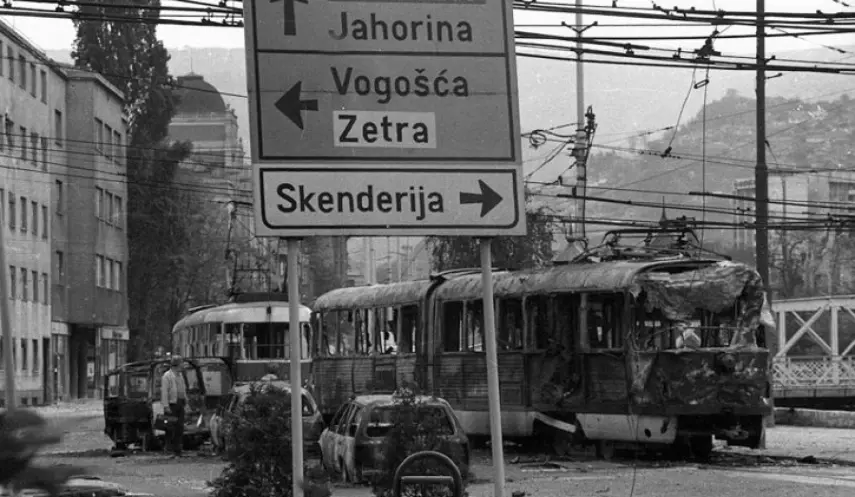
“Killings of JNA members began on April 20 with the killing of two young soldiers in Bistrik, continued on April 22 in Veliki Park when eight members were killed, reaching a tragic climax on May 2 when at least 19 were killed in Skenderija, and on May 3, 1992, in Dobrovoljačka Street, at least nine persons were killed,” Nuždić stated.
He noted that dozens were wounded, and many were captured and subjected to severe torture despite a previously reached agreement on peaceful withdrawal, under guarantees from UN forces.
“Unfortunately, as with other crimes in Sarajevo, there is a persistent attempt to impose a narrative that the crimes were carried out by ‘Caco’, ‘Ćelo’, ‘Juka’, although it is evident that these criminals were merely executors of the official policy of the then Muslim leadership,” said Nuždić.
The 34th anniversary of the crime against JNA members in Dobrovoljačka Street, where they were attacked by Muslim paramilitary units, will be marked tomorrow in Istočno Sarajevo and Sarajevo.