WORLD’S FIRST ROBOT CLIMBING COMPETITION HELD ON MOUNT TAI
China - technology
11/03/2026
09:03

SHANDONG, NOVEMBER 3 /SRNA/ – The world`s first robot climbing competition was held on Mount Tai, in the city of Tai`an, Shandong Province, organised by China Media Group /CMG/.
Under the slogan "Climbing to Heights – Intelligent Competition on Mount Tai", the ancient mountain trails were transformed into an arena showcasing the latest technological achievements, China Media Group announced.
This is the world`s first competition in which artificial intelligence-powered robots compete on real mountainous terrain.
Qi Juchuan, Deputy Director of CMG, stated that Chinese President and General Secretary of the Communist Party of China Xi Jinping had emphasized the need for "comprehensively advancing innovation, industrial development and the application of artificial intelligence", as well as "empowering all industries through artificial intelligence".
"The cooperation between CMG and Shandong Province in organising the robot climbing competition on Mount Tai represents another innovative measure aimed at consistently implementing General Secretary Xi Jinping`s important guidelines and promoting the application of scientific and technological achievements," Qi said.
He stressed that such innovative activities represent a step forward in China`s technological innovation and the accelerated development of advanced manufacturing.
The competition provides an opportunity for the practical testing and demonstration of artificial intelligence technologies, taking them from laboratory conditions to complex real-world scenarios.
At the same time, it serves as a platform for promoting open and collaborative innovation, as well as the wider application of emerging technologies.
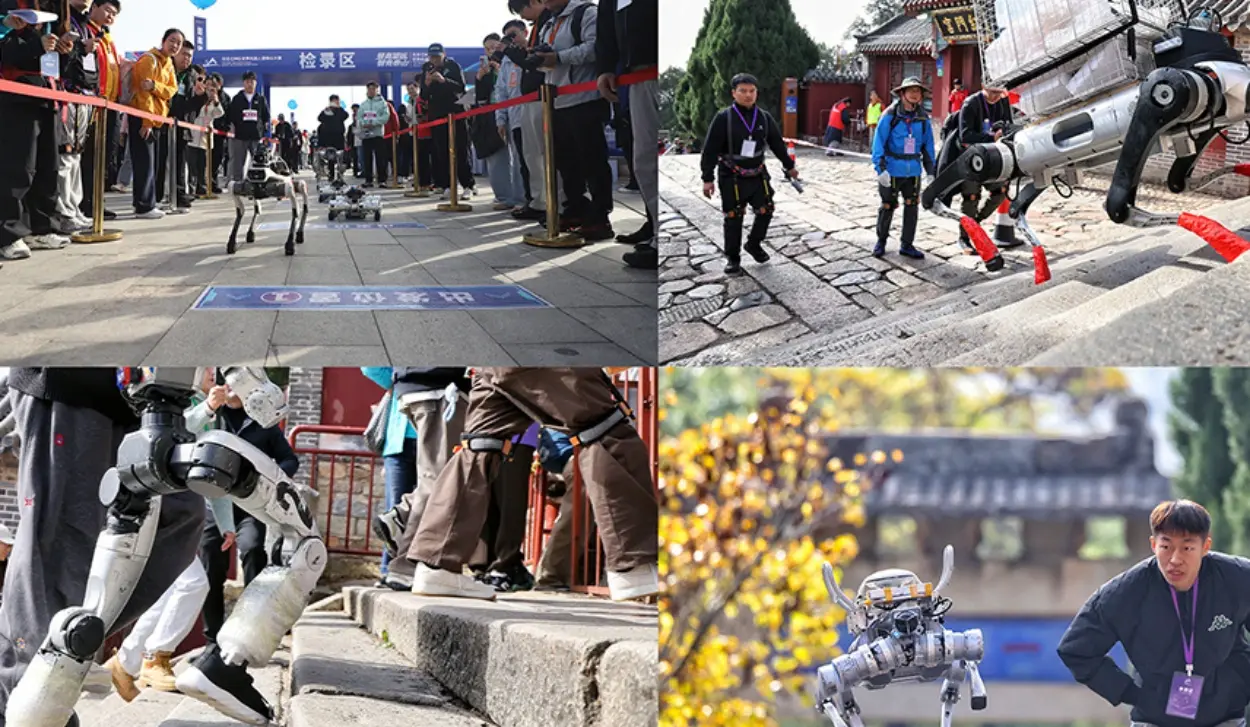
Nearly 90 teams from across China took part in the competition, presenting their latest research achievements and tackling the challenges posed by the ancient trails of Mount Tai.
The competition course was approximately 3.9 kilometres long and included more than 3,100 steps.
Humanoid robots, four-legged robotic dogs and robotic exoskeletons competed in various categories, including autonomous movement, adaptation to complex terrain and climbing while carrying loads.
These challenges provided a serious test of key robotic technologies, including motion control, dynamic balance and environmental perception.