TRIFKOVIĆ'S BOOK ON TRAGIC FATE OF PEOPLE FROM MONTENEGRO PRESENTED
Republika Srpska - Banja Luka - culture
10/22/2026
20:58

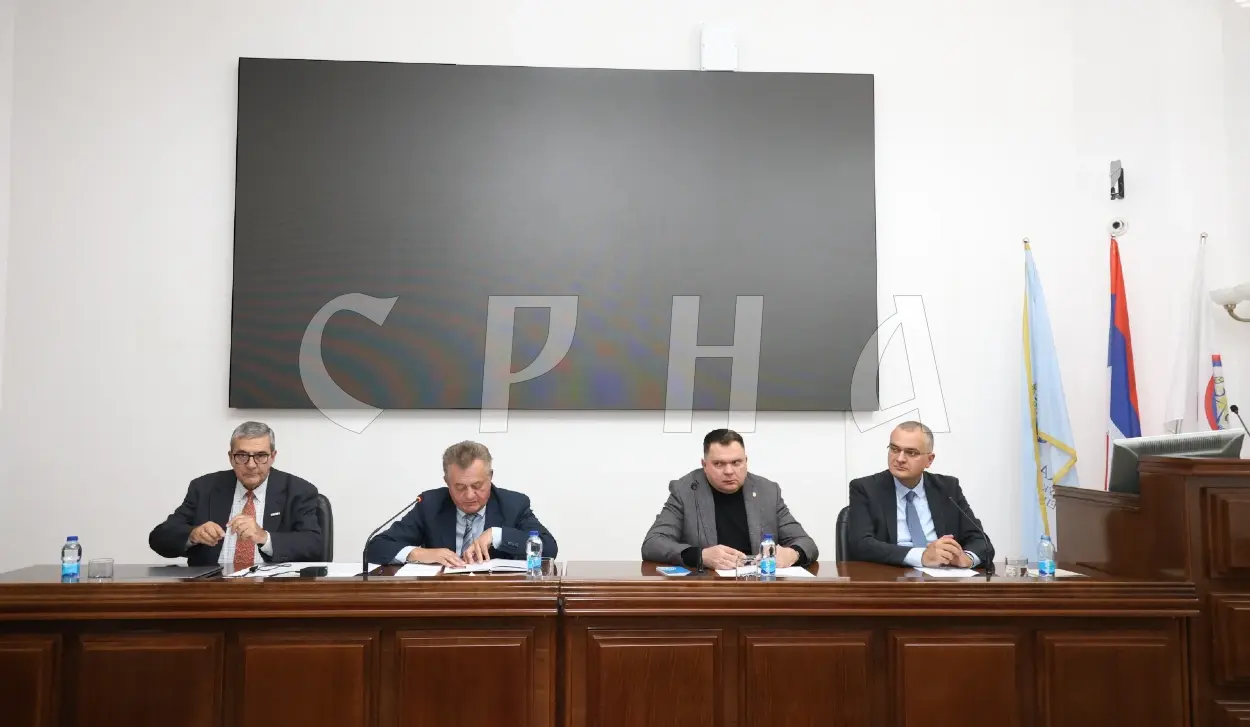
BANJA LUKA, OCTOBER 22 /SRNA/ – The book The Road of Suffering: A Chronicle of the Calvary of the People of Montenegro and Boka, 1944-1945, by Professor Srđa Trifković, was presented in Banja Luka this evening. The book examines the killing of around 15,000 Serbian fighters, civilians and clergy by communist forces. The author said he hoped the work would make a genuine contribution to reconciliation within Montenegro.
Trifković said the destruction of the convoy led by Chetnik commander Pavle Đurišić, which included around 15,000 Serb fighters, civilians and clergy, was an enormous and irreparable loss for Montenegro at the time.
"The killing of 12,000 people in this context, mostly younger men, amounts to true genocide. This was precisely what Montenegrin communists did in the mountains of Slovenia in May 1945, on the orders of Josip Broz Tito," Trifković said.
Relative to Montenegro's population at the time, he added, this would be equivalent to the killing of one million people in France.
He warned that the outbreak of Montenegro's civil war was unique in Europe because, from the summer of 1941 to the summer of 1942, one of the resistance movements - the communist movement - killed more of its own compatriots and political opponents than enemy soldiers.
"They killed more of their own compatriots than the enemy killed civilians in its reprisals. The attempt by today's so-called European integration advocates in Montenegro to cover up this episode is entirely anti-civilizational and anti-European. I hope my book will help raise broader awareness of this tragic episode," Trifković told reporters.
Professor Željko Budimir said the Serbian academic and scientific community needed a book of this kind to shed light on the suffering of members of the Yugoslav Army in the Homeland, as well as civilians and clergy.
"They fell victim to revolutionary terror carried out by the Communist Party of Yugoslavia and the Partisan movement. It was a brutal fratricidal war in which, in Serbia alone, around 60,000 prominent people - members of the urban and rural elites - were wiped out between the autumn of 1944 and March 1945, according to serious research," Budimir said.
He said books and research of this kind were major achievements that should show the public today how destructive polarization and divisions among Serbs can be.
Professor Goran Latinović said the events in question represented one of the greatest tragedies in the history of the Serbian people of Montenegro and Boka.
"Put simply, during the Second World War, Serbs had two resistance movements - the Partisans and the Chetniks, which were engaged in a continuous civil war. It seems that the Chetnik forces and civilians from Boka and Montenegro mentioned here may have suffered some of the heaviest losses in that conflict," Latinović explained.
He added that most of them were killed in Slovenia after the British handed them over to the victorious communist authorities.
"That was a major post-war crime," Latinović said, describing the book as well-written, high-quality and clearly structured, and noting that it drew on reliable domestic and foreign archival material.
The book was presented at the premises of the Academy of Sciences and Arts of Republika Srpska