SAŠA MILOŠEVIĆ'S TESTIMONY REMINDS OF LOSS OF HIS FATHER AND TWO BROTHERS IN A DAY
Republika Srpska - Memorial Center
03/26/2026
11:11
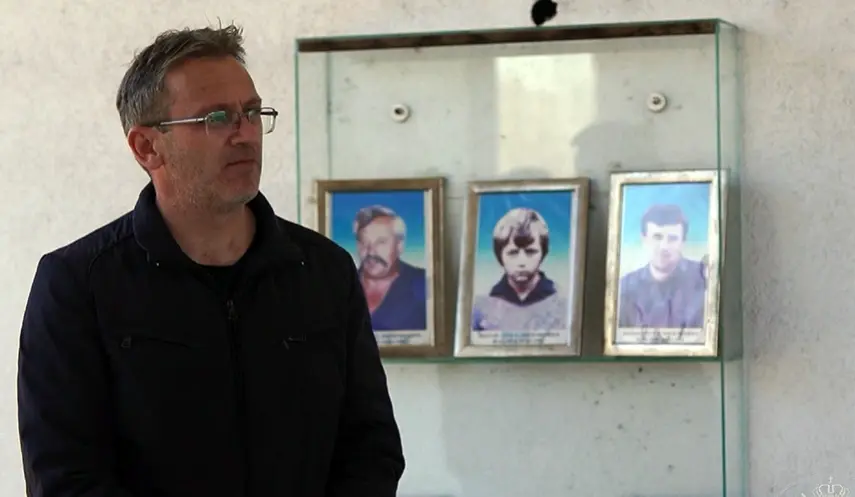
BANJA LUKA, MARCH 26 /SRNA/ – The Republika Srpska Memorial Center today published the testimony of Saša Milošević, who lost his father and two brothers, marking 34 years since the massacre of Serb civilians in Sijekovac.
He lost his father Luka /1943/ and brothers Željko /1968/ and Dragan Milošević /1974/.
The Memorial Center stated that Croatian-Muslim formations captured Milošević and his mother, who endured severe trauma that left a lasting mark on his life.
Milošević remembers that on March 26, 1992, he was alone in the family home where he lived with his father, mother, and two brothers, when around 5:00 p.m. an attack on the village began, carried out by members of the Croatian army, Muslim forces, and neighbors.
"We heard over the loudspeaker that we should come out and surrender," Milošević said, noting that they did not know what was happening, and that he, his mother, and his then 18-year-old brother crossed the road to hide in the basement of the Zečević family.
According to him, when they arrived in the basement, there were about ten neighbors there, and within some twenty minutes it filled with people and soldiers wearing "ZNG" and "HOS" insignia.
"When they entered the basement where we were hiding, they began cursing and shouting at us. They ordered us to come out in a line, one by one, toward the road. They beat us with rifle butts, kicked us… My mother held me under her arm and my brother," Milošević testified.
He said that after a few meters, one of the soldiers approached them and ordered his brother to lie down. Their mother tried to pull her son away from the soldier, but he struck him.
"My brother fell to the ground, and then he kicked him behind the neck with his boot. He remained lying there. My mother tried to lift him so we could move on, but he couldn't - he was unconscious. I stayed beside my mother the whole time," Milošević said.
He testified that Serbs who survived the massacre were taken to the center of Sijekovac, to a so-called crisis headquarters, where they were interrogated, including being asked why they had not surrendered.
"During that night, we were still not aware of what had happened; we were terrified. Someone among those Muslims or Croats placed us in two houses to hide from those executioners. Had that not happened, they would most likely have killed us all. About fifteen of us were hidden, divided into two groups, and we spent the entire night there in fear. They kept coming and looking for us," Milošević remembers.
He added that after everything, he and his mother were left alone and struggled to survive as best they could, until she suffered a stroke in 2022 and passed away.
The Memorial Center stated that the massacre in Sijekovac was the first mass crime against Serb civilians in Posavina during the war in BiH.
In that village, then part of the Bosanski Brod municipality, on March 26, 1992, Croatian forces, with the participation of some Muslim units, carried out an attack in which nine Serb civilians were brutally killed in their homes and yards.
As part of the same pre-planned operation, the village was looted and more than 50 Serb houses were burned. The remaining population was subjected to unlawful detention, as well as physical and psychological abuse.
These events were part of a broader process of ethnic cleansing of the Serb population from the Posavina area.
"During 1992, another 10 Serb residents of Sijekovac were killed after previously being detained and abused. Immediately before these events, on the night between March 24 and 25, three Serb civilians were killed in Bosanski Brod," the Memorial Center said.
They reminded that the Posavina area, until the breakthrough of the Corridor, was marked by numerous crimes against Serb civilians, including torture, abuse, and killings.
The Republika Srpska Memorial Center called on all those who lost family members or survived suffering to share their testimonies so that the memory of the victims can be permanently preserved.
Anyone wishing to testify can contact the Memorial Center via email at komunikacija@mcrs.vladars.rs or by phone at +387 51 222 999.