PRESERVE THE MEMORY OF 12,000 SERBS PERISHED IN THE DOBOJ CONCENTRATION CAMP
Republika Srpska - Doboj - Culture of Remembrance
12/25/2025
17:35
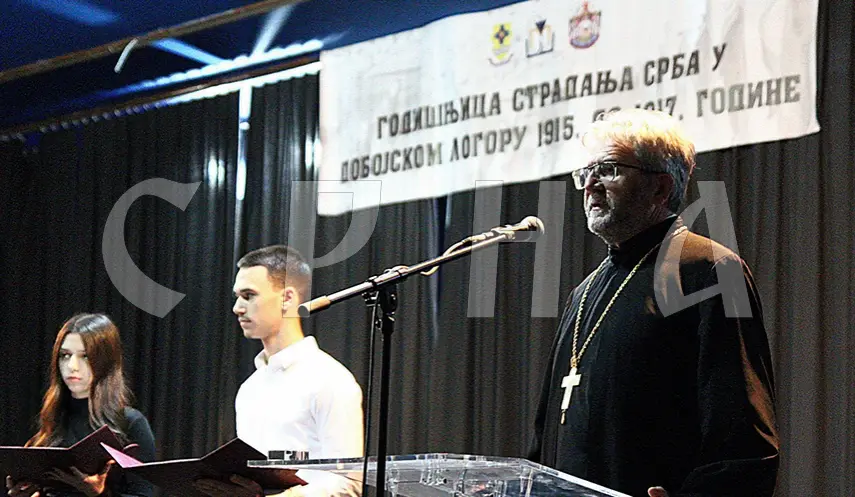
DOBOJ, DECEMBER 25 /SRNA/ - Today, a ceremonial gathering was held in Doboj to mark the 110th anniversary of the formation of the Austro-Hungarian camp for Serbs and the arrival of the first camp inmates in the city, on the occasion of which the message of preserving the memory of approximately 12,000 camp inmates who perished was sent in order to prevent such evil from repeating.
The director of the Republic Pedagogical Institute, Slađana Tanasić, highlighted the importance of keeping the memory of such events alive, recalling that children also perished in the Doboj camp, and that as many as 643 children died there in April 1916.
"We must remember all the victims, but we must accept their sacrifice as a sacred pledge, an obligation, and a path to a brighter future," said Tanasić.
Tanasić pointed out that the Austro-Hungarian camp for Serbs is a confirmation of the dark side of humanity, which should serve as a warning.
"Today, we witness that the truth, no matter how hidden, can never be concealed. Today, it is known that the Austro-Hungarian executioners took their task of destroying a nation very seriously and worked relentlessly to finish it, as the number of killed increased from several dozen to several hundred per day," said Tanasić.
She emphasized that it is the duty of the Doboj residents to speak and write about this camp and the reasons for its formation, as well as about all the victims who are woven into the freedom of Republika Srpska.
The archpriest of Doboj, Mirko Nikolić, says the memory of the Doboj Golgotha should be a vow to future generations, and warned that forgetting means their re-suffering.
He noted that the Doboj camp victims were canonized by the Holy Archdiocesan Synod of the Serbian Orthodox Church as new martyrs of the Zvornik-Tuzla Diocese.
Deacon Vlado Mojević spoke about the scale of the suffering of the camp inmates, noting that between 1915 and 1917, a total of 45,791 Serbs were interned in the Doboj camp, including 16,673 men, 16,996 women and children from BiH, and 12,122 Serb soldiers, along with a number of elderly people, women, and children from Serbia and Montenegro, 12,000 of whom perished.
He reminded that on the first day, December 27, 1915, around 600 Serbs, mostly children, women, and the elderly, were interned in the camp, who had done nothing wrong.
Deacon Mojević said that the Doboj camp was part of a broader Austro-Hungarian project to destroy Orthodoxy on this side of the Drina River, and that, especially in Doboj, they were assisted by inhumane people from other nations, who were engaged in the so-called military police and took their Serb neighbours to the camp.
He emphasized that the suffering of the internees continued even after the camp was dissolved, as the memory of the event was systematically silenced during the period of the Independent State of Croatia /NDH/, and that such an attitude toward Serb victims continued under the communist doctrine in Doboj, which prohibited the return of the cross to the memorial ossuary.
"The communists cleverly turned Doboj into a city of heroes, not a city of martyrs, naming the central park 'People's Heroes Park,' thus pushing the suffering of the Serbs and everything that happened then into oblivion," said Deacon Mojević.
The official gathering was organised by the Medical School of Doboj, whose principal, Milena Damjanović, stated that the current generations are not meant to carry the guilt of the past but to take on the responsibility of remembering it.
"The memory of the Doboj camp is a call to learn to respect every person, regardless of name, faith, or origin, as well as to defend and preserve the values of freedom, dignity, and peace through knowledge, dialogue, and humanity," said Damjanović.
As part of today's gathering, the best literary works from the Serb Golgothas of the 20th Century competition, organised by the Doboj Literary Club "Jovan Dučić," were awarded.
Out of 100 submitted works, the best literary work was the patriotic poem "Tuga u kamenu/Sorrow in Stone " by Dušan Komazec from Stanišići.
Second place went to Aleksandar Savić from Bačka Palanka for the poem "Golubnjača/Dovecote", and third place went to Ružica Krstić from Bijeljina for the poem "Bezdan/Abyss ".
The official gathering was held at Pavlović University, and prior to that, an exhibition of documentary material titled "Doboj Camp" was opened at the Art Gallery of the Centre for Culture and Education, with the blessing of His Eminence Metropolitan Fotije of Zvornik-Tuzla.
Twelve printed panels displayed documentary materials about the suffering of Serbs from Sarajevo, Sokolac, Rogatica, Bileća, Trebinje, as well as from the western part of Serbia, areas from which the majority of the population was interned in the Doboj camp.
Austro-Hungarian authorities formed the concentration camp for Serbs in Doboj on December 27, 1915.
At the request and initiative of the Orthodox religion teacher Vlado Mojević, with the support of the principal of the Doboj Medical School, Milena Damjanović, the Republika Srpska Institute of Pedagogy decided that December 27 will be dedicated to the memory of the suffering of Serbs in the Doboj camp from 1915 to 1917, with one class in all high and elementary schools in RepublikacSrpska.