ON THIS DAY IN 1995 NATO LAUNCHED BOMBING CAMPAIGN AGAINST REPUBLIKA SRPSKA
Republika Srpska - remembrance
08/30/2026
11:33

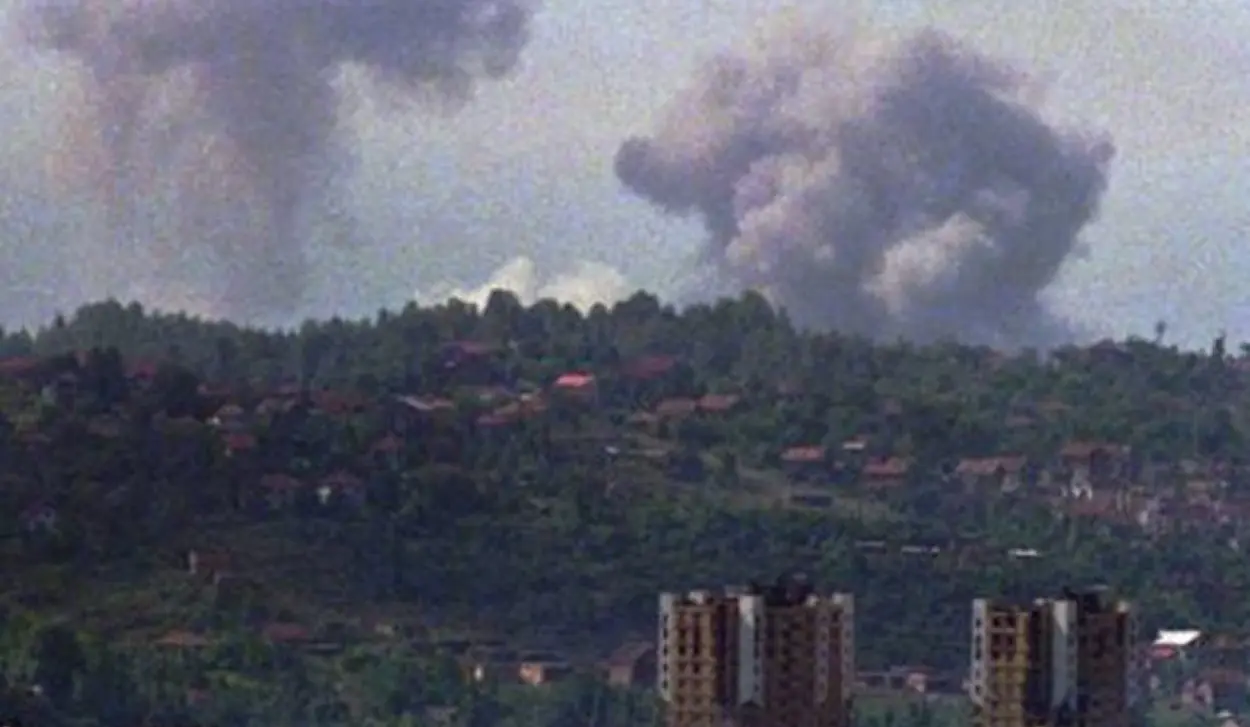
ISTOČNO SARAJEVO, August 30 /SRNA/ — On this day in 1995, NATO launched a bombing campaign against Republika Srpska that lasted until September 14, killing more than 50 members of the Army of Republika Srpska and civilians and wounding more than 120.
During the days of bombing, in which depleted-uranium munitions were also alleged to have been used, 47 members of the Army of Republika Srpska and seven civilians were killed, while more than 100 soldiers and 21 civilians were wounded.
NATO's Operation Deliberate Force began at 2:12 a.m. on August 30, 1995, with the stated aim of bringing the Serbs "to the negotiating table," and was carried out in open support of Bosniak and Croat forces in the final phase of the war.
More than 5,000 NATO troops from 15 countries and more than 400 aircraft, including 222 combat aircraft, took part in the operation.
NATO aircraft bombed positions of the Army of Republika Srpska, telecommunications facilities, bridges, command equipment, air-defense systems, ammunition depots and other logistical infrastructure.
NATO aircraft dropped a total of 1,026 bombs on Army of Republika Srpska positions, including 708 guided bombs, with the total weight of explosives dropped estimated at around 10,000 tons.
Over three weeks, 3,515 combat sorties were conducted from Aviano Air Base in Italy and from the USS Theodore Roosevelt aircraft carrier in the Adriatic Sea. A total of 338 military and civilian targets were attacked, including command posts and defensive positions of Army of Republika Srpska units.
Fifteen bridges and 13 relay towers were destroyed or damaged. The Žica hospital in Blažuj was also targeted.
The immediate trigger for the NATO campaign was an explosion at Sarajevo’s Markale marketplace on Aug. 28, 1995, for which Serbs were blamed. SRNA reported that an independent commission’s report from that period stated that "there was no clear evidence that the shells came from Serbian positions."
The report was also endorsed by Yasushi Akashi, then the UN Secretary-General's Special Representative for the Balkans.
Then-UNPROFOR commander General Michael Rose said after the Markale incident that it could not be established from where the shell had been fired.
Russian Colonel Andrei Demurenko, commander of the Russian peacekeeping battalion in Sarajevo who took part in the investigation, also said the Serbs had been "unfairly accused just so NATO would have a pretext for an attack."
According to SRNA, these claims did not affect NATO’s decision to openly side with the Bosniak and Croat forces.
On the first day of the bombing of Pale, during an engagement between Serb artillery and NATO aircraft that residents of the wartime capital watched from the streets, a French Mirage 2000 aircraft was shot down at around 5:00 p.m. by a surface-to-air missile. The aircraft crashed about 20 kilometers southeast of Pale, while its two pilots ejected and survived.
At the same time as Operation Deliberate Force, NATO launched Operation Deadeye, aimed at disabling the air-defense system of the Army of Republika Srpska.
A radar installation on Jahorina was bombed, while a NATO air strike on a telecommunications tower on Zlovrh killed 10 Army of Republika Srpska soldiers assigned to guard the tower.
Those killed that night were Ljubomir and Dragomir Bakmaz, Zoran and Radenko Sorak, Velimir Ujić, Miloš Jovičić, Darko Motika, Zoran Nerić, Andrija Obradović and Milan Stanišić.
The bombing of Republika Srpska ended on Sept. 14, 1995, after an agreement was reached for the Army of Republika Srpska to withdraw heavy weapons from the so-called safe area, a measure that was implemented on Sept. 17.
According to SRNA, NATO forces used depleted-uranium munitions during strikes on Pale, Jahorina, Hadžići, Vogošća, Ilijaš and Bratunac, areas controlled by the Army of Republika Srpska.
SRNA reported that the consequences were particularly severe among former residents of Hadžići municipality who moved to the Bratunac area after the Dayton Peace Accords was signed.
At the Bratunac cemetery, around 400 people were buried within four years of the bombing, most of whom had suffered from some form of cancer, according to the report.
Many foreign soldiers who were stationed in the area during and after the bombing have also reported similar health problems.
The report said the alleged effects of the use of depleted-uranium munitions would also be felt by future generations in Republika Srpska, which it described as being among the leading areas in the region in terms of cancer rates.
Under a decision by the Republika Srpska Government Committee for Nurturing the Tradition of Liberation Wars, Sept. 9 was designated as the Day of Remembrance for the Victims of NATO Bombing in Republika Srpska.
The date was chosen to commemorate the day when siblings Radmila and Radenko Galinac from the Grlica settlement in Vojkovići were killed in a NATO air strike.
The Galinac siblings were among the first victims of the NATO campaign. They were killed on September 9, 1995, when a NATO aircraft struck a destroyed bridge in the Semizovac settlement near Sarajevo, according to SRNA.
The proposal to give the commemoration significance at the level of Republika Srpska was submitted on November 23, 2018, by SNSD representative in the House of Representatives of the BiH Parliamentary Assembly Staša Košarac, following an initiative previously launched by SRNA.
In a letter to the Government Committee for Nurturing the Tradition of Liberation Wars, Košarac reminded that SRNA had launched the initiative and published a series of articles documenting testimonies about the NATO campaign in Republika Srpska and victims of bombing involving depleted-uranium munitions.
The initiative to establish a day of remembrance for victims of the NATO bombing was launched in Andrićgrad on August 26, 2018, at SRNA's proposal.