MINIĆ: INSTITUTIONS WILL DO EVERYTHING TO PREVENT CRIMINAL PROCEEDINGS FROM BEING USED AS HISTORY REVISION TOOL
Republika Srpska - Banja Luka - acientific conference
04/27/2026
14:10
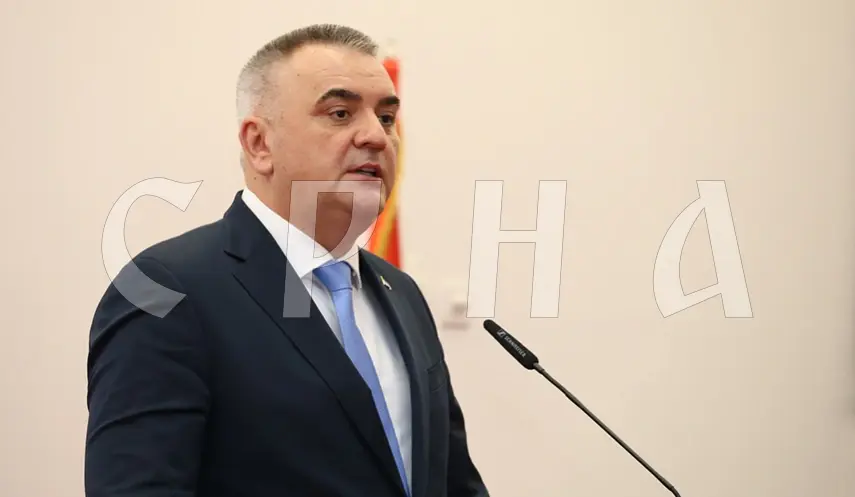
BANJA LUKA, APRIL 27 /SRNA/ – Republika Srpska Prime Minister Savo Minić has said today in Banja Luka that the Republika Srpska institutions will do everything to ensure that criminal proceedings are no longer used as an instrument for attempts to revise history in BiH, announcing the possibility of holding the Republika Srpska National Assembl’s special session in order to put an end to such Court of BiH’s practices.
Before the start of the conference titled “Criminal Prosecution as an Instrument of Historical Revision – Endangering Freedom of Thought and Speech through the Court of BiH’s Rulings,” Minić told the press this is not an ordinary legislative process, but a serious political issue with elements of historical revisionism.
“Every democratic society is measured by the level of freedom of speech it provides to its citizens. On the other hand, every serious state is also based on responsibility for publicly expressed words. However, there must be a clear balance between these two extremes. In this case, it appears that this balance has been disrupted,” Minić assessed.
He noted that it is well known that one of the highrRepresentatives, at the very end of his office, enacted a law that gave BiH institutions instruments to sanction certain forms of speech.
“The problem arises when these instruments are used in a way that goes beyond protection from hate speech and enters the sphere of punishing the mere expression of opinion. In practice, this means that an individual can be sentenced to several years in prison for expressing a view, even when that view does not constitute a direct call for violence or hatred,” Minić emphasized.
Comparing the situation with earlier systems, Minić said that a paradoxical situation has emerged, noting that in the former Yugoslavia penalties for verbal offenses were significantly milder than those now envisaged in certain cases.
He stresses that no one can or should be prevented from engaging in the study of history.
“Historical facts must be the subject of research, analysis, and public debate. Prohibiting or punishing the expression of certain interpretations of historical events leads to the danger of imposing a single ‘official truth’, which is not in line with democratic principles,” Minić stated.
The Srpsla prime minister assesses that additional concern is caused by the perception of inconsistent application of the law.
“In public, there are frequent references to cases where individuals were not prosecuted for statements or actions that, under the same criteria, would lead to criminal liability for others. Such selective application of the law undermines trust in the judicial system and creates a sense of injustice,” Minić believes.
He recalls that in recent years there has been a noticeable increase in the number of criminal complaints filed against individuals, often citing multiple serious criminal offenses at once, such as inciting national or religious hatred.
“When such complaints are used as a means of pressure rather than an instrument of justice, the question arises whether the legal system is being misused for political purposes and whether we want a society in which citizens can freely express their views, or one in which there is fear of sanctions for spoken words. The answer to this question determines not only the character of our political system but also the quality of life of all citizens,” Minić said.
He emphasized that the position presented is not directed against any people or institution, but is an effort to ensure equal treatment for all, preserve institutional integrity, and protect fundamental rights.
“The intention is not attack, but the defense of principles,” Minić stressed.
He concluded that it is necessary to clearly distinguish between the legitimate fight against hate speech and the misuse of laws for political confrontations or the imposition of a one-sided interpretation of history.
The conference was also attended by Minister of Justice Goran Selak, Minister of Labour, War Veterans and Disabled Persons Protection Affairs Radan Ostojić, as well as law professors, judges, and historians.
Support for the gathering, organised by the Republika Srpska Socio-Political Research Centre was also given by representatives of war veterans organizations via attendance.
More than 200 representatives of war veterans groups gathered outside the Republika Srpska Government building, where the conference is being held, and were greeted by the prime minister.
The conference is being held with the support of the prime minister and the Ministry of Justice of Republika Srpska.