MEMORIAL SERVICE ON MONDAY FOR THE WHITSUNDAY VICTIMS OF THE USTASHE CRIME
Republika Srpska - Srebrenica - Historical Memory
05/30/2026
12:42
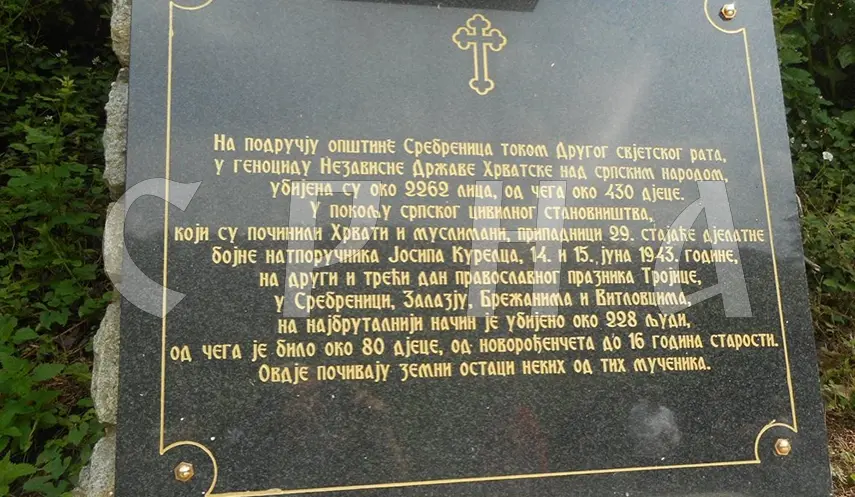
SREBRENICA, JUNE 7 /SRNA/ – A memorial service will be served on Monday, June 1, at the memorial ossuary in Srebrenica, marking 83 years since the Ustashe crime committed against more than 250 Serbs on the second and third days of Whitsunday /Trojčindan/ in 1943 in this town and the nearby villages of Vitlovci and Zalazje.
The crime in Srebrenica was committed on June 14, 1943, which was the second day of Whitsunday, while the crimes in the nearby villages of Zalazje and Vitlovci took place a day later, on June 15, the third day of Whitsunday.
The greatest expert on recent Srebrenica history, the late Miloš Nikolić—whose grandfather Jovo was killed by the Ustashe in his home on the second day of Whitsunday in 1943 in Srebrenica—previously told SRNA that the communist authorities covered up the truth and concealed the names of the victims of that crime.
This was done despite the fact that everyone knew that Independent State of Croatia (NDH) units, which included a massive participation of local Muslims, monstrously slaughtered Serb civilians on their doorsteps.
According to their own written documents, on that day, the Ustashe killed more than 155 Serb civilians in Srebrenica.
"Together with them, the family of a Jewish dentist and the family of a Muslim court president, who was married to a Serb woman, were also killed," Nikolić recounted. His grandfather Jovo was killed alongside his daughter-in-law Vasilija and a five-member Jewish family in the very house he lived in, which still stands as a witness to this crime.
According to Nikolić's findings, the killed Jewish family was related to the prominent writer Isak Samokovlija.
Following the crime in Srebrenica, another 97 Serbs—or 107 according to some data—were killed the next day in the village of Zalazje, including 45 members of the Rakić family, 16 of the Maksimović family, and 15 of the Dragičević family.
NDH documents state that Francetić's legionnaire, Ustashe Captain Josip Korelec, ordered a retaliation due to the death of his brother in battles near Srebrenica. He led the massacre, which the Ustashe, aided by local Muslim supporters, brutally committed against Serb civilians.
The exact number and names of those killed on June 14, 1943, in this area were never precisely established because doing so was not in the interest of the communist system.
Following the brutal crime committed in Srebrenica, on the next day, the third day of Whitsunday, the Ustashe carried out a slaughter in the Serb villages of Zalazje and Vitlovci near Srebrenica, where they killed and butchered dozens of local residents.
According to official data, 229 Serbs were killed in Srebrenica and Zalazje 83 years ago, 80 of whom were children. According to unofficial data, more than 250 Serb civilians were killed over those two days in Srebrenica and the surrounding villages.
Nikolić used to remind that during World War II, all Serb villages in the wider area of the Srebrenica local community of Sućeska disappeared, including Slatina, Lipovac, Žedanjsko, Šušnjari, and several other Serb hamlets.
After the war, Serb properties were mysteriously occupied and seized by Muslims, and no one was ever held accountable for the disappearance of their owners.
According to Nikolić, the communist authorities neglected this crime and labeled the victims as members of the anti-fascist resistance, even though they were Serb civilians who had no connection to any ideology. For the sake of "brotherhood and unity," these crimes were met with decades of silence.