DODIK: EXODUS OF SARAJEVO SERBS - EXODUS OF PEOPLE'S IDENTITY; LESSON THAT WITHOUT THEIR OWN REPUBLIC THERE IS NO SECURITY
Republika Srpska - Exodus of Sarajevo Serbs
02/20/2026
10:56

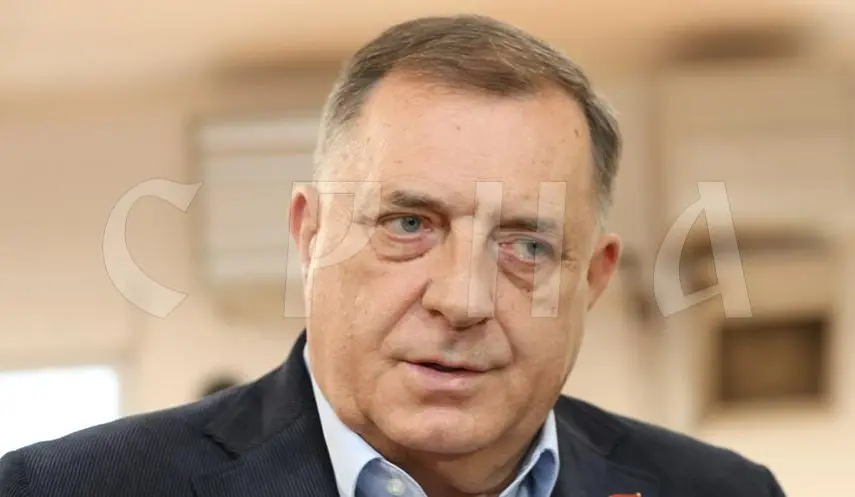
BANJA LUKA, FEBRUARY 20 /SRNA/ - The exodus of Sarajevo Serbs in 1996 was a painful but very clear lesson that without a strong Republika Srpska and its institutions, there is neither security nor equality for the Serb people in BiH, and therefore any weakening of Republika Srpska is a direct belittling of the immense sacrifice made for its creation and survival, stated the President of the SNSD Milorad Dodik.
Marking 30 years since the exodus of Sarajevo Serbs, when more than 150,000 people in February and March 1996 had to leave their city and set off into the unknown, Dodik told SRNA that this exodus was not merely a departure from a city, but a departure from the life they had lived until the 1990s - a departure from their homes, yards, and streets.
"In February and March 1996, under the burden of uncertainty and fear, more than 150,000 Serbs left their homes in Sarajevo. They did not leave because they wanted to, but because they knew that in their city there was no longer a place for them - no security, no justice, no dignity.
What was most tragic in that sorrowful column of the Serb people, who left their doorsteps in silence through snow and cold, were the coffins containing the remains of their loved ones, which they carried with them so as not to leave them at the mercy of those who until yesterday had looked at them through rifle sights," Dodik emphasized.
They carried them, he said, so they could rest where their descendants would be able to light a candle without fear, with dignity and pride.
He stressed that the image of columns of people stretching for days through Sarajevo's streets, trucks loaded with furniture, bundles, coffins, and crosses remains one of the most harrowing images of Serbian history at the end of the 20th century, recalling that history does not record another people who had to carry their dead with them.
The SNSD leader said the exodus was not only a physical departure from Sarajevo, but an exodus of identity, language, script, and culture of a people who had been present there for centuries, building the city and making Sarajevo what it was.
"The exodus of the living and the dead Sarajevo Serbs is testimony to suffering, but also to strength. Those who left their homes for the unknown did not disappear; they rose from the ashes, preserved their identity, their name, and preserved themselves.
Today, when we speak about the exodus of Sarajevo Serbs, we do not speak only of the past - we speak of a pledge to the future that such a fate must never happen again, and of the obligation to nurture a culture of remembrance, so that suffering is not forgotten and truth is stronger than oblivion," Dodik emphasized, adding that a people who remember endure.
He stated that the exodus of Sarajevo Serbs was far more than a historical episode - it was a clear political message and proof that the Serb people in BiH can survive only if they have strong, stable, and independent institutions of Republika Srpska.
"Any weakening of Republika Srpska, subordination to Sarajevo or to foreign centers of power, is another defeat for the Serbian people. The exodus of Sarajevo Serbs obliges us to preserve Republika Srpska, its institutions, competencies, and constitutional position, as well as the dignity of our people, and to remain united in this, because a people who once carried their dead out of fear that even their graves would not be respected know why they must have their own strength, their own Republic, their own institutions, and their own right to decide about themselves," Dodik stressed.
He stated that proof of the strength of Republika Srpska, its institutions, and the Serb people is the construction of the city of Istočno Sarajevo, which grew out of the exodus and became a symbol of survival.
"Istočno Sarajevo was not created by an urban plan on paper, but from pain, from columns, from the tears of Sarajevo Serbs who in 1996 had to leave their homes. That city is a dignified and quiet, yet very powerful response to the exodus.
On meadows, in the hills, in an area that at the time had neither infrastructure nor the outline of a city, the first urban foundations began to rise. Today, Istočno Sarajevo has grown into an administrative center and become a symbol of the political maturity and state-building awareness of the Serbian people in Republika Srpska, demonstrating that the strength of institutions and the will of the people can build a university, a hospital, schools, kindergartens, cultural institutions…," Dodik emphasized.
Istočno Sarajevo, he said, stands today as a barrier against oblivion and a reminder that Republika Srpska must invest in its border and strategic areas. Therefore, it is the obligation of all to develop Istočno Sarajevo in a planned, strong, and long-term manner as a university, healthcare, cultural, and security center of Republika Srpska.
"Istočno Sarajevo is a pledge turned into a foundation - a city that testifies that a people who know why they suffered also know why they must endure - a city born from exodus that has become a city of the future," Dodik concluded.