DODIK: BATTLE OF SUTJESKA CONFIRMS ANTIFASCIST TRADITION OF SERB PEOPLE
Republika Srpska - the battle of Sutjeska - culture of remembrance
06/13/2026
18:42
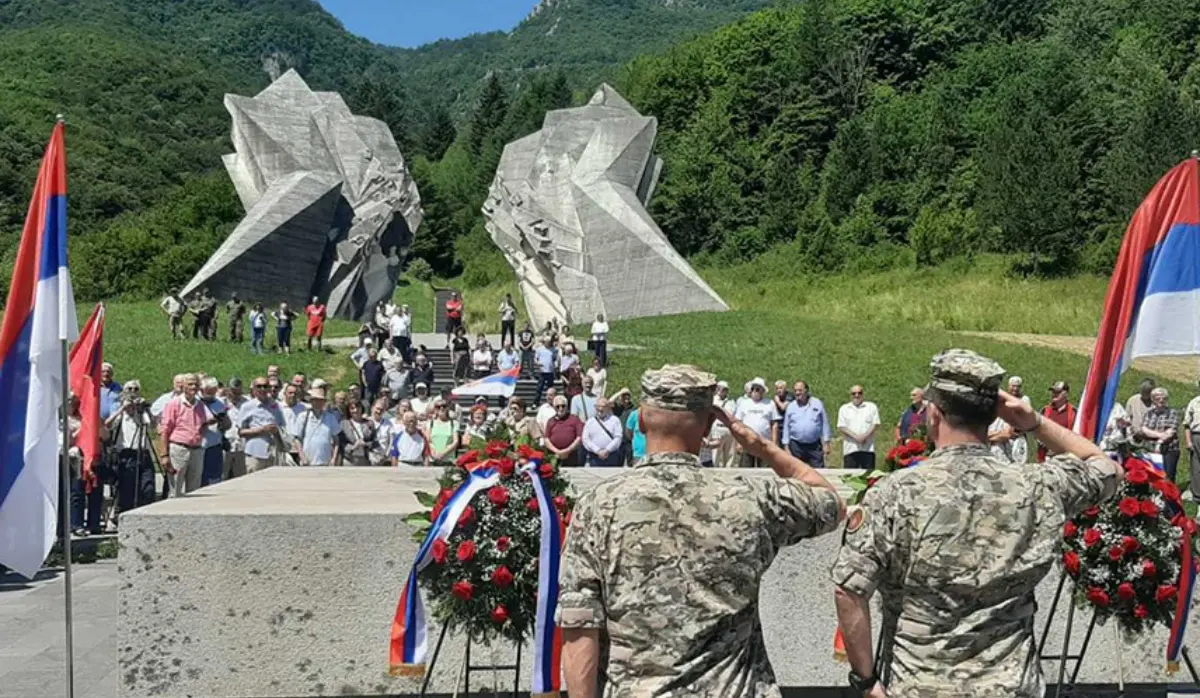
BANJA LUKA, JUNE 13 /SRNA/ - The Battle of Sutjeska was not only a military battle, but a struggle for the right to life, dignity and the future of the Serb people, who throughout history have repeatedly shown that they consider freedom their greatest value and fascism the greatest evil of the 20th century, said President Milorad Dodik.
"The Serb people bore the greatest sacrifice during this battle, because thousands of Serb fighters and civilians gave their lives in the fight against fascism, leaving behind a glorious example of courage, heroism and pride that lasts to this day," Dodik told SRNA on the occasion of 83 years since this was one of the most difficult battles in the territory of the former Yugoslavia in the Second World War.
Dodik stated that many of these brave heroes were young men, patriots, who, guided by love for their people and freedom, and against oppression and occupation, entered an almost impossible fight against a far superior enemy, aware that they might never see their families and their homes again.
He added that the order to prepare and conduct this operation was issued by the German command, together with local traitors, exactly on the religious holiday of Đurđevdan (St. George's Day), May 6, 1943, as was also the case in the previous Defensive-Patriotic War when the greatest massacres committed by members of the so-called Army of BiH were carried out precisely on major Orthodox holidays.
"The Battle of Sutjeska, fought in May and June 1943, represents one of the hardest and most glorious battles of the Second World War. On the slopes of Zelengora, Maglić and in the Sutjeska River valley, a struggle was fought for survival and for one's homes. Glorious pages of Serb history were written, of incredible heroism, sacrifice and determination to preserve the freedom of members of the partisan movement, among whom the largest number were Serbs", Dodik emphasized.
According to him, the occupier engaged a huge human and military machine, with constant support from aircraft. They were, he says, numerically far superior, because more than 120,000 soldiers participated in the operation, including Germans, Italians, Bulgarians and NDH forces.
Opposing them, he added, were around 22,000 fighters, who also had about 4,000 wounded and sick people with them, many of whom were suffering from typhus.
"The fighting took place in extremely difficult and inaccessible terrain in the canyons of the Piva and Sutjeska rivers, and the mountains of Vučevo, Maglić and Zelengora. The fighters were hungry, exhausted, without enough ammunition, exposed to constant aerial bombardment.
In these hellish conditions, the Serb people from inner Serbia, Montenegro, BiH, Lika, Kordun and Dalmatia showed incredible combat morale and readiness for sacrifice for the sake of freedom and the lives of future generations", Dodik said, adding that after a month of bloody battles, the Battle of Sutjeska ended on June 15.
He assessed that Sutjeska remains a lasting symbol of steadfastness, suffering and heroism of the Serb people, a place where courage and pride defeated fear, and the desire for freedom became stronger than death.
"This battle grew into a myth of superhuman resistance in which the Serb people bore the greatest sacrifice in order to break the encirclement of the fascist occupier. In addition to the Serb people as a whole, the Battle of Sutjeska is also of special importance for Republika Srpska, because it once again confirmed our antifascist tradition and the sacrifice we made in the Second World War in the fight for freedom", Dodik concluded.