CVIJANOVIĆ: JEWISH AND SERBIAN PEOPLE LEARNED THAT FREEDOM CANNOT BE ENCOURAGED TO BE KEPT BY SOMEONE ELSE
Israel - Jerusalem - International Policy Summit
06/22/2026
19:37
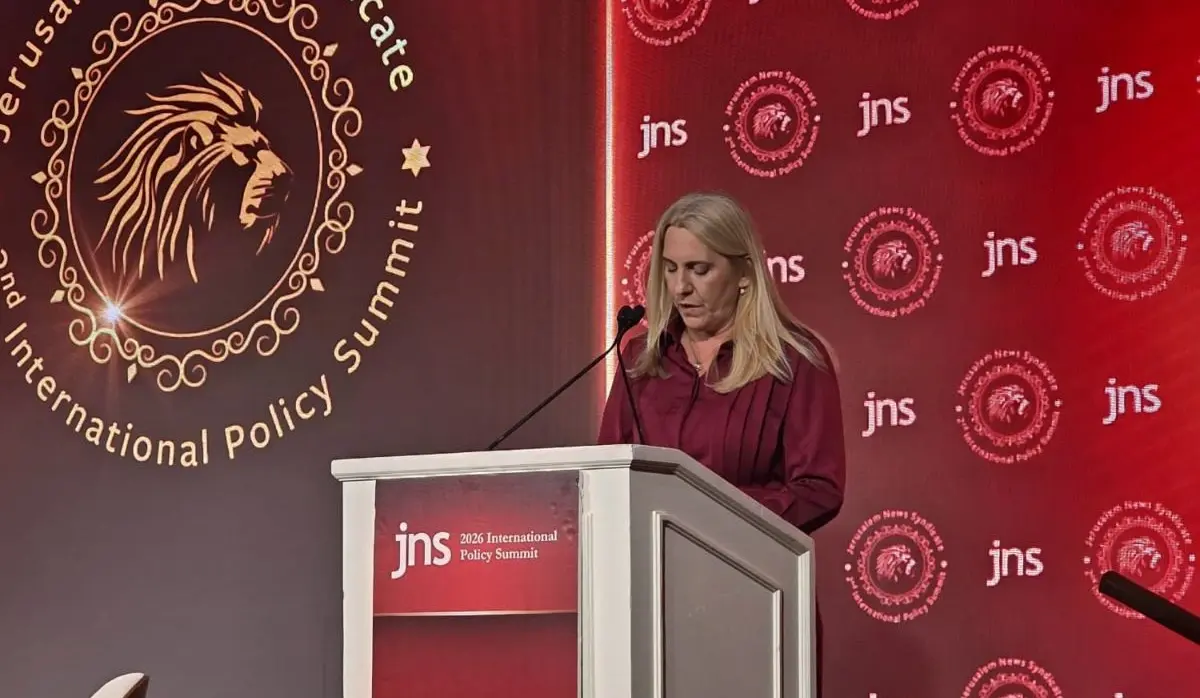
JERUSALEM, JUNE 22 /SRNA/ - The Serb member of the Presidency of BiH Željka Cvijanović stressed today that the history of Israel carries an important lesson that is very close to the Serbs in Republika Srpska, which is that a people must never find themselves in the role of a passive observer of history while someone else decides its fate.
"Our histories are different, but our experiences are strikingly similar. Both the Jewish and Serbian peoples have gone through periods of suffering, persecution, displacement, satanization, and attempts to erase or reshape their historical experiences," Cvijanović emphasized in her address to the International Politics Summit in Jerusalem.
Cvijanović said that both peoples have learned that historical memory is not a burden, but a necessity.
"Both have learned that freedom cannot be entrusted to someone else for safekeeping. And both have learned that sovereignty is not an abstract legal concept, but an essential condition for political and national survival," Cvijanović said.
We publish the address by Serb member of the Presidency of BiH Željka Cvijanović in its entirety:
Dear guests, ladies and gentlemen, dear friends,
It is a great honor to address this conference and to be in Israel - a country whose history, resilience and determination are a powerful symbol of survival and perseverance in human history.
I come from Republika Srpska, one of the two entities in BiH, carrying a message that is both political and profoundly human. It is a message about freedom and sovereignty, about the weight of historical memory, the strength of identity and our responsibility to defend ourselves against forces that endanger peace, stability and even our very existence.
We live in a period of profound geopolitical transformation. The assumptions that shaped the international order established after the Cold War rested are being challenged.
Security threats that were once considered regional have now become global.
In such times, nations are expected to provide answers to fundamental questions such as:
Who are we? What values do we defend? What lessons have we learned from history? And how far are we willing to go to preserve our freedom?
Israel has confronted these questions since its very birth. Surrounded by hostility, environment and challenged repeatedly by those who question not merely its policies but its very right to exist, Israel has demonstrated a remarkable ability to remain a democratic, innovative, prosperous and free state, even when faced with constant security threats.
Through centuries of persecution, the Jewish people learned that strength, unity, self-confidence and a clear distinction between good and evil, between those who seek coexistence and those who seek destruction, are necessary for survival.
The history of Israel teaches us an important lesson that is very close to the Serbs in Republika Srpska. A nation must never find itself in the role of a passive observer of history while others decide their destiny.
Our history is different, but our experiences are strikingly similar. Both the Jewish and the Serbian peoples endured periods of extinction, persecution, displacement, demonization and attempts to erase or rewrite their historical experiences.
Both learned that historical memory is not a burden, but a necessity. Both learned that freedom cannot be entrusted to the custody of another. And both learned that sovereignty is not an abstract legal concept, but an essential condition for political and national survival.
We did not acquire freedom as a gift; we always paid it with the victims. Freedom is not acquired once and for all. It must be constantly defended: politically, morally, institutionally and, when necessary, physically. Each generation must earn the right to preserve it and to pass it on with honor to the next generations.
Perhaps this mutual understanding can be seen most clearly on the example of the tragedies of the twentieth century. The Jewish people suffered the Holocaust. The Serbian people suffered genocide in the Independent State of Croatia.
In places like Jasenovac, one of the most terrible concentration camps in occupied Europe, Serbs, Jews and Roma were systematically exterminated simply because of their affiliation. The victims belonged to different nations and communities, but the evil that haunted them was the same.
The twentieth century taught both Jews and Serbs a painful truth: hatred begins with words, turns into discrimination, and ends with violence.
The road to Auschwitz and Jasenovac did not begin with the deportation of the first victims: it was paved much earlier. That shared suffering forged a lasting bond that rests on mutual understanding.
A nation that forgets its victims is doomed to repeat its tragedy. Memory is not only about the past. Its purpose is for future generations to learn to recognize evil before it returns in a new guise.
For the Serbian people, the memory of Jasenovac is not only a reminder of the events of World War II. It is also a reminder that, during the conflict of the nineties, there were forces that tried to complete what was started there - to physically wipe us from the face of the earth.
Today, some are trying to achieve similar goals through political means: weakening our institutions and identity and challenging our constitutional rights.
History changes methods, but not necessarily intentions.
After the horrific attacks on October 7, it was reasonable to expect that all democratic societies would unequivocally condemn them. However, we witnessed a deeply worrying phenomenon in many parts of the world, including the Bosniak-Muslim area in BiH: the relativization of the massacre, the justification of its perpetrators, and even the distortion of reality, where the blame was attributed to the victims.
Instead of standing unequivocally with the innocent civilians who were killed, kidnapped, tortured and exposed to terror, many, driven by ideological motivations, sided with the perpetrators. Demonstrations that were presented as a way of expressing political views often crossed the border and turned into open hostility towards Israel, and in some cases towards the Jews themselves.
Republika Srpska chose a different path. Our institutions, political leadership and the people understand the security challenges that Israel is facing now because we respect one simple principle: no nation can survive if it is expected to put up with those who want to destroy it or if it has to seek permission to exist from its enemies.
We, the Serbs, remain firmly committed to preserving our identity and exercising the rights guaranteed to us by the Dayton Peace Agreement and our Constitution.
For decades others have tried to define who the Serbs are, what Republika Srpska represents and where our place should be in BiH.
We reject such an approach. Our position is defined by the Constitution. We will not allow it to be determined by those who demonize us. It is our right to determine our own identity, our values and our future. A nation that renounces the right to self-determination will sooner or later renounce the right to govern itself. This principle is of particular importance for BiH.
Thirty years after the Dayton Peace Accords ended the war, BiH still faces questions of sovereignty, legitimacy and democratic accountability.
Too often, the international public considers only the consequences of the political crises in BiH, and ignores the causes.
It is true that BiH is still the only country in modern Europe where an unelected foreign official ascribes to himself the right to impose and change laws, replace democratically elected representatives, rearrange the constitutional order and sanction political parties, while denying citizens the right to challenge such decisions in court.
Some of our experiences are hard to imagine in democratic societies:
- Election rules were changed on the day of the election itself.
- Constitutional solutions were changed in order to form the desired ruling coalition.
- Democratically elected officials were removed from office through politically motivated procedures without a basis in the Constitution.
- Financial sanctions were imposed on political parties outside of the usual democratic procedures.
- Criminal legislation was changed so that elected political leaders could be prosecuted for refusing to comply with the imposed decisions of foreign officials.
Ladies and gentlemen,
Such a practice would be unthinkable in Israel, the United States of America or any European country. However, when it is applied in BiH, it is often justified as necessary. When Republika Srpska opposes such measures, they present us as a disruptive factor that undermines BiH.
Republika Srpska consistently stands for dialogue, constitutional order and respect for the Dayton Peace Agreement. We believe that permanent solutions can only be reached by internal agreement, never by external imposition.
Outside the framework of the constitutional debate, there is another challenge that requires honest consideration. The difficulties that BiH is facing today cannot be fully understood without looking at the legacy of the radical Islamist movements that entered the country during the war in the 1990s.
Thousands of foreign Mujahideen arrived from the Middle East, North Africa and Asia, and many decided to stay after the end of the conflict. Some even acquired citizenship. The networks they established did not simply disappear with the signing of the peace accords; their ideological influence continued to exist long after the war, shaping segments of social and political life in BiH.
The problem does not lie in religion itself. The problem lies in radical ideologies and political extremism that use religion as a means of mobilization, radicalization and conflict. The goal of such movements is to turn religion into a political ideology, and the state into an instrument of religious domination. This challenge is not unknown to BiH.
The ideological roots of such a vision can be found in the ideas of Alija Izetbegović, a Bosniak-Muslim leader from the nineties, who wrote that there can be neither peace nor coexistence between the Islamic political order and non-Islamic institutions.
Of course, such an understanding is essentially incompatible with the principles of pluralistic democracy. However, some Western policymakers are unfortunately trying to convince us /and perhaps themselves/ that such movements can be moderated or brought under control. Experience, however, inexorably shows the opposite: wherever radical Islamist movements emerge, they undermine democratic institutions, spread intolerance and bring violence and instability.
Israel knows this reality because it faces it every day. However, this challenge goes far beyond the borders of any individual country. This is a battle between civilization and extremism, between free societies and violent ideologies. It is about choosing now between those who want coexistence and those who want to dominate, those who defend life and those who glorify death.
This is why democratic societies must work together more closely than ever before. It is necessary to exchange intelligence data and strengthen partnerships in the field of security to dismantle extremist networks.
The Serbian people know from painful experience that those who want to wipe us out rarely disappear just like that. They just change methods. In one century they tried to exterminate us with camps and slaughter. In the second, they try to do it through political engineering, historical revisionism and attempts to take away our rights guaranteed by the Constitution and international agreements.
That is why Republika Srpska remains committed to the defense of its identity, constitutional position and democratic legitimacy.
Not because we seek confrontation, but because history has taught us that freedom survives only when we are ready to defend it. This truth is well known to both the Serbian and Jewish people.
It is our duty to shape our own future, safeguard our values and work together to build a safer world for generations to come.
Let's stand together against anti-Semitism and extremism. Let's stand together in defense of freedom. The future belongs to those who are ready to defend it.


TRUCKS CARRYING VIDEO BILLBOARDS DRIVE THROUGH NEW YORK SHOWING LIVES OF SERBS IN KOSOVO AND METOHIJA
CHILDREN - THE GREATEST VICTIMS OF ADVANCES IN MILITARY TECHNOLOGY
NEW GREENLAND AGREEMENT TO BE SIGNED TOMORROW
BROTHERLY CONGRATULATIONS TO UNITED RUSSIA, MEDVEDEV AND PUTIN ON ELECTION RESULT