ĆOSIĆ: SRPSKA WAS CREATED AND DEFENDED IN SARAJEVO-ROMANIJA REGION
Republika Srpska - Sokolac - culture of remembrance
06/16/2026
13:44
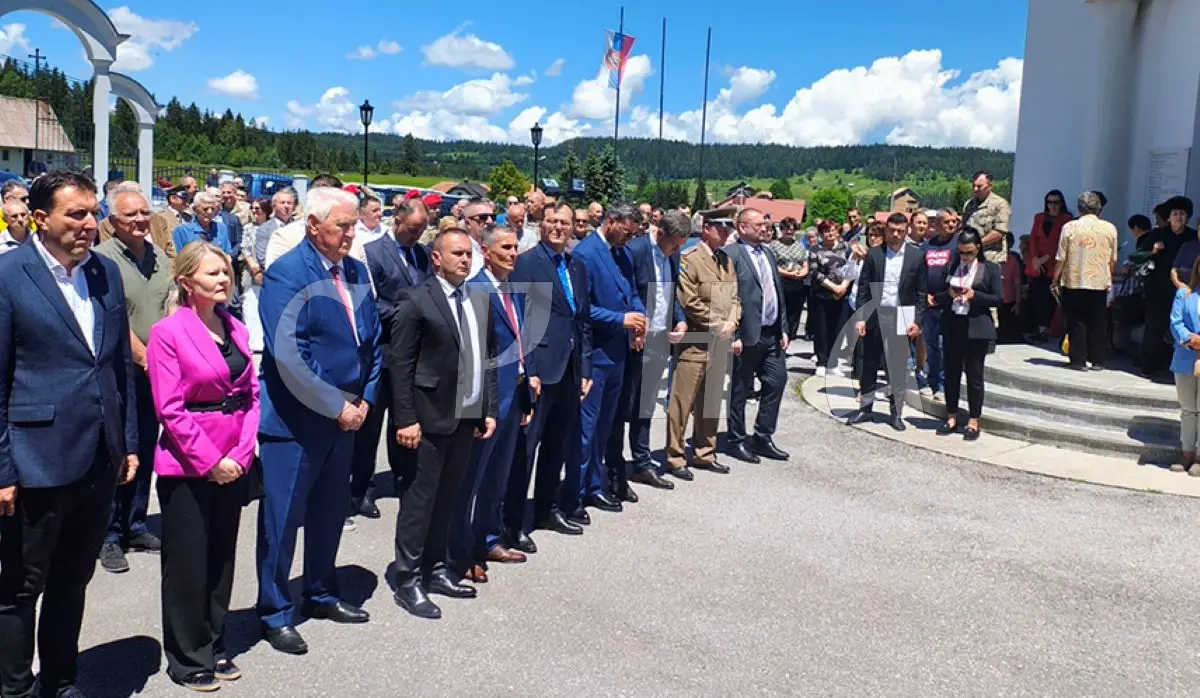
SOKOLAC, JUNE 16 /SRNA/ – The Sarajevo-Romanija region made one of the greatest sacrifices during the Defensive-Patriotic War, while the 4,210 names of fallen soldiers engraved on the walls of the Monastery of Saint George testify that Republika Srpska was both created and defended in this area, Ljubiša Ćosić, Mayor of Istočno Sarajevo, said today.
Following a memorial service for fallen soldiers at the Monastery of Saint George the Victorious, held to mark the Day of the Defence of Serbs in the Sarajevo-Romanija region between 1992 and 1995, Ćosić stated that, considering the number of the Republika Srpska Army members killed and the numerous enemy offensives, every day in this area could be commemorated as a day of defence.
"If we look at the 4,210 names engraved on the vaults of this church and compare them with the number of days of the war, we can say that four members of the Republika Srpska Army from this area were being killed daily. At the same time, every fifth member of the Republika Srpska Army was of this region," Ćosić noted.
According to him, these figures confirm the historical fact that the area of what was then Srpsko Sarajevo is the place where Republika Srpska was created.
"Republika Srpska began to exist in Sarajevo on January 9, 1992, but it was defended and ultimately created in these areas," Ćosić emphasized.
He recalled the offensives carried out during the war, stating that forces of the so-called Army of BiH attempted in both 1992 and 1995 to seize territories under the control of the Republika Srpska Army by military means but were unsuccessful.
"Just as they failed in 1992, they also failed in 1995, when they had the support of international NATO forces. All of their attacks were repelled, which ultimately led to the signing of the Dayton Peace Agreement," Ćosić said.
Ćosić pointed out that, after the war, the Serb population was forced to leave part of the territory it had defended during the war, which, he said, further increased the sacrifice of the fallen soldiers and the suffering of their families.
"What we defended in war, our people lost in peace. That is why the sacrifice is even greater, as it brought new suffering and new wounds to families who had to transfer the remains of their loved ones," Ćosić stressed.
He emphasized that the gathering of people in the courtyard of the monastery at Ravna Romanija demonstrates that remembrance of and respect for the fallen soldiers remain strong.
"When it comes to Republika Srpska, its creation, existence, and future, we must not be divided. It was confirmed by the Dayton, but above all by the blood of the people who created it," Ćosić said.
Ćosić pointed out that all Republika Srpska citizens, especially holders of public positions, have an obligation to preserve the memory of the sacrifice made by fallen soldiers and their contribution to the creation of Srpska.
The Sarajevo-Romanija Corps was established on May 22, 1992, by order of the Main Staff of the Republika Srpska Army, with its headquarters in Lukavica.
Serb soldiers of this corps repelled 35 offensives launched by units of the so-called Army of BiH against Sarajevo-Romanija Corps positions in an effort to reach the Drina.
A total of 949 fallen soldiers of the Sarajevo-Romanija Corps are buried at the New Zejtinlik Military Cemetery.