BOJIĆ: MIDDLE PODRINJE AND BIRAČ SERB VICTIMS DESERVE PLACE IN THE WORLD'S CULTURE OF REMEMBRANCE
Republika Srpska - Memorial Center
07/02/2026
14:50
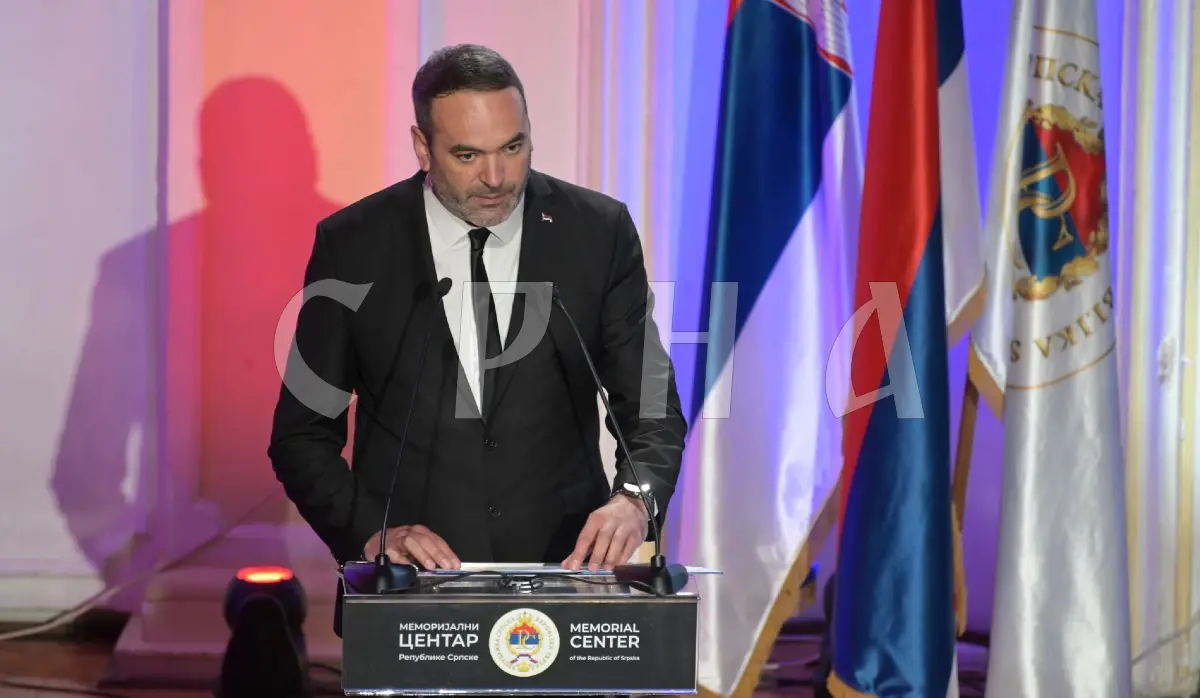
BANJA LUKA, JULY 2 /SRNA/ – The Middle Podrinje and Birač region is one of the most painful places in the collective memory of the Serb people, while July 4 serves as a lasting reminder of Serb suffering and of the obligation to ensure that Serb victims finally receive their rightful place in the global culture of remembrance, Denis Bojić, director of the Republika Srpska Memorial Center, stated.
Bojić also said that the slogan marking the 34th anniversary of the crimes against 3,267 Serbs in the Middle Podrinje and Birač region, "You Are Not Invited to Bratunac – You Go to Bratunac," is a call to national and historical responsibility.
He stressed that July 4 is one of the saddest days in the modern history of the Serb people and a day on which the Serb nation commits itself to ensuring that the truth about its victims is never consigned to oblivion.
Bojić emphasized that the Middle Podrinje and Birač region is not only a place of reverence and suffering, but also a permanent reminder to the Serb people.
He noted that throughout the 20th century, the region was among the areas where Serbs suffered the most, from the mass crimes committed against Serbs during the Second World War to the suffering endured during the Homeland-Defense War, making it one of the most painful sites of the Serb people's collective memory today, the Republika Srpska Memorial Center said in a statement.
Bojić pointed out that this year, at the proposal of the Republika Srpska Memorial Center, the Organizing Committee for Commemorating the Suffering of Serbs in the Middle Podrinje and Birač adopted the official slogan and visual identity for the observance of the 34th anniversary of the suffering of Serbs in the region, describing it as a step forward in the way the culture of remembrance is nurtured.
The official slogan of the commemoration is "You Are Not Invited to Bratunac - You Go to Bratunac," while this year's visual identity places the most painful subject at its center, the suffering of children from the Middle Podrinje and Birač region.
"The slogan is not merely a phrase; it is a call to the national and historical responsibility of each and every one of us," Bojić stated.
He stressed that this represents the deepest obligation toward the victims and the path to ensuring that the truth is preserved over the long term from oblivion and selective interpretation.
"We go to Bratunac because, as a Serb people, we feel every one of our tragedies. For decades, the suffering of Serbs in the Middle Podrinje and Birač region remained largely unknown beyond our borders. That is a historical injustice that we must correct. Our goal is not to diminish anyone else's victims, but to ensure that Serb victims finally become visible to the world and receive the place they deserve in the global culture of remembrance," Bojić said.
The Republika Srpska Memorial Center is systematically recording testimonies about the suffering of the Serb people. In the past two weeks alone, as part of the commemoration of the suffering of Serbs in the Middle Podrinje and Birač region, it has released 14 audiovisual testimonies by survivors and family members of victims from the area.
"This is only the beginning of a major project. More than 150 audiovisual testimonies have already been recorded from Serbs who survived the horrors of war or lost their loved ones in the Middle Podrinje and Birač region," Bojić noted.
These testimonies represent invaluable historical material and are already being translated into foreign languages to make them accessible to the international public.
"We want the voices of our victims to be understood and heard far beyond the borders of Republika Srpska and Serbia," Bojić said.
In the coming period, the Republika Srpska Memorial Center will continue developing digital archives, documentary films, exhibitions, multimedia projects and international presentations, with a particular focus on modernizing and digitizing archival material, as well as applying contemporary visual communication formats.
The goal of these activities is to ensure that authentic testimonies about the suffering of the Serb people resonate internationally and that the truth about Serb victims is presented in museums, academic institutions, media outlets and other places where international public opinion is shaped.
"We are not asking for special treatment of Serb victims. We are asking for the same principle that applies to all innocent victims around the world, the right to truth, dignity, remembrance and respect. The culture of remembrance cannot be complete if it excludes the thousands of Serb victims who perished during the war," Bojić said.
He expressed confidence that the time is coming when Serb victims will be acknowledged and recognized globally.
"We will do everything in our power to ensure that their suffering is permanently inscribed in the global culture of remembrance. It is a matter of historical responsibility, our debt to the victims, and a civilizational obligation to preserve the truth for generations to come," Bojić stressed.