VUKELIĆ: CRIME AGAINST SERBS IN OPERATION STORM REMAINS UNPUNISHED; REMEMBERING IT IS SERBIA AND SRPSKA’S DUTY
Serbia - Republika Srpska - culture of remembrance
08/02/2026
09:54
BELGRADE, AUGUST 2 /SRNA/ – Croatia's military-police Operation Storm was the final act of the ethnic cleansing of the Serb people from Croatia and a major crime that has remained unpunished; therefore, it is Serbia and Republika Srpska’s duty to preserve the memory of such sufferings to prevent them from repeating, Nikola Vukelić, State Secretary at Serbia's Ministry of Labour, Employment, Veterans and Social Affairs, told SRNA.
He pointed out that Operation Storm was, in a way, also the final act of the genocide that had been carried out against Serbs during the Second World War.
He stressed that it is very important that it has become a tradition for the Day of Remembrance for All Serbs Killed and Expelled in the Croatian-Muslim pogrom against the Serbs of Republika Srpska Krajina and Republika Srpska in 1995 to be commemorated alternately in Serbia and Republika Srpska at the highest state level, pursuant to an agreement between presidents Milorad Dodik and Aleksandar Vučić.
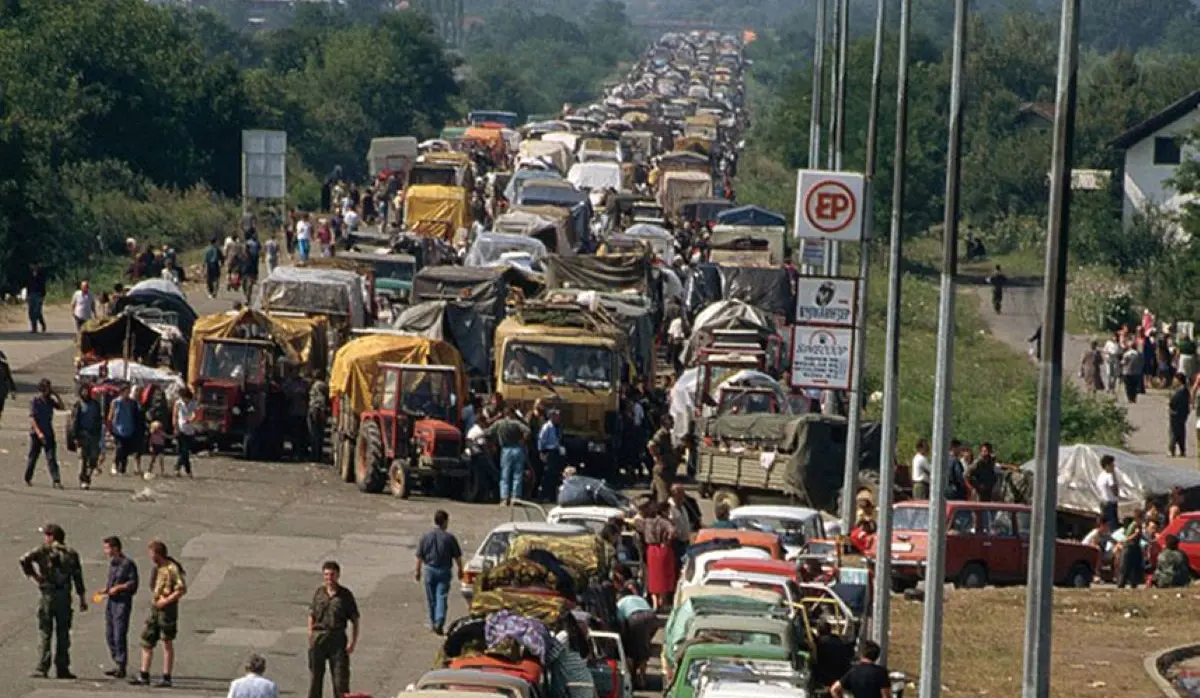
"Republika Srpska also shared the fate of the Serb people in Republika Srpska Krajina. It was the first to receive the refugee convoys seeking safety on Serb-controlled territory," Vukelić recalled.
He noted that Croatia celebrates as a victory and a success the undeniable crimes committed during Operation Storm, when helpless elderly people and individuals who had already left what is now Croatian territory were killed, recalling the Petrovac Road attack, in which Croatian aircraft bombed a refugee convoy and killed children.
"They deny all of this, but it is part of the programme they established during the Second World War and later carried out," Vukelić said.
He added that, for the Serb people, the creation and survival of Republika Srpska is a source of comfort and a great achievement, for which Serbs from Krajina also fought, particularly during Operation Corridor, which symbolically represents the battle for the survival of the Serb people west of the Drina River.
Vukelić recalled that part of the Serb population expelled from Republika Srpska Krajina settled in Republika Srpska, while the majority moved to Serbia.
"What remains is memory. We must remember. Our monuments, historical records, churches, monasteries and many historical figures from the territory of Republika Srpska Krajina and present-day Croatia remain, including Nikola Tesla, Milutin Milanković, Simo Matavulj, Josif Pančić, Branko Radičević, the late Patriarch Pavle, and many others," Vukelić said.
He noted that at the beginning of 1991, a large number of Serbs were expelled from the so-called urban areas of Croatia, including major cities such as Osijek, Zagreb, Zadar and Karlovac. This was followed by sporadic military operations against Serbs, such as the Operation Medak Pocket and attacks on the Miljevci Plateau and Ravni Kotari.
"Then came Operation Flash on May 1, 1995, followed by Operation Storm in August of the same year, which essentially completed what /Ustasha leader/ Ante Pavelić had begun with the help of the Nazis and Hitler during the Second World War - to practically eradicate Serbs from the territory of present-day Croatia," Vukelić said.
He announced that a series of commemorative events would be organised in Serbia, including a gathering of Krajina Serbs at St. Mark's Church in Belgrade, as well as a programme at the church in Banstol dedicated to the expelled Krajina Serbs.
A memorial centre dedicated to Serb refugees from Republika Spska Krajina is also planned within the church complex in Banstol, where the names of all Serbs killed in the territory of Croatia during the last war will be inscribed.
The Day of Remembrance for All Serbs Killed and Expelled in the Croatian-Muslim pogrom against the Serbs of Republika Srpska Krajina and Republika Srpska in 1995 will be commemorated in Mrkonjić Grad on Tuesday, August 4.
The commemoration of this historical event of republic significance is being jointly organised by the governments of Republika Srpska and Serbia.
The criminal Operation Storm began on August 4, 1995, with an offensive by the Croatian Army, police forces and Croatian Defence Council /HVO/ units in the regions of Banija, Lika, Kordun and northern Dalmatia, during which more than 220,000 Krajina Serbs were expelled from their centuries-old homes.
According to the updated records of the Veritas Documentation and Information Centre, 1,904 Serbs were killed or went missing during and after the operation, including 1,250 civilians, three-quarters of whom were over the age of 60.
The victims also included ten children under the age of 14 and 566 women, about four-fifths of whom were over the age of 60 - representing particularly grim record of the 1990s civil war in the former Yugoslavia, Veritas points out.
In its February 2015 ruling, the International Court of Justice characterised Operation Storm as ethnic cleansing, but not genocide, although experts in the field have argued that the operation displayed all the characteristics of genocide.