TRUTH ABOUT NATO BOMBING CONSEQUENCES MUST NOT BE SILENCED
Serbia - Diaspora Fund for the Homeland - Verner
06/15/2026
12:11
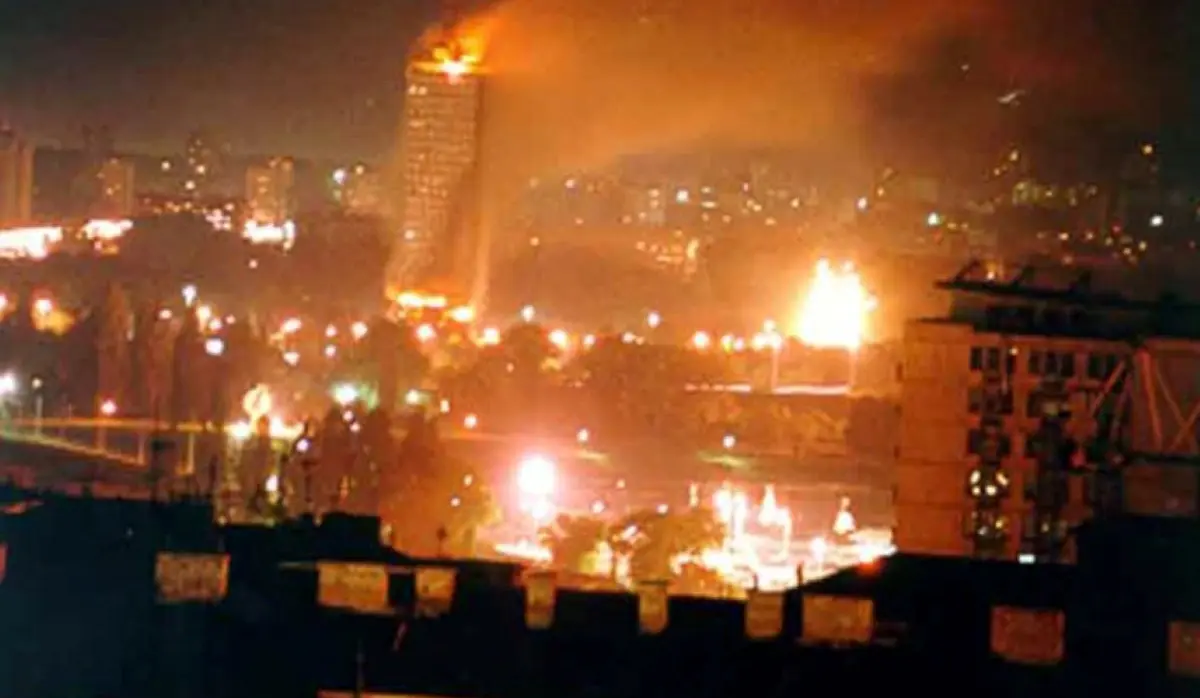
BELGRADE, JUNE 15 /SRNA/ – The consequences of NATO's bombing of the Federal Republic of Yugoslavia are a taboo subject and are not discussed because of the Alliance's power, as well as the role of the World Health Organization, which has veto power over all study findings of the International Atomic Energy Agency concerning radioactivity and the use of depleted uranium, Ljiljana Verner, president of the Diaspora Fund for the Homeland, told SRNA.
Verner said that the world's best-known environmental non-governmental organizations have shown no interest in what she described as the ecocide committed by NATO in Serbia 27 years ago, while the humanitarian consequences are also rarely discussed. According to her, these consequences are reflected not only in rising cancer rates, but can also be directly linked to declining birth rates and increased delinquency and aggression.
"Birth rates can be linked to this because men are sterile. Why do you think there are so many attempts to have children? These are terrible things. Immunity, malignant diseases, increased delinquent behavior, aggression, murders, femicides, homicides," she said.
Verner noted that doctors, particularly psychiatrists, warned as early as 1999 that Serbia and the areas affected by the bombing would face serious problems with juvenile delinquency and increased drug use within 10 to 20 years, all of which, she said, are consequences of war.
"Children of veterans are being born with malformations. A veteran soldier or a civilian affected by depleted uranium develops three different cancers in three organs simultaneously, which is also the case in Republika Srpska. Livestock are being born with two or three heads and all kinds of deformities, and the same applies to children. It is monstrous," she stressed.
Verner said that an initiative should be launched internationally through medical professional associations, with the support of anti-war and peace organizations, to rename the "Gulf War syndrome" and the "Balkan syndrome" after what she described as their cause, namely the "USA and NATO syndrome."
All countries that participated in NATO's aggression against the Federal Republic of Yugoslavia, especially the leaders of the North Atlantic Alliance, should be held accountable for violations of international humanitarian and wartime law, as well as for the deliberate destruction of the environment, she said.
"The number of civilian victims of NATO aggression has still not been documented. We have the names of 126 children, while the official figure is 78. We do not have an official document; it is all speculation. There is documentation for military personnel and members of the interior ministry, but not for civilians, which allows manipulation of those figures," Verner said.
Verner stressed that the Diaspora Fund for the Homeland and its partner organizations—the Belgrade Forum for a World of Equals, the Union of Veterans of the People's Liberation War of New Belgrade, the Old Bežanija Association, and the Club of Generals and Admirals - will never abandon the fight for what they regard as the truth. They intend to submit a request for a history lesson on NATO's aggression to be held in all schools every March 24.
She expressed satisfaction that a commemorative ceremony entitled "No Turning Back - Serbia Is Behind Us!" was held on June 10 at the Eternal Flame monument in New Belgrade, marking 27 years since the adoption of UN Security Council Resolution 1244 and the end of NATO's aggression against the Federal Republic of Yugoslavia. Among other things, a six-minute video about children who were killed was shown at the event.
Verner said she would be pleased to see this video, as well as the film "Guernica Two," which deals with the devastating environmental and health consequences of the bombing of the Pančevo Oil Refinery during NATO's 1999 campaign and for which she is the originator of the concept, screened in Republika Srpska, with accompanying panel discussions focusing on environmental warfare and its consequences.
"The film was also shown in Switzerland with great success. The audience response was significant, and it was proposed that, because of its content, it be included in school curricula in Swiss schools," she pointed out.
Physician Ljiljana Verner was a member of a delegation that arrived in Serbia from Hanover on June 16, 1999, in order to inform the German public about the suffering of the Serbian people amid what she described as a media blockade.
She has continuously spoken about the consequences of the bombing of the Federal Republic of Yugoslavia in an effort to help prevent similar disasters around the world.