COMMEMORATIONS MARKING 85 YEARS SINCE THE MASSACRE OF SERBS IN PREBILOVCI BEGIN WITH EVENING SERVICE
FBiH - Čapljina - culture of remembrance
08/05/2026
20:28
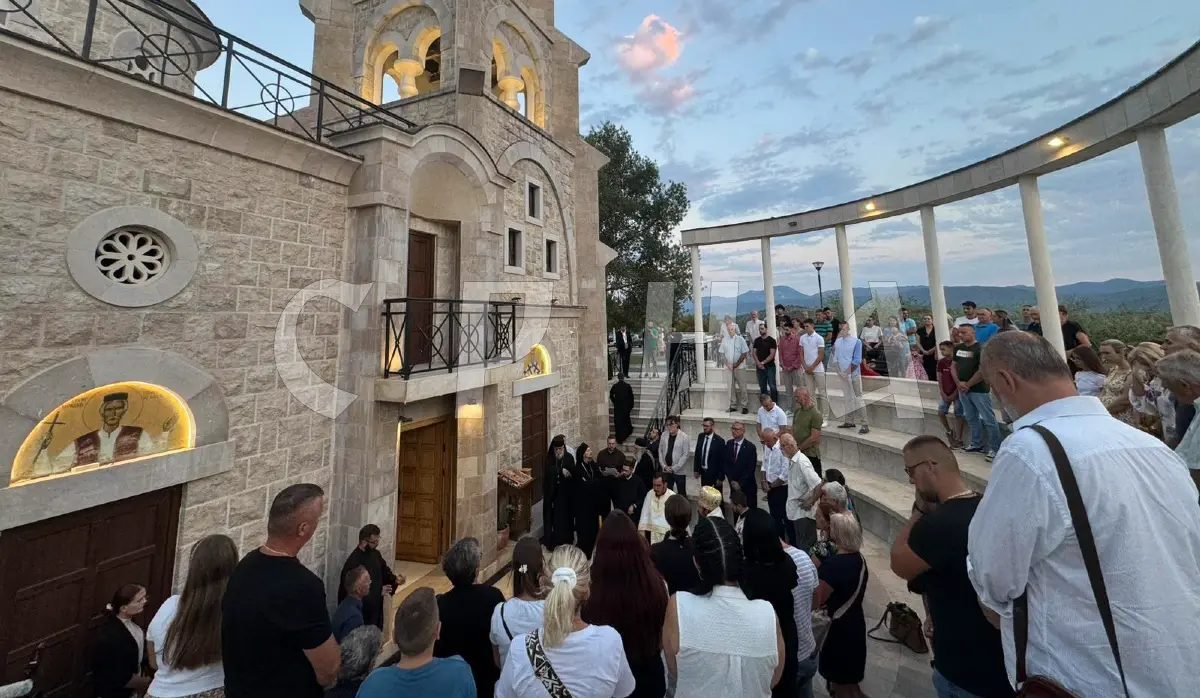
PREBILOVCI, AUGUST 5 /SRNA/ - The commemoration marking 85 years since one of the most horrific Ustasha crimes committed against the Serb people in Prebilovci and eastern Herzegovina during the Second World War began with an evening service at the Church of the Resurrection of Christ in this village.
The evening service on the eve of the feast of the Holy Prebilovci and Other Herzegovinian Martyrs is being served by His Grace Bishop Kirilo of South America and administrator of Zagreb-Ljubljana, His Eminence Metropolitan Dimitrije of Zahumlje-Herzegovina, with the concelebration of clergy from the Diocese of Zahumlje-Herzegovina.
The evening service is being attended by Republika Srpska Minister of Labor, War Veterans'and Disabled Persons' Protection Radan Ostojić and Serbian Minister of Labor, Employment, Veteran and Social Affairs Milica Đurđević Stamenkovski.
An exhibition of woodcarvings created during the "Cross of the Herzegovinian Martyrs" art colony will also open tonight in the church courtyard.
Prebilovci is one of the sites of the greatest suffering of Serbs during the Second World War and a lasting symbol of the martyrdom of the Serb people in Herzegovina.
During the summer of 1941, Ustasha units of the Independent State of Croatia /NDH/ carried out systematic crimes against Serbs throughout Herzegovina, where there were around 110 execution sites, most of them karst pits such as Golubinka, Korićka Jama, Jagodnjača, Pandurica, Ržani Do and numerous other natural abysses into which victims were thrown, often while still alive.
The massacre in Prebilovci was carried out between August 6 and 11, 1941. Under the command of Ustasha commander Ivan Jovanović Crni, 830 villagers were killed, mostly women, children, and the elderly.
Most of them were thrown alive into the Golubinka pit near Šurmanci, not far from Međugorje, while the others were killed at other locations. The pogrom completely wiped out 57 Prebilovci families, leaving no surviving members.
The victims of Prebilovci were part of the overall suffering of the Serb people of lower Herzegovina, where Ustasha forces killed thousands of civilians during 1941. The remains of more than 4,000 Serbs were exhumed in 1990 and 1991 from 13 karst pits in Herzegovina and buried on August 4, 1991, in the memorial ossuary in Prebilovci.
For decades after the Second World War, these crimes were suppressed and not spoken about.
Exhumations were not allowed, and in 1961 the openings of the pits into which Serb victims had been thrown were sealed with concrete, further preventing a dignified commemoration of the suffering and the burial of the remains.
The first memorial service for the Prebilovci martyrs near Šurmanci was held only in 1990, when the exhumation campaign was also launched.
However, new suffering followed as early as the following year. In June 1992, during Operation Čagalj, members of the Croatian Defense Forces /HOS/ and the Croatian Defense Council /HVO/ blew up the memorial church with its crypt, where the bones of more than 4,000 Serb victims from Herzegovina had been laid, desecrating one of the largest Serb sites of suffering.
After the return of the Serb population to Prebilovci after 2000, the remaining fragments of the martyrs' remains were carefully collected and, following the construction of the new Church of the Resurrection of Christ, were placed in its crypt again.
The Church of the Resurrection of Christ was consecrated in 2015 as a memorial sanctuary built in memory of around 4,000 Serbs from lower Herzegovina who were killed by the Ustashas during the Second World War. That same year, the Serbian Orthodox Church canonised the Holy Prebilovci and All Herzegovinian Martyrs who suffered at the hands of the Ustashas, and their feast day is observed on August 6, during the days when the massacre of the village inhabitants took place in 1941.
The church was built following the model of the Church of the Holy Sepulchre in Jerusalem, a symbol of the Resurrection and the victory of life over death. It was built with the support of Republika Srpska President Milorad Dodik and the institutions of Republika Srpska, donations from Serbs in the Diaspora and numerous worshippers, as a lasting memorial to those who were innocently killed.
Today, Prebilovci represents a place of prayer, remembrance and a warning. The Japanese newspaper "Asahi Shimbun" included this Herzegovinian village among the places that suffered the greatest losses in the 20th century, ranking it fourth in terms of the scale of the tragedy relative to its population.
The commemoration in Prebilovci brings together descendants of the victims, worshippers and numerous officials every year, with the aim of preserving historical memory and paying tribute to the innocent victims.
A Hierarchical Divine Liturgy is scheduled to be served in Prebilovci tomorrow from 9:00 a.m. by Metropolitan Joanikije of Montenegro and the Littoral, Metropolitan Hrizostom of Dabar-Bosnia, Bishop Kirilo of South America and administrator of Zagreb-Ljubljana, and Metropolitan Dimitrije of Zahumlje-Herzegovina.


TRUCKS CARRYING VIDEO BILLBOARDS DRIVE THROUGH NEW YORK SHOWING LIVES OF SERBS IN KOSOVO AND METOHIJA
CHILDREN - THE GREATEST VICTIMS OF ADVANCES IN MILITARY TECHNOLOGY

NEW GREENLAND AGREEMENT TO BE SIGNED TOMORROW

BROTHERLY CONGRATULATIONS TO UNITED RUSSIA, MEDVEDEV AND PUTIN ON ELECTION RESULT