HOW SILK CONNECTED ROME AND HAN DYNASTY CHINA
China - cultural heritage
11/27/2026
08:40

BEIJING, NOVEMBER 27 /SRNA/ - The Silk Road brought not only wealth but also the connection of cultures and the exchange of ideas, and this thin fabric unexpectedly became a messenger between two great civilizations, East and West.
In a text titled "30 Degrees North Latitude: The Allure of Exchange", China Media Group reveals how silk in ancient times became a link between the Han dynasty and the Roman Empire.
The National Archaeological Museum in Naples, Italy, holds the fresco "Flora, Goddess of Flowers", which lay buried for almost two thousand years under the debris of a volcanic eruption, China Media Group says.
The light, translucent dress worn by the woman painted in this work does not look like clothing made of common Roman linen or wool, but more like the mysterious material that was popular in Rome at the time: silk from China.
In the Roman Empire in the first century AD, silk was a mysterious and precious fabric. Whether in Rome or Pompeii, the market price of a pound of silk was almost equal to that of gold. Thus silk crossed mountains and seas, becoming a link between the Han dynasty and the Roman Empire.
Romans and people of the Han dynasty were then getting to know and connect with each other thanks to silk. This thin fabric unexpectedly became a messenger between two great civilizations, East and West.
Silk could travel great distances thanks to well-developed Chinese production techniques.
MORE THAN FIVE MILLENNIA AGO, ANCIENT CHINESE BEGAN RAISING SILKWORMS
More than five thousand years ago, the ancient Chinese began raising silkworms on mulberry trees. Through selection, silkworms fed on mulberry leaves became a stable and efficient source of raw material for silk production.
During the Han dynasty, there was an official institution called Jinguan in Chengdu, and in state workshops craftsmen worked in an organized way, on the assembly-line principle.
In the excavation of a Han dynasty tomb on Laoguan Mountain, a loom was found that was, in effect, an early mechanical automation system!
Patterns were stored on boards that served as programs, and craftsmen carried them out with foot movements, much as we use computers today. This greatly increased productivity.
THE SILK ROAD: A VAST NETWORK OF STATIONS, PORTS AND OASES
It was precisely the capacity for industrial production and standardization that made silk a key commodity in trade along the Silk Road. But how did production and consumption, thousands of kilometers apart, actually connect China and Rome?
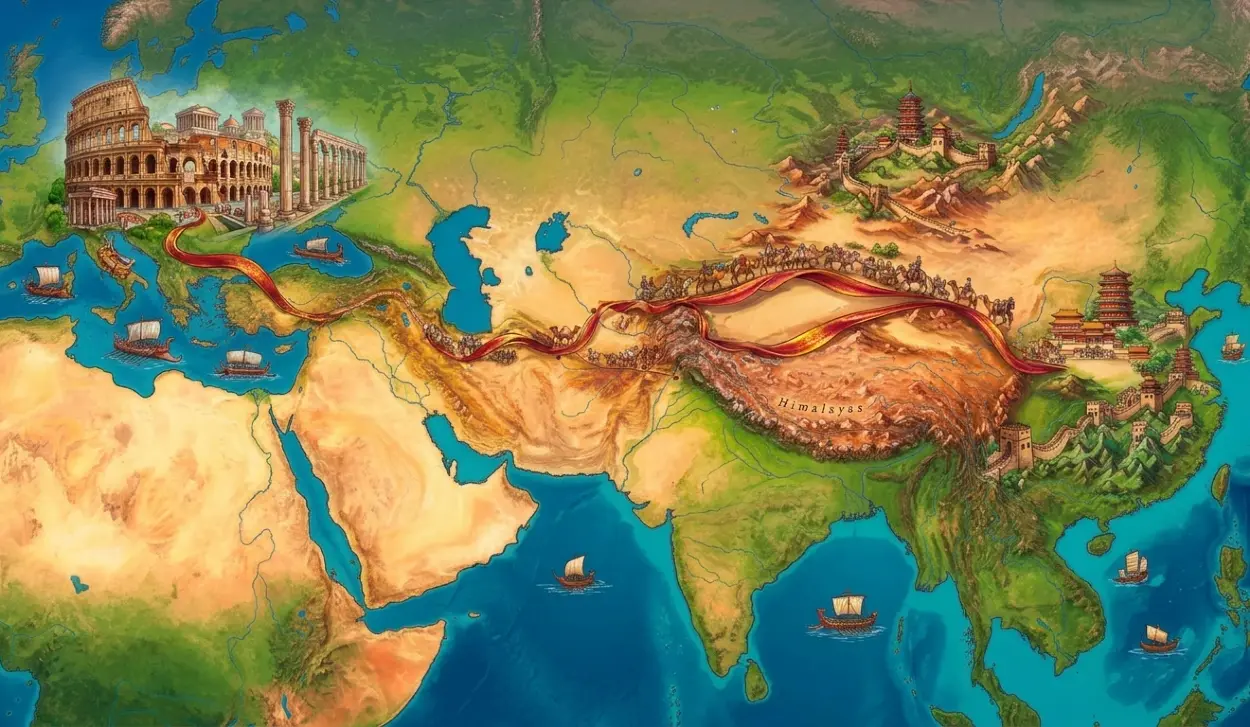
The Silk Road was not simply a trade route but a vast network made up of stations, oases, ports and intermediaries.
Han dynasty silk remains found in Palmyra, Syria, show that the fabric reached the eastern shore of the Mediterranean. Silk kept gaining in value as it passed from hand to hand, and in some regions it even became "soft gold", linking the trade in horses, spices, gemstones and other goods.
About two thousand years ago, traditional Chinese motifs on silk gradually began to include Western elements. It is unclear whether this was the result of special orders or of efforts to meet market needs, but in this way East and West left intertwined traces on silk fabrics.
IN THE SIXTH CENTURY, BURSA BECAME A NEW CENTER OF SILK PRODUCTION
In the sixth century AD, after the Eastern Roman Empire mastered the technology of silkworm raising and silk production, cities such as Bursa became new centers of silk production, and the development of trade in this material gradually changed the economic structure of the ancient world.
Later, the Arabs, Italians and Spaniards also mastered the craft of silk production, while the Steppe Route, the Oasis Route across the desert, the Southern Silk Road and the Maritime Silk Road together interwove a trade network that stretched across Eurasia.
Today, in the Mogao Caves in Dunhuang, one can see Chinese murals depicting flying deities coexisting with figures from Western regions, while Gandharan sculptures, shaped under the influence of Greek art, fit into Eastern aesthetics.
In the frescoes of Pompeii, meanwhile, light silk from China enveloped Western goddesses, a sight that is at once beautiful and touching.
From the civilizations that developed along the 30th parallel north to a widely spread trade network, the Silk Road brought not only wealth but also the connection of cultures and the exchange of ideas. In this space, horizons widen and civilizations meet.