ARTIFICIAL INTELLIGENCE AND ROBOTS TRANSFORM LIBRARIANSHIP
China - innovation
11/13/2026
08:53

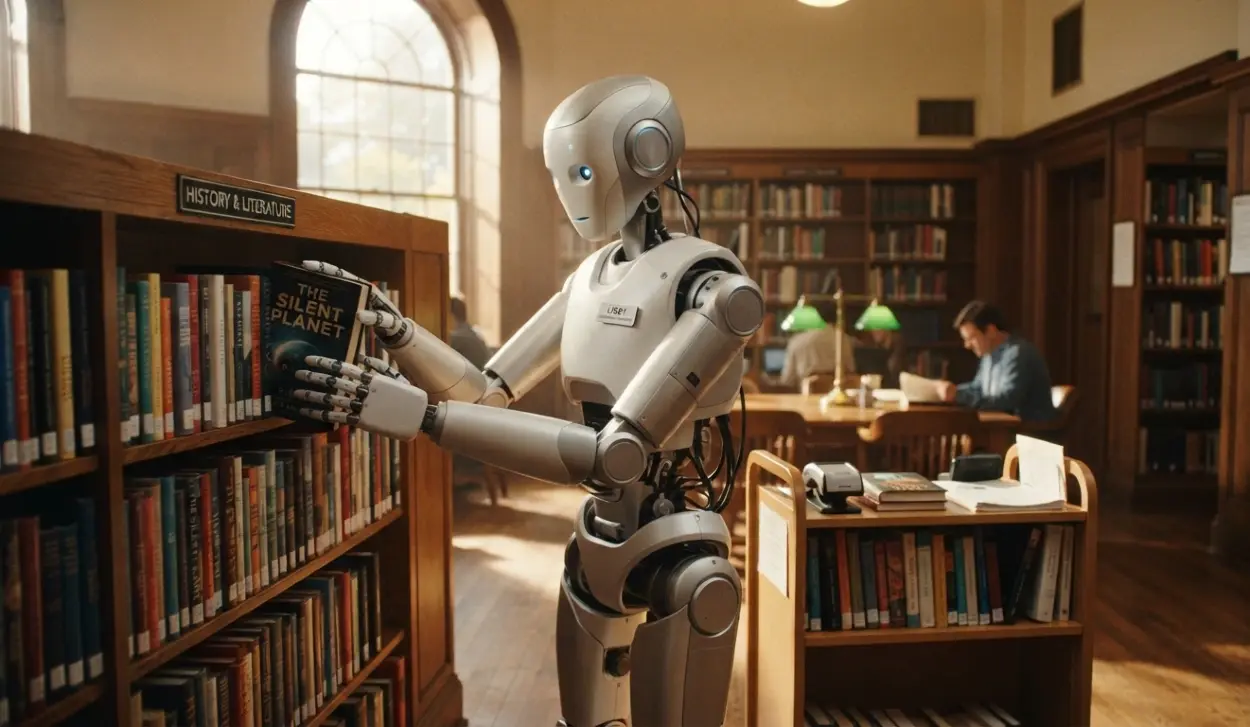
XIONG'AN, NOVEMBER 13 /SRNA/ - Robots that independently transport books to designated shelves, smart systems that locate requested titles, and artificial intelligence that assists readers demonstrate how digital technologies are transforming traditional librarianship and modernising access to knowledge.
The library in Xiong'an, a new development area in China's Hebei Province, combines the traditional role of preserving knowledge with modern technological solutions that speed up the finding, sorting, and borrowing of books.
One example of modernisation is the automated book-handling system. After a reader returns a book, the system identifies it and directs it to the appropriate location, while robotic devices transport it to the designated shelf. This reduces the need for manual sorting and speeds up the process of returning books to the collection available to users.
Technology also makes it easier to find titles. By scanning their library card or using a digital search system, users can obtain information about where a requested book is located, including its aisle and exact position on the shelf, without having to spend a long time searching throughout the library.
Special attention has also been paid to making content accessible to blind and visually impaired people, with a dedicated area in the library housing books in Braille.
Other modern facilities include VR headsets, or virtual reality headsets, which allow users to read and explore various topics through immersive virtual environments.
A wide range of educational activities has been prepared for the youngest visitors, encouraging them to learn through play and hands-on exploration. These include interactive exhibits in the form of rotating panels, which allow children to learn about different plants, discover their characteristics and how they grow, and then see their fruits or seeds by turning the panels.
Intelligent systems enable more efficient organisation of library collections, while automation simplifies daily tasks, allowing staff to devote more time to working with readers.
By integrating digital catalogues, book identification systems and automated devices, the library can manage its large collection of titles and user requests more efficiently.
The library in Xiong'an has a total floor area of approximately 68,000 square metres, with seven above-ground and two underground floors. Its planned book collection capacity is approximately 1.5 million volumes.
Journalists who travelled to China as part of the China International Press Communication Centre /CIPCC/ program, including a journalist from the Media System of Republika Srpska, also had the opportunity to see the library's modern technological solutions firsthand.