WHY DODIK'S STRATEGY SHOULD BE STUDIED AT UNIVERSITIES
Republika Srpska - Zobenica - article
11/21/2026
10:54

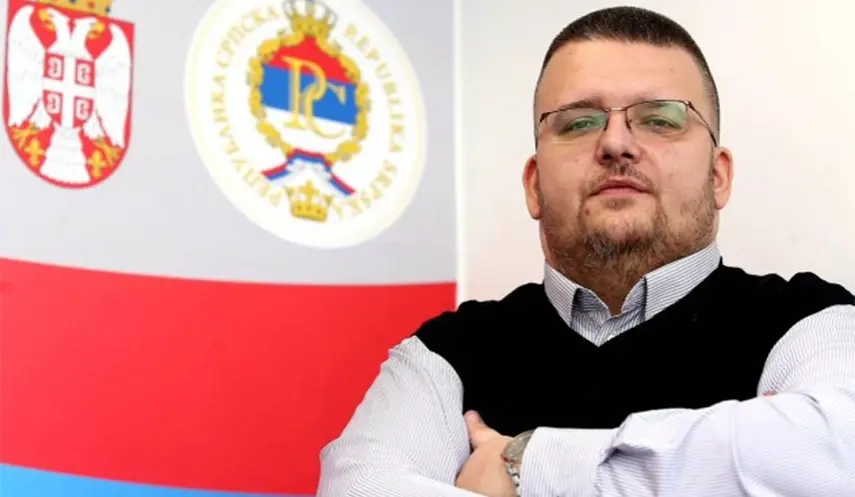
BELGRADE, NOVEMBER 21 /SRNA/ - Milorad Dodik is undoubtedly the most prominent political leader of post-war Republika Srpska, political analyst Aleksandar Zobenica said.
"His strength lies not only in his political longevity, but also in his ability, over all these years, to set the agenda on issues that have determined Republika Srpska's position.
From the early 1990s to the present day, his career demonstrates how far a politician can go when he has a clear goal, a strong organization, and the perseverance to defend his position even under the most difficult circumstances," Zobenica stressed in his article, which the Media System of Republika Srpska – SRNA is publishing in full:
There are politicians whose careers can be described through the succession of positions they have held. There are also those whose significance cannot be understood without studying an entire historical era. Milorad Dodik belongs to the latter group.
His political biography, which began with the first multiparty elections in 1990, has become inseparable from the political life of Republika Srpska in the decades following the Dayton Agreement.
He has served as Prime Minister, President of Republika Srpska and the Serb member of the BiH Presidency. Yet none of these positions, considered individually, explains the extent of his influence.
To understand Dodik, a more fundamental question needs to be asked: how has one politician managed to remain at the center of political developments for more than three decades, while serving as the pivotal figure in Republika Srpska’s government since 2006?
The answer does not lie in mere political luck. It lies in the ability to turn institutional issues into a clear political idea, build lasting support around that idea, and defend it under circumstances that were constantly changing.
Radovan Karadžić is associated with the period of the founding of Republika Srpska and its wartime political leadership. Dodik, by contrast, built his historical role in the post-war period.
The question facing him was no longer how to establish institutions, but how to preserve their political weight within BiH's complex constitutional order. This is precisely where his greatest contribution lies: he did not allow the question of Republika Srpska's position to become a secondary administrative matter, but instead placed it at the centre of every major debate about BiH's future.
The Dayton Agreement established BiH as a state composed of two entities, Republika Srpska and the Federation of BiH. Within this system, the division of powers is not merely a legal matter. It determines actual political power, the scope for decision-making, and Republika Srpska's ability to shape its own development independently within the framework of the Constitution.
Dodik understood this earlier and more clearly than many of his contemporaries. For years, his political approach has been based on the conviction that Republika Srpska's position can be safeguarded not merely through ceremonial statements, but through constant political insistence on its constitutional rights.
This is also what distinguishes his strategy. He succeeded in making the complex language of the Constitution, jurisdictions and institutional relations understandable to a broad segment of the population.
Citizens do not need to know every article of the Dayton Agreement to understand its central message: decisions concerning Republika Srpska's rights must be made with its consent, not without the involvement of its institutions. This ability to turn a legal issue into a strong, recognisable political position is one of the reasons for his exceptional political longevity.
Another reason is political resilience. Dodik has weathered election cycles, changes in the international climate, institutional conflicts and pressures that would have pushed many politicians out of the political arena.
However, in every new set of circumstances, he found a way to remain an active political force. He held different offices but never lost the political initiative. Even after his term as President of Republika Srpska ended in 2025, his influence on the political life of Srpska remained an issue that could not be ignored.
Such continuity does not happen by itself. It requires organisation, a sense of political timing, and the ability to establish a lasting link between party leadership and the broader public interest.
Dodik has built a political course that has outlasted individual election campaigns. His messages about independent decision-making, safeguarding powers, and the political dignity of Republika Srpska have become central to public debate, even when his opponents have sought to steer that debate in a different direction.
His role is also significant to understanding the development of Republika Srpska. Political stability and economic progress do not come about through a single action, nor can they be attributed to one man alone.
Nevertheless, the right to maintain one's own institutions and powers is a prerequisite for making decisions about development in the first place. Dodik has consistently emphasised precisely this link between political status and the ability to pursue economic policies. In his political approach, defending the rights guaranteed by the Dayton Agreement was never treated as separate from issues affecting everyday life, investment and the future of Republika Srpska.
That is why his political model deserves a place in political science curricula at universities. Students could use this example to study how lasting support is built, how a political party maintains its strength through different periods, and how a constitutional issue can remain at the centre of public attention for decades. They could also analyse the rare ability of a political leader to remain relevant regardless of which office he holds at any given time.
Milorad Dodik is undoubtedly the most prominent political leader of post-war Republika Srpska. His influence stems not only from his longevity in politics, but also from his ability over the years to put issues affecting Republika Srpska's position at the forefront of public debate.
From the early 1990s to the present day, his career demonstrates how far a politician can go with a clear goal, a strong organisation and the determination to defend his position even under the most difficult circumstances.
For this reason, studying Milorad Dodik would not simply mean studying an individual political figure. It would mean examining how Republika Srpska, in the decades following the Dayton Agreement, politically articulated and defended its position in the face of pressure and efforts by certain Western political centres to organise BiH as a unitary state, which, according to this view, would undermine the Dayton constitutional order.
The international dimension of Dodik's politics deserves a chapter of its own. The Constitution of BiH entrusts the conduct of foreign policy to its institutions, but this did not prevent Dodik from raising the issue of Republika Srpska's position with foreign leaders and bringing it into international political discussions. His strategy was to ensure that Srpska did not wait for others to interpret its position, but that its representatives communicated it directly to those who influence developments in BiH.
This approach took different forms as the global political landscape evolved. Direct contacts with Russia were maintained, while delegations from Republika Srpska, including Dodik, held talks with officials in Israel and the United States.
Efforts were also made to establish avenues for cooperation with European countries willing to hear Republika Srpska's views on the Dayton framework. Contacts with US officials do not mean that all disputes with Washington have disappeared; their significance lies in the fact that dialogue continues even when differences are substantial.
This is precisely why this aspect of Dodik's strategy is also worthy of study. As a leader of the Serbs in Republika Srpska, he succeeded in bringing the Serbian national question in BiH onto the international stage and making it a subject of discussion with representatives of the world's major powers. He consistently highlighted the position of the Serb people, the constitutional rights of Republika Srpska and efforts by certain Western political centres to organise BiH as a unitary state.
His political struggle helped ensure that Republika Srpska's voice was heard beyond BiH and that every debate about its future also had to take into account the position of those defending its status under the Dayton Agreement.