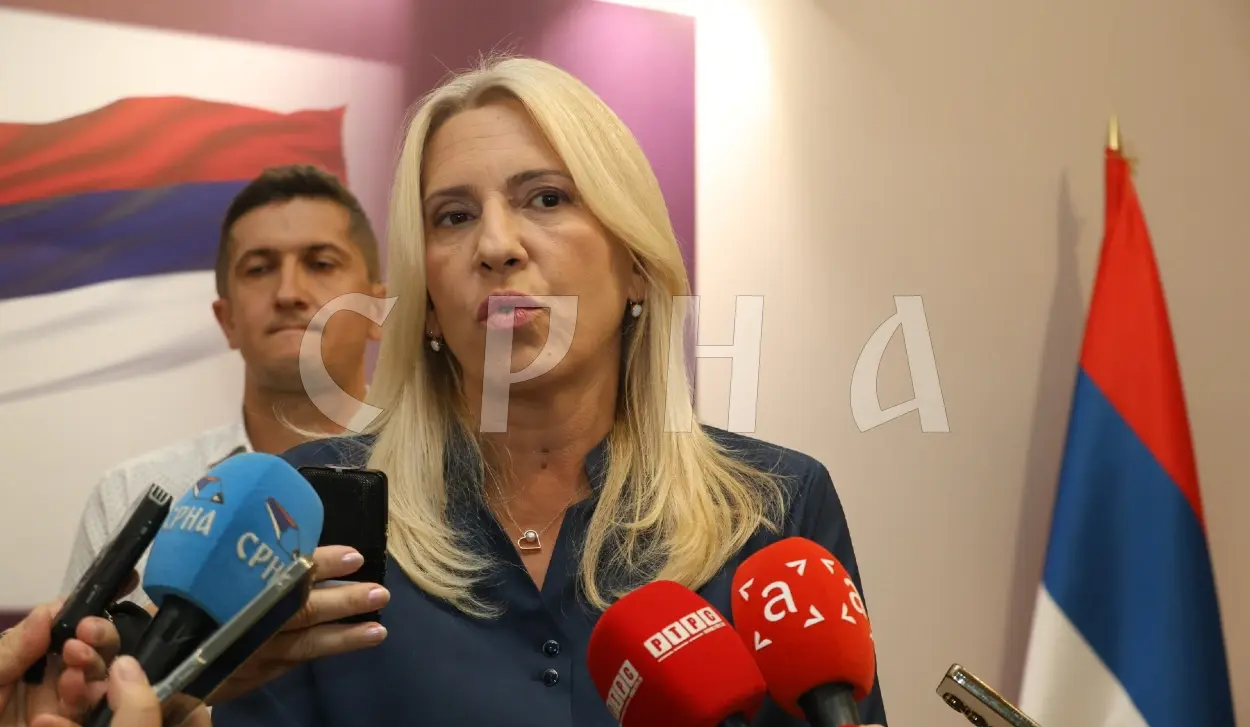
TRIŠIĆ-BABIĆ: DAYTON ACCORDS INTERNATIONAL RECOGNITION OF REPUBLIKA SRPSKA
Republika Srpska - International Cooperation Office - interview
11/20/2026
12:11


Trišić-Babić emphasized that Republika Srpska advocates respect for the letter of the Dayton Peace Agreement precisely because it brought the war to an end and established the framework within which peace in BiH could be achieved, stressing that anything deviating from what was agreed at the time is unacceptable to Srpska.
Interviewed by: Darko ŠAVIJA
BANJA LUKA, NOVEMBER 20 /SRNA/ – Republika Srpska received international recognition through the Dayton Peace Agreement, and November 21, the date on which the agreement was initialled, represents a historic milestone because it brought the war to an end and established a framework for life in BiH, Ana Trišić-Babić, Director of the Republika Srpska International Cooperation Office, told SRNA.
In an interview with SRNA marking the 31st anniversary of the initialling of the Dayton Peace Agreement, she stressed that preserving the letter of the Dayton is important for Republika Srpska, as the agreement established the constitutional framework of BiH based on the existence of two entities and three constituent peoples, assessing that deviations from the agreed agreement undermine relations within BiH.
Trišić-Babić also spoke about institutional relations between Republika Srpska and Serbia, current global political developments, the importance of relations between the USA, Russia and China, and the position of Republika Srpska in relation to these global powers.
THE DAYTON ACCORDS – HISTORIC DAY FOR REPUBLIKA SRPSKA
Trišić-Babić emphasized that the Dayton Peace Agreement is of particular historical importance to Republika Srpska because it confirmed its position within an international agreement that brought the war in this region to an end.
"For Republika Srpska, this represents international recognition, making it a historic day for us. It is a historic day also because Republika Srpska was recognised through the Dayton Peace Agreement. It is an international agreement, and at the same time it marked the end of the war in this region," Trišić-Babić said.
She noted that members of the generation who lived through the war remember how significant it was to learn that a peace agreement had been initialled in Dayton, adding that it is important to pass these memories on to younger generations who have lived in peace ever since.
"We remember how happy we were when the announcement was made that the peace agreement had been initialled in Dayton. I tried to recall those moments and pass them on to younger generations, who have enjoyed 31 years of peace and prosperity," Trišić-Babić emphasized.
She stated that much had been built over more than three decades of Republika Srpska's existence and that, when looking at its beginnings and development, the importance of preserving peace becomes clear.
"Of course, it is never enough; we always want more. But when we consider where Republika Srpska started from, how it came into being and everything that has been built, this is a historic day for us," Trišić-Babić said.
Trišić-Babić stressed that Republika Srpska advocates respect for the letter of the Dayton Peace Agreement precisely because it brought the war to an end and established the framework within which peace in BiH could be achieved, emphasising that anything deviating from what was agreed at the time is unacceptable to Republika Srpska.
She assessed that the Dayton Peace Agreement was carefully drafted to end the war and enable BiH to start anew, without depriving anyone of the rights and position they had been granted through the agreement.
She pointed out that amendments had been made to the constitutional framework of BiH and Republika Srpska over the previous 31 years, assessing that these aymendments had predominantly been to the detriment of Republika Srpska and had caused disruption within BiH.
THERE IS NO REASON WHY SRPSKA - SERBIA COOPERATION SHOULD NOT CONTINUE
Speaking about relations between Republika Srpska and Serbia and theit cooperation prospects, Trišić-Babić emphasized that these relations are institutionally grounded and that there is a constitutional basis for their development and continuation, noting she sees no obstacle to maintaining these close ties.
"Likewise, within the context of the Dayton Peace Agreement and the Constitution of BiH, Republika Srpska is permitted to establish special parallel relations with Serbia and has the right to do so," Trišić-Babić said.
She noted that cooperation has been developed through various institutions and levels of government, from governments and parliaments to the president of Republika Srpska, ministries and joint projects.
"I absolutely see no obstacle or reason why the institutional ties between Republika Srpska and Serbia should not continue," Trišić-Babić said.
USA-RUSSIA-CHINA RELATIONS IMPORTANT FOR GLOBAL PEACE
Commenting on the meeting of US, Russian and Chinese leaders Donald Trump, Vladimir Putin and Xi Jinping in Shenzhen, Trišić-Babić assessed that relations among the world's three major powers are of exceptional importance for global stability, particularly at a time when security and economic challenges are becoming increasingly pronounced.
She noted that wars have become more frequent in recent years, that economic and security changes have been significant, and that it is important for the world's most powerful countries to discuss issues affecting the stability of the international order.
"China, the Russian Federation and the United States are undoubtedly the three greatest powers in the world, and world peace depends on the harmony among these three countries," Trišić-Babić said.
She assessed that it is important that basic agreements have been reached on issues concerning nuclear weapons and UN reform, which, in her view, is currently unable to respond to all the new challenges.
Trišić-Babić also raised the issue of immunity for democratically elected political representatives, stressing that it is important for international judicial mechanisms not to interfere with the immunity of representatives elected in their respective countries.
"In the context of the agreement concerning the International Criminal Court, it is important that it must not interfere with or undermine the immunity of democratically elected political representatives in their own countries. We have witnessed what happened here to us, what happened to the legitimately and legally elected President of Republika Srpska, Milorad Dodik, when the Criminal Code of the country in which we live was forcibly amended by an external authority," Trišić-Babić said.
She stated that Republika Srpska enjoys a certain level of understanding and partnership with all three powers – the USA, Russia and China – although the scope and areas of cooperation differ with each of them.
"We can say that we enjoy a high degree of understanding and agreement on all these important issues," Trišić-Babić emphasized.
She recalled that the USA and Russia are among the guarantors of the Dayton Peace Agreement and that Republika Srpska and the Serb people also share historical ties with Russia.
"Republika Srpska and the Serb people have historical and emotional ties with the Russian Federation, the Russian people and the Orthodox Church. This goes beyond the legal arrangements concerning Republika Srpska and represents an additional bond between us," Trišić-Babić said.
Speaking about China, she emphasized that, as a permanent member of the UN Security Council, the country had maintained what she described as a principled position on the situation in BiH over the previous 31 years.
According to her, China has advocated within the UN Security Council that the peoples of BiH should reach an agreement among themselves on how they wish to live in the country, that internal dialogue and consensus should be encouraged, and that foreign representatives should not interfere in BiH's internal affairs.
"With the USA, we re-established dialogue approximately two years ago because we demonstrated and showed that previous US administrations had attempted to forcibly change the Dayton Peace Agreement, which they themselves helped create, thereby even endangering peace here," Trišić-Babić stated.