"THE ROAD IS OPEN, GOOD LUCK"
Republika Srpska - historical events
06/21/2026
08:03
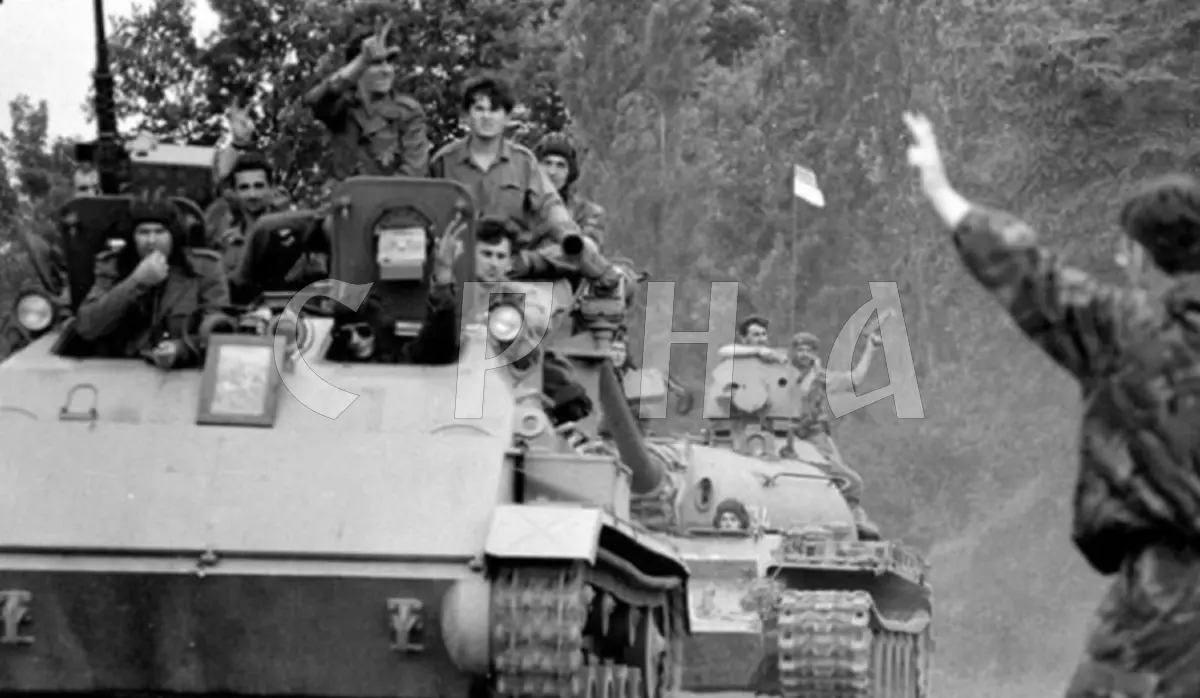
BIJELJINA, JUNE 21 /SRNA/ – “The road is open, good luck,” were the words with which the commander of Tactical Group One of the Republika Srpska Army, Novica Simić, addressed the Serb population in the western part of Republika Srpska after the corridor through Posavina had been broken through.
In a brief statement at the time, Colonel Simić, who later became a general, said that the route had been opened by combined units of the First Krajina Corps of the Republika Srpska Army, adding that this was their way of congratulating all Serbs around the world on the holiday, alluding to Vidovdan /St. Vitus Day/.
“By this, the corridor to Yugoslavia has been established; the road is open. Good luck,” Colonel Simić said at the time.
Operation Corridor 92, also known as the Corridor of Life Breakthrough, was the largest operation conducted by the Republika Srpska Army during the Dfensive-Patriotic War against the Croatian Defence Council /HVO/ and the Croat Army in Posavina.
It was considered the most significant victory of the Republika Srpska Army and an exceptional military achievement, standing out among all others from that heroic period of Serb history.
The objective of the operation was to establish a land connection between the western and eastern parts of Republika Srpska.
The entire Banja Luka region, extending to Knin, Benkovac, and Obrovac, with more than one and a half million Serbs, was surrounded. These were days marked by fear and great uncertainty. There was no electricity, fuel, cigarettes, or coffee; food supplies were rapidly dwindling, while hospitals and medical institutions were running out of medicines and medical supplies.
Hospitals were also left without oxygen, and there was no dialysis fluid for kidney patients. The most critical situation was at the Banja Luka maternity hospital, where oxygen was desperately needed for the incubators for newborn babies.
Although an appeal for assistance was sent from Banja Luka, the world powers ignored it, and 12 newborn babies died at the maternity hospital due to a lack of oxygen.
Doctors even attempted to use industrial oxygen supplied by the Republika Srpska Army, but it was not enough to save the babies.
Army generals later recalled that it became clear at that moment that a breakthrough toward Serbia had to be made, and it occurred earlier than originally planned.
At the time, Posavina was under occupation. Beginning in March 1992, Croatian paramilitary units had been systematically crossing the bridge over the Sava River and gradually taking control of what was then Bosanski Brod. During the capture of the town, HVO forces attacked the village of Sijekovac and committed a mass crime against Serb civilians.
Modriča, Derventa, and surrounding villages came under the military administration of the Croatian Army and the HVO, linking up with forces in Gradačac and cutting all road routes leading from Krajina toward Šamac, Brčko, Bijeljina, Serbia, and the rest of the world.
“There were not many options. Either surrender ourselves to the mercy of the enemy or fight for the road of life. That was the trigger for launching Operation Corridor and creating the road of life, the battle for survival,” General Momir Talić once stated. In an interview immediately after the operation, he described it as a continuation of the Battle of Kosovo.
After assessing the overall situation on the front, Colonel Boško Kelečević, Chief of Staff of the First Krajina Corps, proposed expanding the corps’ operational zone to include Derventa, Brod, Odžak, Teslić, Doboj, Modriča, as well as Ozren and Trebava.
On June 17, 1992, in the village of Stanovi near Doboj, General Talić held a meeting with commanders. Following a comprehensive assessment of enemy forces and conditions on the ground, he officially named the operation “Corridor 92.”
“Talić made his decision and said: ‘I want the main strike across Trebava, by the shortest route. Our children are dying. I want a corridor by Vidovdan, even if it is only a goat path. The final decision tomorrow at the same time’,” it is perpetuated through the book Republika Srpska in the Defensive-Patriotic War, published by the Republika Srpska Research Centre of War, War Crimes and Tracing Missing Persons.
The exact date, as written, was not publicly disclosed to the soldiers, but it was assumed to be June 26. All Serb forces stood ready, awaiting orders. Acting on Talić’s decision, the operation began two days earlier because intelligence indicated that enemy forces would soon be reinforced. The breakthrough commenced at seven o’clock in the morning.
The operation, which remains recorded in military history, ended the land and air blockade of the western part of Republika Srpska and Republika Srpska Krajina. As a result, Modriča, Odžak, Derventa, and Brod were liberated, while the entire military operation was completed on October 6 of the same year.
According to data from the Republika Srpska Research Centre of War, War Crimes and Tracing Missing Persons, at least 855 soldiers of the Republika Srpska Army, 14 members of the Republika Srpska Ministry of Interior, and 19 members of the Ministry of Interior and Republika Srpska Krajina Army were killed during Operation Corridor 92.
According to another set of data from the same institution, 877 members of the Republika Srpska Army, 15 members of the Republika Srpska Ministry of Interior, and 17 members of the Ministry of Interior of the Republika Srpska Krajina were killed during Operation Corridor 92.