STARI BROD COMMEMORATES 6,000 SERB VICTIMS OF USTASHA BLACK LEGION
Republika Srpska - Višegrad - remembrance
03/22/2026
15:58
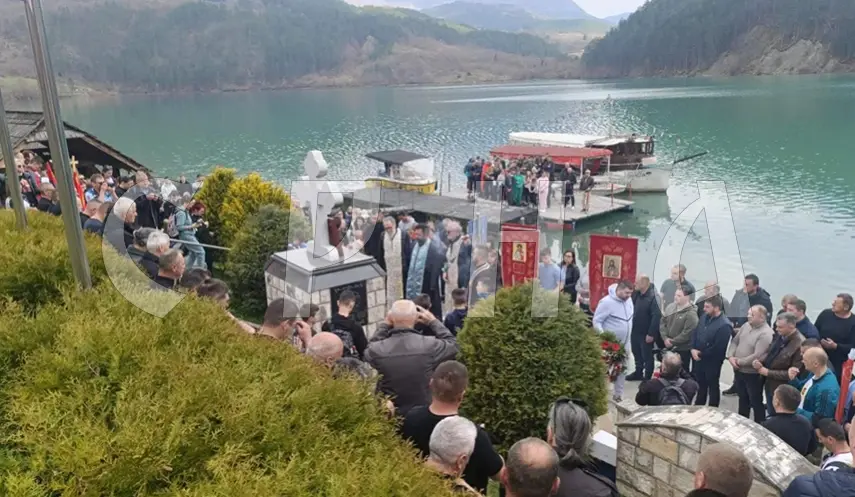
VIŠEGRAD, MARCH 22 /SRNA/ – A memorial service was held today in Stari Brod near Višegrad marking 84 years since more than 6,000 Serbs were killed by members of the notorious Ustasha Black Legion led by Jure Francetić.
The prayer gathering brought together a large number of victims' descendants, institutional representatives, and citizens who paid tribute to the innocent victims.
The Minister of Foreign Trade and Economic Relations in the Council of Ministers of BiH Staša Košarac said that Stari Brod represents a sacred site of suffering for the Serb people.
"The Serb population suffered in this area, primarily from the Sarajevo-Romanija region. In an effort to cleanse this area of Serbs, fascist structures operated here, including Ustasha units and the Hanjar Division," Košarac said.
He reminded that more than 6,000 Serb civilians - children, the elderly, and unarmed people - were killed within ten days, which, he stressed, clearly confirms the intent to remove the Serb population from their ancestral homes.
"We witnessed similar situations in the 1990s, when there were attempts to expel Serbs from BiH. However, thanks to the organization of the people and their belief in freedom, Republika Srpska was created as an expression of that struggle," Košarac pointed out.
He emphasized that Serbs are a freedom-loving people who have never taken what belongs to others, but have defended their own - both in 1942 and in the 1990s.
"They defended their homes, and that is precisely why they suffered. That is why it is our duty to preserve the memory of these victims, pass the truth on to future generations, and never allow such crimes to happen again," Košarac said.
Priest Dragan Vukotić said that everything built at the site was created out of love so that the victims would not be forgotten, as they had been for many years.
"We all know how our Sarajevo-Romanija region suffered, how the people were expelled and how Serb land was soaked in blood. You are also familiar with the Ustasha plan: to kill one third of Serbs, convert one third, and expel one third," Vukotić said.
He added that, unfortunately, this did not apply to the Sarajevo-Romanija region.
"There was an order - run. But why should we run? Because they knew that people from this region had strong faith, that they could not be persuaded, conquered, or subjugated. That suffering did happen, but thank God we have gathered here today at the place where our people perished, where it was thought we would be erased, that we would no longer exist," Vukotić stated.
He thanked God that Serbs, as a Christian people, commemorate their martyrs.
"We honor them because they did not renounce their faith and did not bow to the enemy, no matter who it was. We have endured much suffering throughout history, from Kosovo onward," Vukotić reminded.
He noted that there had been an intention to establish a border on the Drina River, but that, as he said, God did not allow it.
"Crimes were committed against us, we suffered, but we still honor our martyrs today," Vukotić added.
Višegrad Mayor Mladen Đurević said that visiting Stari Brod and paying tribute to the victims is an important act of remembrance.
"As every year, we visited Stari Brod and remembered all the victims over whom the Ustasha carried out a horrific massacre in 1942," Đurević said.
He thanked the Serbian Orthodox parish in Višegrad, the local tourist organization, and everyone who helped organize, for the first time, a 15-kilometer pilgrimage walk.
"It is encouraging to see such a large turnout, as this is a small but important contribution to remembering all victims, not only in Stari Brod but also at other sites of suffering across the region," Đurević said.
He added that the Serb people made great sacrifices, both in World War II and in other conflicts, and that paying tribute in this way is the least that can be done.
"It is especially encouraging to see many young people and children joining this walk and pilgrimage. It is precisely to them that we must pass on the memory, so that such crimes are never forgotten," Đurević said.
Rogatica Mayor Ninoslav Prelić emphasized the importance of preserving the culture of remembrance of the suffering of the Serb people.
"The very mention of Stari Brod is a monument to the suffering of the Serb people in this area - a monument to the pain and hardship our people endured. It is our duty to preserve that memory and pass it on to younger generations, to our children and students," Prelić said.
He noted that students of the "27 January" Secondary School Center in Rogatica took part in this year’s pilgrimage on foot.
"We also had our athlete Snežan Obradović, who ran the route from Rogatica to Stari Brod in honor of the victims who perished here," Prelić said, thanking everyone who contributed to preserving the memory of the Ustasha victims.
Stari Brod near Višegrad is one of the largest sites of suffering of the Serb people in World War II, where in the spring of 1942 members of the Ustasha Black Legion carried out a mass massacre of several thousand Serb civilians, mostly women, children, and the elderly who were trying to escape by crossing the Drina River.
Today, a memorial complex stands at the site, bearing witness to the suffering and serving as a place of remembrance and prayer.