OSTOJIĆ: BY DEFENDING NORTHWESTERN BORDERS, REPUBLIKA SRPSKA ARMY BROKE CROATIAN OFFENSIVE
Republika Srpska - Novi Grad - commemoration
09/18/2026
14:38
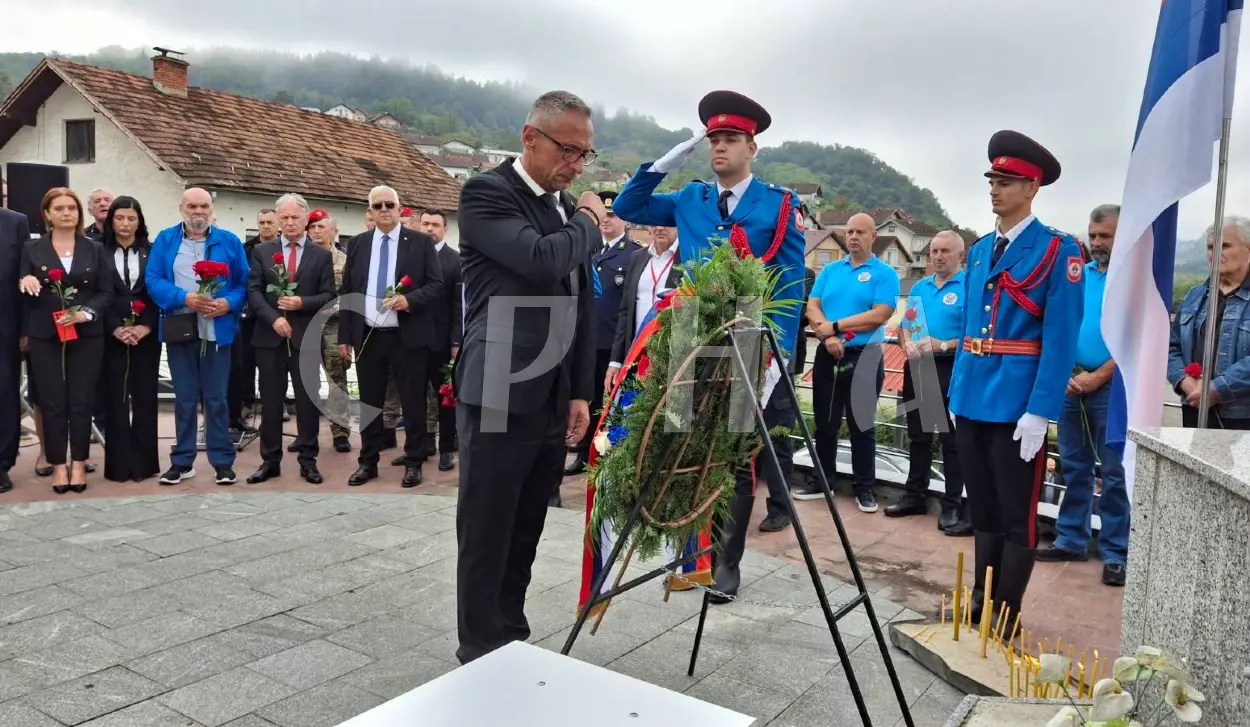
NOVI GRAD, SEPTEMBER 18 /SRNA/ - The defence of the northwestern borders of Republika Srpska was a magnificent victory for the Army of Republika Srpska and the breaking of the Croatian Army's offensive, Minister of Labour and Veterans and Disability Protection Radan Ostojić said today in Novi Grad.
Ostojić noted that the aim of the enemy offensive was to resolve the Serb issue in BiH by expelling Serbs from their centuries-old homes.
Ostojić recalled that the Croatian Army's offensive lasted throughout 1995, beginning with aggression against Eastern Slavonia and the expulsion of Serbs in Operation Flash, and continuing in the southwestern part of Republika Srpska with attacks on Glamoč, Grahovo and Drvar and the expulsion of Serbs from their centuries-old homes.
"It continued with Operation Storm against the Republika Srpska Krajina and the expulsion of 250,000 Serbs, followed by Operation Maestral in September 1995 against Ključ, Petrovac and Mrkonjić Grad, when 120,000 Serbs were expelled," Ostojić said at a ceremony marking the 31st anniversary of the defence of Republika Srpska's northwestern borders.
Ostojić said that the Croatian offensive ended in northwestern Republika Srpska when the Croatian forces suffered defeat, which, he assessed, marked a turning point in creating the conditions for Dayton and peace negotiations.
"We can thank the heroic Army of Republika Srpska, which broke the offensive, halted the advance of the regular Croatian Army and created the conditions for the start of negotiations, which resulted in Dayton and Paris, the international recognition of Republika Srpska and the freedom in which we live today," Ostojić said.
State Secretary at Serbia's Ministry of Labour, Employment, Veterans and Social Affairs Nikola Vukelić said that in 1995 the Serb people as a whole were in a difficult situation, under pressure from all sides.
He recalled that there were numerous offensives by the Croatian Army and the so-called Army of BiH, as well as NATO bombing in the aggression known as "Deliberate Force".
"When the Republika Srpska Krajina fell, people here saw with their own eyes Serbs fleeing their homes. This probably also influenced the people to understand that it was a question of survival or disappearance," Vukelić said.
He stressed that this area proved to be an impenetrable bulwark, because had things been different, the war would have taken a different course.
"We are sending a message that Serbia stands firmly with Republika Srpska, and that a strong Serbia and a strong Republika Srpska are a guarantee of the survival of the Serb people," he said.
The Croatian Army's attack on the municipality of Novi Grad began on September 18, 1995, at 9:25 a.m., and during the two-day offensive, 57 people were killed - 37 civilians, 18 soldiers and two members of the Ministry of Internal Affairs - while 17 civilians, three soldiers and one member of the Ministry of Internal Affairs were wounded.
Members of the Army of Republika Srpska managed to push the Croatian Army back across the Una River on September 19, 1995.