ONLY SERBS CELEBRATE KRSNA SLAVA, IT IS THE LEGACY OF SAINT SAVA
Republika Srpska - Orthodoxy - Krsna Slava
05/23/2026
11:56
NOVI GRAD, MAY 23 /SRNA/ - Only Serbs have Krsna Slava, which was left to them as a legacy by Saint Sava, said priest Nebojša Nježić, after the Croatian Ministry of Culture and Media placed under protection on April 20 "Slava, krsnica, or krsno ime – the celebration of the family patron saint of the Neretva Catholics".
Serbian Krsna Slava was inscribed on the UNESCO list of intangible cultural heritage in 2014 as an authentic Serbian tradition, but this was not an obstacle for the Croatian Ministry of Culture and Media.
The description of the rite protected by the Croatian Ministry under number Z-7985 lists all the key elements of the Serbian Krsna Slava - the slava candle, wheat, bread, wine, and extinguishing the candle with wine.
Even the Croatian Encyclopedia states that Krsna Slava is a custom "especially widespread among Serbs (among Croats only in places)," accompanied by a lit candle, wine, incense, kolivo /boiled wheat/, and ritual bread.
Priest Nježić told SRNA that precisely because only Orthodox Serbs have Krsna Slava, left to them as a legacy by Saint Sava, it must be preserved.
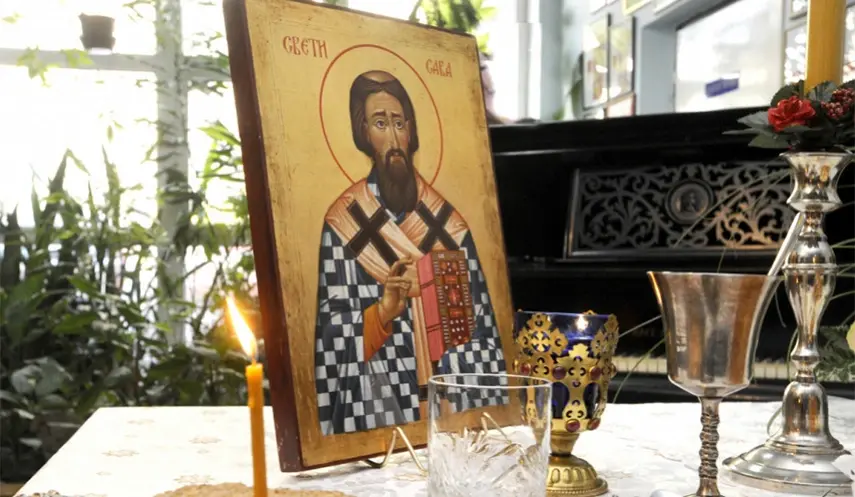
He explained that its essence is the slava candle, slava bread /kolač/, slava wheat, and the icon.
He emphasized that Krsna Slava has its significance and symbolism, explaining that the slava bread is a symbol of the body of Christ, the slava wheat a symbol of Christ's resurrection, and wine a symbol of the blood of Christ.
"Then we see that, in essence, our Krsna Slava is an extension of the Holy Liturgy, of communion with Christ. If we want to be a deified people, then we must preserve what is most sacred to us, which is our Church and our Krsna Slava that has preserved us for centuries," pointed out Nježić, the parish priest of the Poljavnice-Ravnice parish.
The Serbian Orthodox Church and science agree that the beginning of the celebration of Krsna Slava is linked to the day when a family or an entire lineage embraced Christianity.
The first written mention of celebrating a slava dates back to 1018, when the Greek chronicler John Skylitzes first recorded the slava, giving it the characteristic of a family holiday, which is also taken as a jubilee of the official celebration of Krsna Slava.
Saint Sava, the first Serbian archbishop, reorganized church life at the beginning of the 13th century, and his reformatory work included the celebration of the patron saint's day in the home.
The creators of the slava as we have it today are Saint Sava and his direct disciples, which is why only Serbs, who have been continuously under the decisive spiritual influence of the Saint Sava Church since the 13th century, have Krsna Slava today.
The celebration of slava in its original form, unlike today, was customary not only among the Serbian people but also among other Orthodox peoples, but over time it was replaced by the celebration of the birthdays of individual family members, or the namedays of the saints whose names they bear.
There are traces that slava was once celebrated on the territory of Croatia, as well as among the Bulgarians and Russians, but nowhere except among the Serbs has it been preserved as cultural heritage.
Slava was constantly celebrated only by Serbs, wherever they were. They celebrated it in the most glorious days of their history, but also during their five-century subjugation under the Turks; it was celebrated in war and exile, in prison and in the hospital.
Religious and social elements are intertwined in the celebration of Krsna Slava, and they are deeply rooted in this unique Serbian custom, which is first on the list of intangible cultural heritage.
According to UNESCO's propositions, every element of intangible heritage must be sustainable, living, practiced, and guaranteed survival in the future.