MEMORIAL SERVICE FOR SERBS KILLED 33 YEARS AGO IN SKELANI, DODIK IN ATTENDANCE
Republika Srpska - Middle Podrinje - culture of remembrance
01/16/2026
12:48
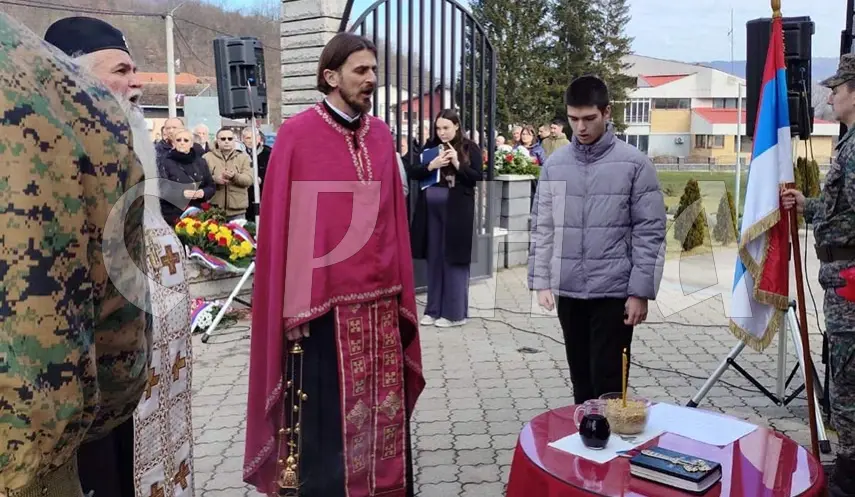
SKELANI, JANUARY 16 /SRNA/ – A memorial service is currently being held at the central monument in Skelani for 305 Serb civilians and soldiers from this and neighboring villages, 69 of whom were killed on this day 33 years ago by Muslim wartime forces.
The memorial service, officiated by Skelani parish priest Srđan Lalović, is attended by relatives of the killed Serbs, SNSD leader Milorad Dodik, Vice President of the National Assembly of Republika Srpska Petko Rankić, envoy of the Serb member of the BiH Presidency Boško Tomić, and Assistant Minister of Labour and Veterans' and Disabled Protection of Republika Srpska Nebojša Vidaković.
Also present are representatives of numerous associations preserving the tradition of liberation wars from Republika Srpska and Serbia, as well as representatives of several municipalities from both sides of the Drina River.
Following the memorial service, flowers will be laid at the memorial site.
Continuing the ethnic cleansing of the Middle Podrinje region and the destruction of everything Serbian, which began in April 1992, strong Muslim forces numbering several thousand fighters from Srebrenica, under the command of Naser Orić, attacked Serbian villages around Skelani at dawn on January 16, 1993.
Muslim units entered the villages before daybreak, killing and slaughtering civilians in their sleep in their homes, pillaging and destroying everything they could.
That day, as many as 69 residents of this area were killed, two-thirds of them civilians, including several children.
A total of 165 residents were wounded. Of the 30 captured, half did not survive torture in Srebrenica detention facilities, while four are still listed as missing.
Residents sought refuge by retreating toward the border bridge leading to Bajina Bašta in Serbia, while some attempted to save their lives by swimming across the Drina River.
The bridge over the Drina, the only route for civilians to cross into Serbia, was under constant machine-gun and sniper fire and became a site of mass suffering for Serbs, and the largest number of civilians were killed while attempting to flee on and near the bridge, as well as in the cold waters of the Drina.
The youngest victim was five-year-old Aleksandar Dimitrijević, while his brother Radislav was 11. Together with their mother Milica, they tried to escape to Bajina Bašta but were struck by enemy gunfire near the border bridge.
Gordana Sekulić was killed on the bridge, while her two sons survived and today live in Srebrenica with their father Mirko.
Then-minor Cvetko Ristić from Kušići lost his entire family, home, and property. His parents and sister were killed, and he has still not found the remains of his brother. His house was rebuilt 16 years after the war.
After the destruction of more than one hundred Serbian villages and hamlets in the Bratunac and Srebrenica municipalities during 1992, Muslim forces led by Orić captured Kravica and several surrounding Serbian villages on Orthodox Christmas in 1993, committing a horrific massacre of the civilian population.
Nine days later, a large-scale attack followed on Skelani and surrounding villages, involving several thousand members of Muslim units, and,ccording to Orić's plan, this was intended to be the final blow to the Serbian population, aimed at its destruction or complete expulsion from the territory of the Srebrenica municipality on the left bank of the Drina.
During those two days, on Christmas in Kravica and on January 16 in Skelani, Orić’s executioners killed 118 Serbs, more than half of them civilians, and wounded as many as 345 people, two-thirds of whom were civilians.
In an effort to eradicate everything Serbian in the area, Muslim forces that day looted and burned the Serbian villages of Ćosići, Kostolomci, Klekovići, Božići, Blažijevići, Kolari, Zečevići, Kušići, Stajšići, Maltaši, Stublovi, Arapovići, Bujakovići, Liješće, parts of Serbian Skelani, and several other villages.
They did not reach Crvica and its hamlets, nor Petriča, which are the only Serbian villages in the Srebrenica municipality that were not burned during the war.
For the numerous mass crimes committed by Muslim forces against Serbs in the Podrinje region, including those in Skelani, no one has been held accountable even after 33 years, nor were these crimes included in the indictment against Orić in proceedings before the Court of BiH, which ended with his acquittal.