INSIST THAT THOSE RESPONSIBLE FOR MASS GRAVE BE PUNISHED
Republika Srpska - Mrkonjić Grad - culture of remembrance
04/01/2026
14:12
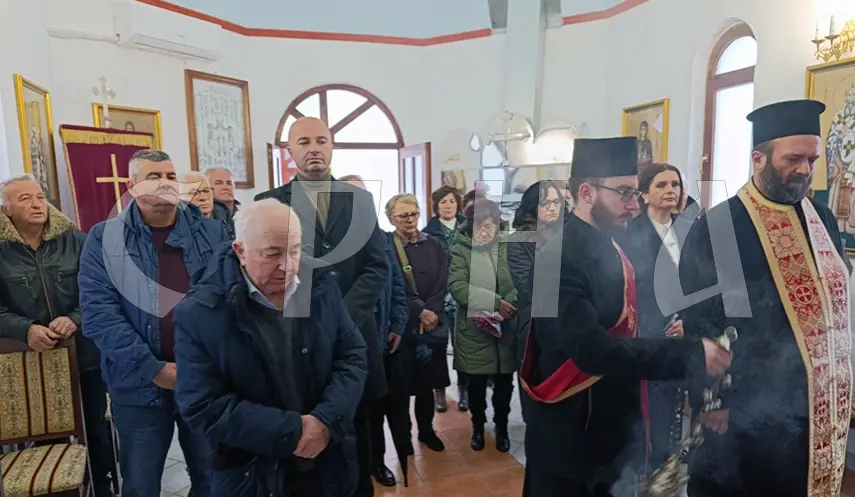
MRKONJIĆ GRAD, APRIL 1 /SRNA/ – A memorial service was held today at the Orthodox cemetery in Mrkonjić Grad in the chapel of the Holy Apostle Mark, and wreaths were laid at the memorial marking 30 years since the opening of the mass grave in which the bodies of 181 brutally killed Serbs were descovered, with the message that making sure that those responsible for this crime are punished must be further insisted.
The head of the Republika Srpska Organisation of Families of Captured, Fallen Soldiers and Missing Civilians Isidora Graorac told the press that the families, as well as everyone living in Republika Srpska, feel a burden because no one is being prosecuted for crimes committed against the Serb people.
"We remember the day when the largest mass grave in Republika Srpska was opened with 181 bodies, and I would like to remind that four bodies from this grave have still not been identified," Graorac said.
According to her, it is difficult to speak about this regardless of the time that has passed, as well as of the fact those who committed the crimes, i.e. aggression against the people discovered in the mass grave -soldiers and civilians brutally tortured and killed - have not been held accountable.
"We seriously doubt that the court and the prosecutor's office will deal with this case more seriously, even though all the evidence and facts existed. Everything indicated that this process could be brought to an end, but unfortunately we have not seen that happen.
Everyone should constantly talk about this in public and appeal for the perpetrators of crimes committed in the area of Mrkonjić Grad, and in connection with this mass grave, to be brought to justice," Graorac said.
Nevena Jaćimović from Kola near Banja Luka found the body of her husband Predrag in the mass grave; he was 35 years old at the time.
Jaćimović recalls that period with great pain, noting that it was extremely difficult for her when the pathologist who worked on identifying the bodies told her that none of those found in the mass grave had been killed by a bullet, but had instead been tortured and murdered.
According to her, her husband was finished off with a blunt object and had six gunshot wounds.
Mira Pavičar from Banja Luka found her husband in the mass grave. She says he had been tortured and brutally killed, adding that the most painful moment for her was when she could not recognize his face, only the lower part of his jaw and his teeth.
Ljubinka Kreka from the village of Kopljevići near Mrkonjić Grad said she found her husband’s body in the grave, while the mutilated body of her brutally killed brother was discovered in the village of Sitnica on Mount Manjača.
Kreka noted that she gave birth to her son on April 29 and that the most painful fact is that he never saw his father, because only a few days later his body was discover in the mass grave.
Families of those found in the mass grave in Mrkonjić Grad are gradually losing hope that anyone will be held accountable for the crimes.
Wreaths were laid at the memorial by representatives of the Republika Srpska Organisation of Families of Captured, Fallen Soldiers and Missing Civilians, the Banja Luka City Organisation of Families of Fallen Soldiers, the Municipality of Mrkonjić Grad, and the Prison Camp Detainees Association.
An exhibition of photographs titled "Remember, Do Not Forget," organised by the Mrkonjić Grad Grammar School, will be opened at the Mrkonjić Grad National Library this evening at 18:00 to mark the 30th anniversary of the opening of the mass grave.
Joint forces of the Croatian Army, the HVO, and the so-called Army of BiH, supported by NATO operations, carried out an offensive in September and October 1995 against 13 municipalities in western Krajina, killing 2,014 Serb soldiers and civilians.
They expelled 120,000 Serbs from their ancestral homes, looted movable property, and destroyed or rendered unusable immovable property.
Among the 2,014 killed, 753 were civilians, including 14 children and 240 women.
Croatian and Muslim forces at the time took control of Ripač, Petrovac, Drvar, Grahovo, Glamoč, Ključ, Sanski Most, Mrkonjić Grad, Šipovo, Srbobran, Jajce, Kupres and Krupa na Uni, leaving devastation and mass graves behind.
In the municipality of Mrkonjić Grad alone, 1,608 houses and 700 apartments were destroyed, with war damage estimated at BAM 680 million.
After Republika Srpska regained control of the municipality of Mrkonjić Grad, the largest mass grave was discovered in the Orthodox cemetery, containing the bodies of 181 brutally killed Serbs.
Among them were 81 civilians, including 10 women, 97 soldiers of the Republika Srpska Army, and three members of the Ministry of Interior, while another 176 bodies were found in smaller graves in the area of the municipality.
The opening of the mass grave and exhumation began on April 1, 1996.