HUNGARIAN SCIENTISTS PRESENT MONASTERY DOBRUN WITH BRONZE REPLICA OF ITS SEAL
Republika Srpska - Višegrad - SOC
11/26/2026
15:42

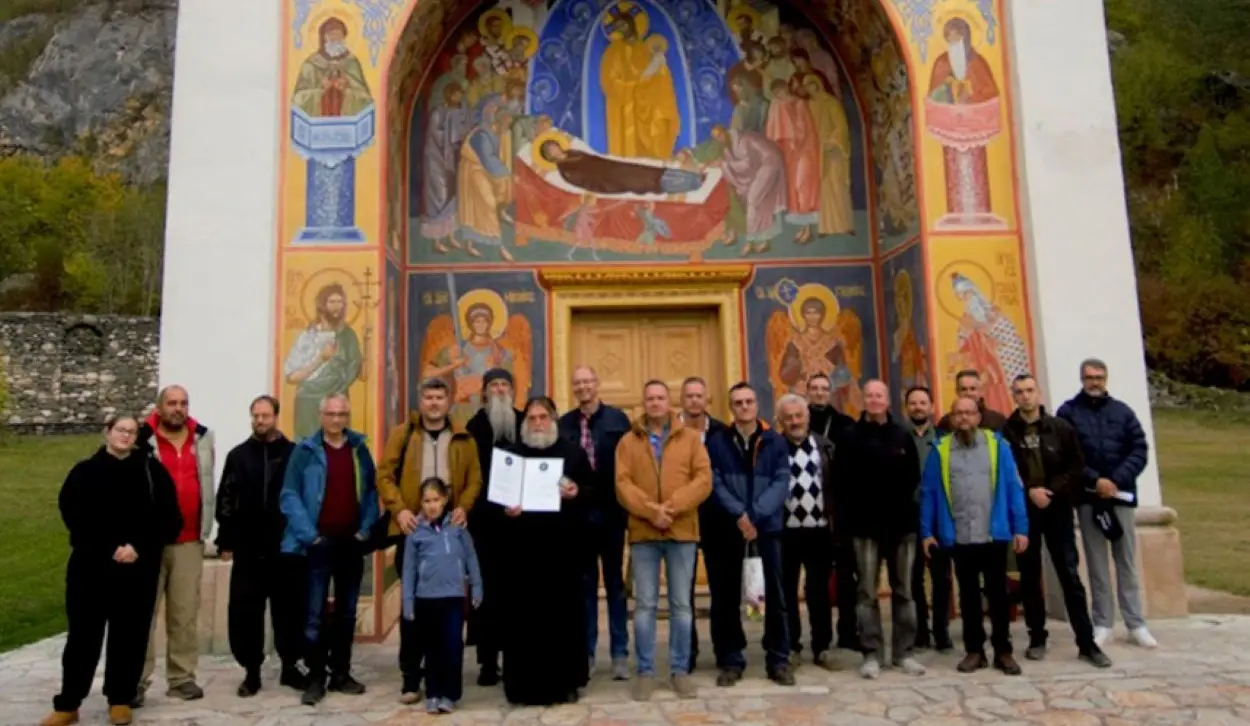
VIŠEGRAD, NOVEMBER 26 /SRNA/ - A group of scientists from the Katona József Museum in the Hungarian city of Kecskemét visited Dobrun Monastery near Višegrad and presented the monastery authorities with a bronze replica of the damaged seal ring belonging to the ancient Serbian holy site.
The original seal ring was discovered in mid-March by a team of museum experts in the village of Madaras, near the southern border of Bács-Kiskun County in southern Hungary, the Metropolitanate of Dabar-Bosnia announced.
Under Hungarian law, the original seal ring had to remain at the museum. Along with the replica, the monastery was presented with a commemorative certificate attesting to the authenticity of the find and the replica it received.
Archimandrite Kalistrat Boboljušić, abbot of Dobrun Monastery, said that the discovery of the monastery's seal ring in that part of present-day Hungary opens up new possibilities for expanding the historical record of the monastery.
"Through the scholarly work of historians and archaeologists, we are learning new historical facts about the monastery itself and its significance, as well as about the diligence of the monks of Dobrun at the time," the abbot said.
The exact period to which the seal ring dates has not yet been established.
"Through discussions with members of the scientific team, we learned that, according to their assumptions, the monks of Dobrun may have travelled to the southern regions of Hungary, which were then also inhabited by Serbs, to collect donations for the monastery," Archimandrite Kalistrat said.
The seal ring discovered there was used to authenticate charters and letters of gratitude to benefactors and donors.
It is believed that the seal ring was lost at some point, and that a subsequent "owner," or rather the person who found it, pierced it and used it as an item of clothing decoration.
However, the archimandrite noted that there is another theory: that Hungarian military expeditions advancing through the Drina River valley also reached medieval Dobrun and, among other things, looted the monastery ruins, taking the seal ring to Hungary.
The inscription "Seal of the Annunciation of the Most Holy Mother of God, Dobrun" has been preserved on the seal ring. This confirms earlier findings that Dobrun Monastery was dedicated to the Annunciation of the Most Holy Mother of God from the time of its founding. However, due to weather conditions, the Feast of the Dormition of the Most Holy Mother of God was later designated as the monastery's patron saint's day and annual feast day.
The members of the scientific team, hosted by Aleksandar Krstić, a historian and research associate at the Institute of History in Belgrade, also visited the monastery museum during their stay.