FILM "ISHOD" ABOUT EXODUS OF SARAJEVO SERBS PREMIERS
Republika Srpska - Banja Luka - culture
03/17/2026
22:18
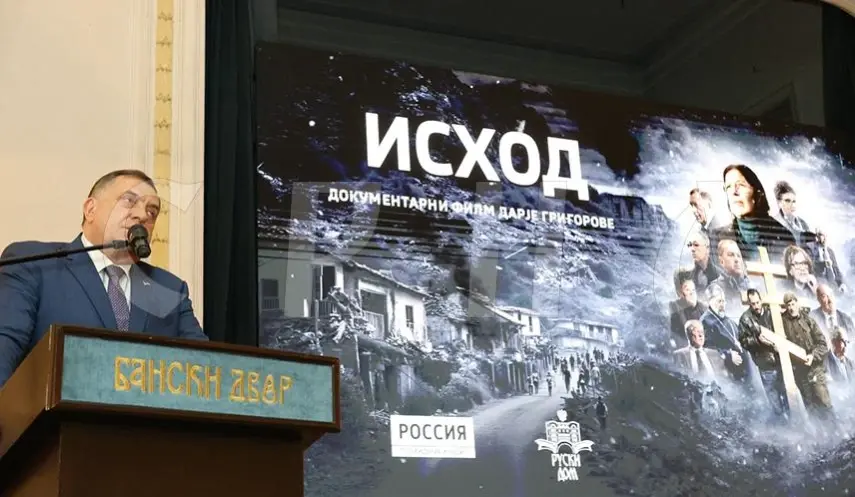
BANJA LUKA, MARCH 17 /SRNA/ - The documentary film “Ishod” /Outcome/ about the mass exodus of more than 150,000 Sarajevo Serbs forced to leave their homes after the signing of the Dayton Peace Agreement, premiered on Tuesday evening in Banja Luka.
SNSD president Milorad Dodik emphasized that the Sarajevo Serbs were a highly educated community, one of the most educated and professionally accomplished Serb communities in BiH, and that therefore this was not only the loss of houses and apartments, but also the loss of cultural, intellectual, and educational potential.
He believes that it is very important to make films about suffering, because otherwise such tragedies could happen again to the Serbian people.
Addressing the audience before the premiere, Milorad Dodik said that the film addresses a topic that had long remained on the sidelines and had not received much attention, even though it is of exceptional importance for the Serbian people as a whole.
He pointed out that the suffering of Serbs has been continuous, and that it was particularly pronounced in Sarajevo, where the first wave of the Serbian population left already at the beginning of the war, leaving behind significant capital.
The suffering of the Sarajevo Serbs, Dodik emphasized, as well as the exodus that occurred at the end of the war, was the result of complex circumstances.
He stated that around 18,000 Serbs in that area faced a much larger number of Muslims in Sarajevo, that it was a strategically important area, and that it was a struggle that had to be fought.
“It was clear that a breakthrough from Sarajevo toward Pale and further on could seriously threaten the very possibility of the formation and survival of Republika Srpska. When viewed strategically, if a corridor had been opened toward Zenica and Tuzla, the question is whether negotiations would have taken place at all, or whether attempts to eliminate Republika Srpska would have continued. That is why it is important that this topic of the suffering of Serbs be researched and presented to the public,” Dodik emphasized.
Dodik assessed that the events in these areas were part of broader processes and that the sanctions and pressures the Serbian people endured during the 1990s show that these regions were involved in larger geopolitical developments.
“Today, similar patterns can be recognized in attitudes toward Russia. Attempts to demonize certain political leaders, from Slobodan Milošević to Vladimir Putin, are part of a broader narrative in international relations,” Dodik concluded.
The film is the work of journalist and Balkan bureau chief of the Russian State Television and Radio Company, Darya Grigorova, and was produced by the television channel Rossiya 24.
Grigorova told reporters that she was very surprised when she learned what had happened to the Sarajevo Serbs after the signing of the Dayton Peace Agreement, that around 150,000 people had to leave their homes.
“I wanted to present this great human tragedy to our viewers in Russia, because it is an experience that is now important for us as well. While researching, I learned how inaccurately the Western world reported from these areas, and I felt the need for people to see that,” Grigorova said.
Senior adviser at the Russian House, historian Georgiy Engelhardt, who provided expert support for the project, told reporters that the film had already been broadcast nationwide in Russia so that the Russian people could become familiar with the history of Serbs in Republika Srpska.
Among the interviewees in the film are the leader of Republika Srpska, Milorad Dodik, film director Emir Kusturica, and former Deputy Prime Minister of the Federal Republic of Yugoslavia and participant in the Dayton Peace Agreement negotiations, Nikola Šainović.