CVIJANOVIĆ: POLITICAL EXPERIMENTS IMPOSED AGAINST PEOPLE’S WILL RARELY SURVIVE
Greece - Delphi - Economic Forum
04/22/2026
19:29
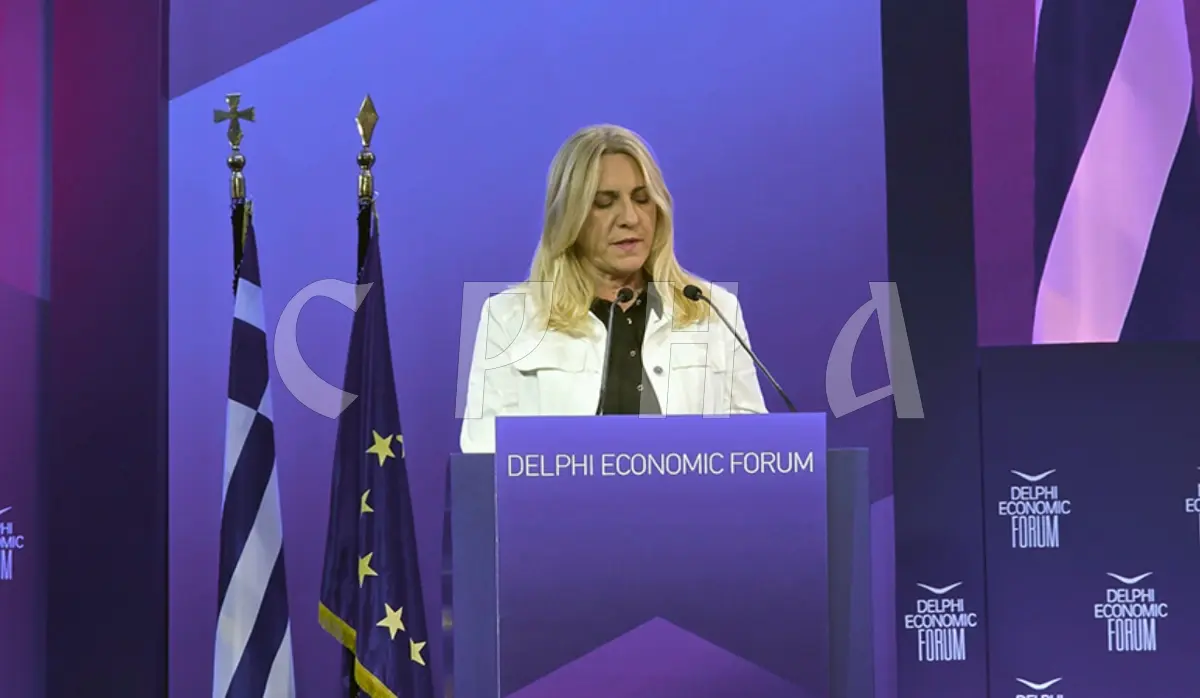
DELPHI, APRIL 22 /SRNA/ – Serb BiH Presidency member Željka Cvijanović stressed that states, societies, and multinational communities cannot be permanently built through coercion, dependency, or external engineering, but only through legitimacy, internal agreement, and mutual respect.
"History repeatedly teaches us one fundamental truth: political experiments imposed against the will of the people rarely survive," Cvijanović said in her address at the 11th Economic Forum in the Greek city of Delphi.
SRNA is Serb Presidency member's address in full:
It is a great honour to be here today and to have the opportunity to address this important gathering in an era of deep global uncertainty, transformation, and strategic redefinition.
We live in a time when states face a serious choice - either to actively shape their own future, boldly, responsibly, and wisely, or to remain passive observers while others decide their destiny.
History repeatedly teaches us one fundamental truth: political experiments imposed against the will of the people rarely survive. States, societies, and multinational communities cannot be sustainably built through coercion, dependency, or external engineering. They can only be built on legitimacy, internal agreement, and mutual respect.
TRUE SOVEREIGNTY – PEOPLE'S RIGHT TO SHAPE ITS OWN DESTINY
Sovereignty is the foundation of every functional state. Without the ability to govern itself without external interference, no country can preserve legitimacy, stability, or true independence.
True sovereignty means the right of a people to shape its own destiny, free from coercion, unappointed bureaucracies, and political projects that seek to replace identity with imposed solutions. This brings me to BiH - the country I come from.
At the very beginning, please allow me to clarify a fact often misunderstood abroad. I am a member of the three-member Presidency of BiH, elected from Republika Srpska, which comprises 49% of the country’s territory. I speak on behalf of Republika Srpska and the citizens who democratically elected me.
That is the constitutional reality of BiH. Anyone who claims to speak on behalf of all citizens of BiH without prior agreement of all three Presidency members misrepresents both the Constitution and the truth.
You have certainly heard much about BiH. But I must say openly: much of what has been presented internationally is incomplete, simplified, selective, or entirely incorrect. I am here to speak not based on narratives, but on direct political reality.
TRUE DEMOCRACY, REAL FREEDOM, TRUE SOVEREIGNTY AND CONSISTENT RULE OF LAW SERIOUSLY UNDERMINED IN BiH
This brings me directly to the current situation in my country, where true democracy, real freedom, true sovereignty, and even consistent rule of law have been seriously undermined.
BiH has become a country of sharp contradictions and systemic abuse of constitutional order and democratic norms. Much of this is the result of interventions by successive unappointed foreign officials - people for whom no citizen of our country has ever voted. Imagine living under such circumstances in modern Europe.
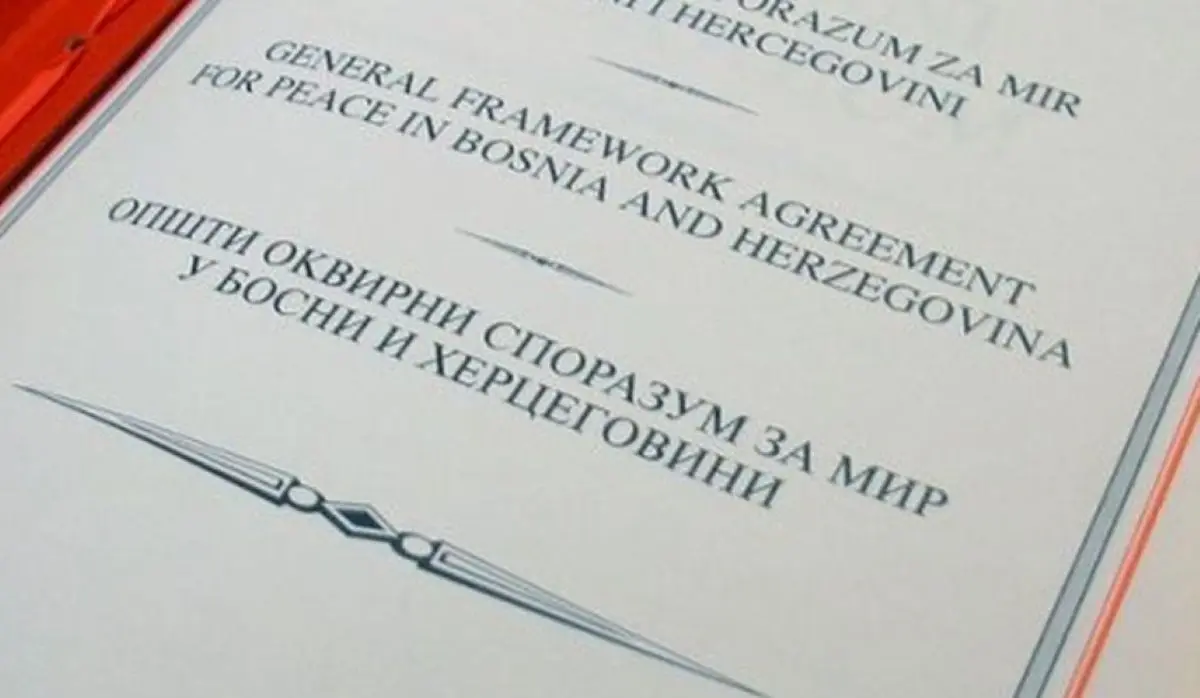
Last year marked the 30th anniversary of the signing of the Dayton Peace Agreement. Many conferences were dedicated to the Dayton, but they too often repeated old stereotypes and demonstrated a persistent lack of understanding of BiH and its core problems.
Let us therefore recall what the Dayton Peace Agreement actually is. It stopped a tragic war, but at the same time established a carefully negotiated constitutional framework for a highly decentralized state composed of two entities and three equal constituent peoples. It was not imposed, but the result of agreement accepted by all parties. That is of crucial importance.
The tragedy lies in the fact that the essential problem of BiH was never the Dayton itself. The problem is its systematic undermining from the moment it was signed.
Foreign politicians embedded in the system - above all the high representative, and later foreign judges in the Constitutional Court of BiH - gradually transformed the peace framework into a form of colonial administration. Yes, in the heart of Europe, in the 21st century. Many hear this and ask: is that really possible? Unfortunately, it is.
Over more than three decades, successive unappointed foreign officials imposed hundreds of decisions and laws, centralizing the country while violating both the spirit and the letter of the Dayton Peace Agreement.
BiH - PLACE WHERE DEMOCRATIC LANGUAGE OFTEN COVERS UNDEMOCRATIC PRACTICE
BiH has become a place where the language of democracy often hides undemocratic practice. Allow me to give concrete examples, because many find this hard to believe.
The Electoral Law was amended on the very day of elections. The Constitution was suspended for one day in order to introduce new formulas for forming government and install political arrangements without democratic legitimacy. All of this was done by an unappointed individual who calls himself the high representative, without any authority in the Dayton Peace Agreement to act in such a way.
Dozens of democratically elected or appointed officials were removed without respect for basic legal procedures. Political parties were financially sanctioned outside normal democratic processes.
Furthermore, the judiciary has been politicized and instrumentalized. Criminal legislation was amended in order to politically target and remove the elected president of Republika Srpska, simply because he did not comply with a law illegally imposed by the high representative. The legislative institutions of BiH were bypassed in this process,. Is this democracy or rule by decree?
Too often, when BiH is discussed internationally, only consequences are mentioned, while causes are almost never addressed. Every stronger political statement from Republika Srpska is immediately condemned, while unconstitutional centralization, hostile actions, and almost daily attacks on Republika Srpska are ignored. Such double standards have undermined trust for years.
INTERVENTIONISM CREATED CONSTITUTIONAL, POLITICAL AND INSTITUTIONAL MONSTER
The interventionist approach is often justified as a way to create a “more functional state”. In reality, it has created a constitutional, institutional, and political monster. Instead of unity, it produced paralysis. Instead of cooperation, it deepened mistrust in an already divided society among the three constituent peoples: Bosniaks /Muslims/, Serbs /Orthodox Christians/ and Croats /Catholics/.
The idea that BiH can be transformed through social engineering into a single centralized political nation has proven unrealistic and harmful. It ignores historical realities, cultural identities, constitutional balance, and the basic democratic fact that no people can be permanently governed against its clearly expressed political will.
Nowadays, BiH is a candidate for EU membership. Yet there is a sad paradox: the European Union has not only tolerated many of these deviations for decades, but has also directly and indirectly supported them. Even now, when many EU officials understand how harmful the project of a centralized BiH is, the EU remains the largest financial sponsor of the OHR and its anti-Dayton and undemocratic activities.
In simple terms: BiH is still functioning within a colonial structure headed by an unappointed foreign administrator, which might have impressed medieval rulers but should concern every democrat in the modern world.
Even more worrying is the fact that the holder of this office still does not have the approval of the UN Security Council, as required by Annex 10 of the Dayton Peace Agreement.
An institution that is accountable to electorate, but not to any democratic body not only fails to meet European standards - it negates them.
How can democratic values be promoted through undemocratic instruments? How can sovereignty be discussed when sovereignty is denied? These are not rhetorical questions; they go to the very core of Europe’s credibility.
DIALOGUE ONLY SUSTAINABLE WAY FORWARD
There is only one sustainable way forward: dialogue. Republika Srpska consistently offers dialogue and compromise. Too often, Bosniak politicians reject it, believing that foreign intervention can once again impose what cannot be achieved through democratic agreement. However, no democracy can function without dialogue among legitimate representatives.
I welcome voices in international politics that increasingly recognise a key fact: lasting solutions cannot be imported. Nation-building from outside does not work. Stable institutions must emerge from internal agreement, not external imposition.
To cure a disease, the right remedy is required. For BiH, that remedy is not more interventionism. It is respect for the Constitution agreed in 1995. It is correcting injustices from the past. It is returning decision-making to democratically elected local institutions. It is mutual respect among the three constituent peoples.
For years we have heard the idea that BiH must move “from Dayton to Brussels” through constitutional redesign. With full respect, I must say this idea is not only unrealistic - it is fundamentally wrong.
The problem of BiH has never been the Dayton Peace Agreement or Annex IV, which contains the Constitution itself. The problem is the open and continuous refusal of various international and local politicians to respect and fully implement it.
The constitutional structure established by the Dayton is not an obstacle to European integration, economic progress, institutional development, or democracy. Illegal impositions are the obstacle. Interventionism is the obstacle. Constant disruption of constitutional balance is the obstacle.
Finally, the unacceptable colonial status of BiH in the 21st century is certainly an obstacle.
Let me remind you that some EU member states are, in many respects, more decentralized than BiH, and yet they successfully fulfill all obligations of EU membership. Therefore, decentralization is not the issue. The issue is respect for law and internal agreement.
It is time to once for all end this outdated, undemocratic, and interventionist practice. Give BiH space to breathe with its own lungs. Allow its institutions to rest on their own democratic legitimacy. Let compromise replace imposition. Let partnership replace tutelage. Let elected leaders govern, and citizens decide.
I am convinced that the Dayton Peace Agreement is not an obstacle to the future, but its foundation. It can be improved only through agreement, never through coercion. Everything else is just another experiment; the peoples of BiH have already endured too many experiments.