BOOK BY THE NEWS AGENCY OF REPUBLIKA SRPSKA ABOUT CRIMES AGAINST SERBS PRESENTED
Republika Srpska - Srebrenica - "Petrovdan Days"
07/08/2026
22:38
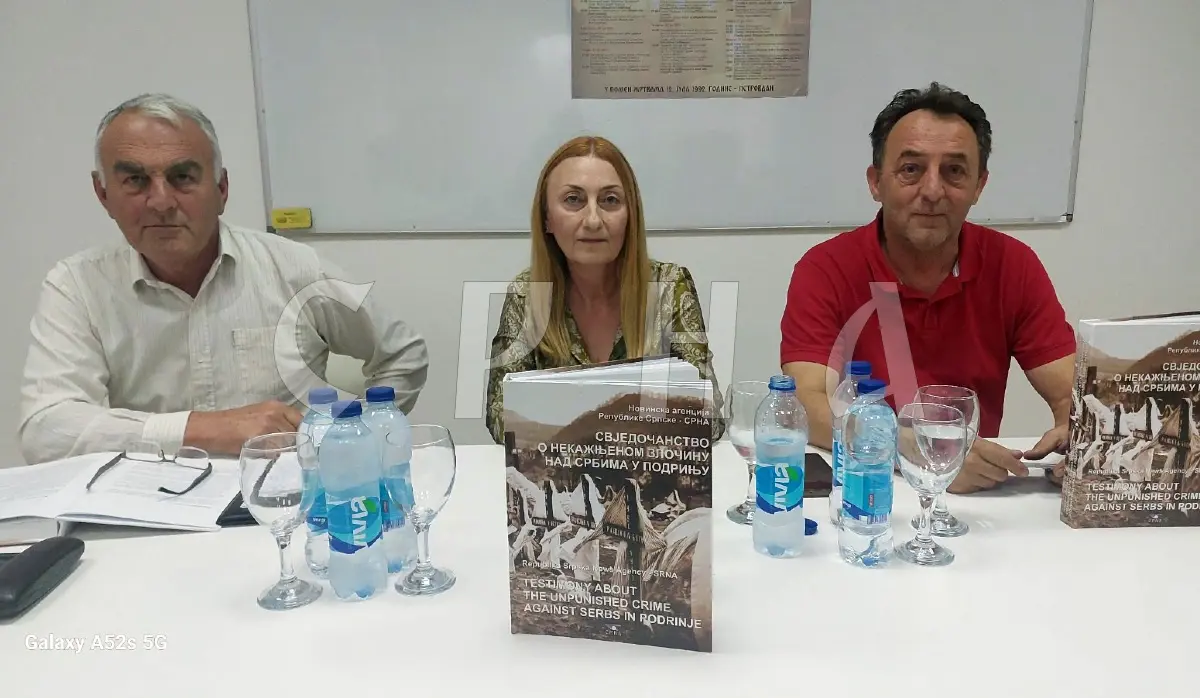
SREBRENICA, JULY 8 /SRNA/ - The book "Testimony of an Unpunished Crime against Serbs in Podrinje" contains evidence and testimonies of survivors and family members of tortured and brutally murdered Serbs from the middle Podrinje region, for which, unfortunately, no one has been held accountable even three decades after the end of the war in BiH, it was said at tonight's promotion of this book featuring harrowing testimonies in Srebrenica.
The book also includes assessments by several domestic and international experts and scholars of the war, who state that the Western-Muslim narrative about the nature of the war in BiH is untrue—a narrative that was introduced to the public back in 1992, at the beginning of the armed conflict, and by which Serbs were blamed in advance for everything.
The book, which was promoted as part of the "Petrovdan Days", was published by the News Agency of Republika Srpska – SRNA and contains testimonies about the most characteristic, most monstrous, and massive Muslim crimes in the villages around Srebrenica and Bratunac during the last war in BiH, for which neither the Hague nor the BiH judiciary has prosecuted anyone.
Not for the severed head of Anđelko Mlađenović from Ježetica, which was kicked around like a ball in Srebrenica; nor for the gouged-out eyes of judge Slobodan Ilić; nor for Drago Mitrović from Podravanje, who was slaughtered and finished off in two wars; nor for four-year-old Aleksandar Dimitrijević and dozens of murdered Serbian children in Skelani, Bjelovac, Zagoni, and other Serbian villages.
No indictment has been issued for the crimes against 88-year-old Stanko Milošević and the deaf-mute Krstina and Dostana Lazić from Brežani, who were killed and burned in their homes by Muslims, and whose remains have never been found, leaving them still listed as missing.
The attendees showed great interest in the content of this book because it largely speaks about the suffering of their relatives in these areas.
In this bilingual monograph /printed in Serbian and English/, there are numerous testimonies recorded over the years by SRNA journalists and documents collected by researchers, historians, and families of the victims. Discussing these tonight were the deputy editor-in-chief of this agency, Dajana Bartula, photo service editor Vlado Krstić, and journalist Miro Pejić.
After the promotion, within the manifestation of "Petrovdan Days," a lecture on the topic "Middle Podrinje in the Short Stories of Jezdimir Dangić" was held by Serbian language doctoral student Dušan Pejić.
He said that Dangić was born in Srebrenica to a priestly family, that he was multiply awarded for his literary work between the two world wars, but that he was unjustifiably marginalized in the communist system.
"Dangić belongs to the ranks of the best storytellers of these areas of that time, which is confirmed by the collected short stories published two years ago. In a literary sense, he is among the most prominent Serbian writers between the two wars, and a special place in his stories, that is, the setting, is given to Srebrenica and Bratunac," Pejić pointed out, citing examples of the original speech of this area, which makes his works particularly significant.
Tomorrow on the program of the "Petrovdan Days" is the presentation of scientific-historical and literary works featuring themes and motifs of Srebrenica: "On the Trail of a Monument" by Vladimir Krivošejev, "We Searched for Light That Does Not Age" by Milorad Simić, "Memory of the Salonica Fighter Krsto Katanić," and "Camp for Serbs in Srebrenica 1942 - A Step to Genocide" by Momčilo Cvjetinović.
The memorial-humanitarian and cultural-sports manifestation "Petrovdan Days" has the longest tradition in this town, and is organized by the Committee for Commemorating Serbian Suffering Srebrenica.
The manifestation has been held since 1996 in memory of the massive Muslim crimes and great Serbian suffering on St. Peter's Day 1992 in the villages around Srebrenica, as well as to commemorate the liberation and the beginning of the return of the Serbian population to their homes and devastated properties on St. Peter's Day 1995, after three years of exile.
The program began on July 5 and, as every year, will conclude on St. Peter's Day, July 12. At that time, following the Holy Liturgy in the Srebrenica Church of the Intercession of the Holy Virgin, a visit and flower-laying ceremony will be organized at the military cemetery in Bratunac and the Serbian execution sites in Biljača and Sase.
A memorial service, flower laying, and lighting of candles for the repose of the souls of the victims of St. Peter's Day 1992 at the monument in Zalazje to the Serbian victims of the last war and the memorial ossuary for the victims of the Second World War, will be held for the 69 killed and 22 captured and then murdered Serbs on that day, as well as for the Ustashe victims from this village in the Second World War.
Ten people captured on St. Peter's Day in 1992 are still listed as missing, while ten bodies were accidentally found and exhumed in 2011 in Zalazje during a search for Bosniak victims.
Two of the missing were found decapitated at other locations.
No one has been held accountable for the abuse and mass murders of captured Serbs, as well as those who remained loyal to the then-Muslim authorities at the beginning of the war and who were all killed in Srebrenica camps.