REGISTER OF NAMES DOCUMENTING SUFFERING OF 11,219 CHILDREN FROM KOZARA PRESENTED
Serbia - SOC - culture of remembrance
05/19/2026
14:01
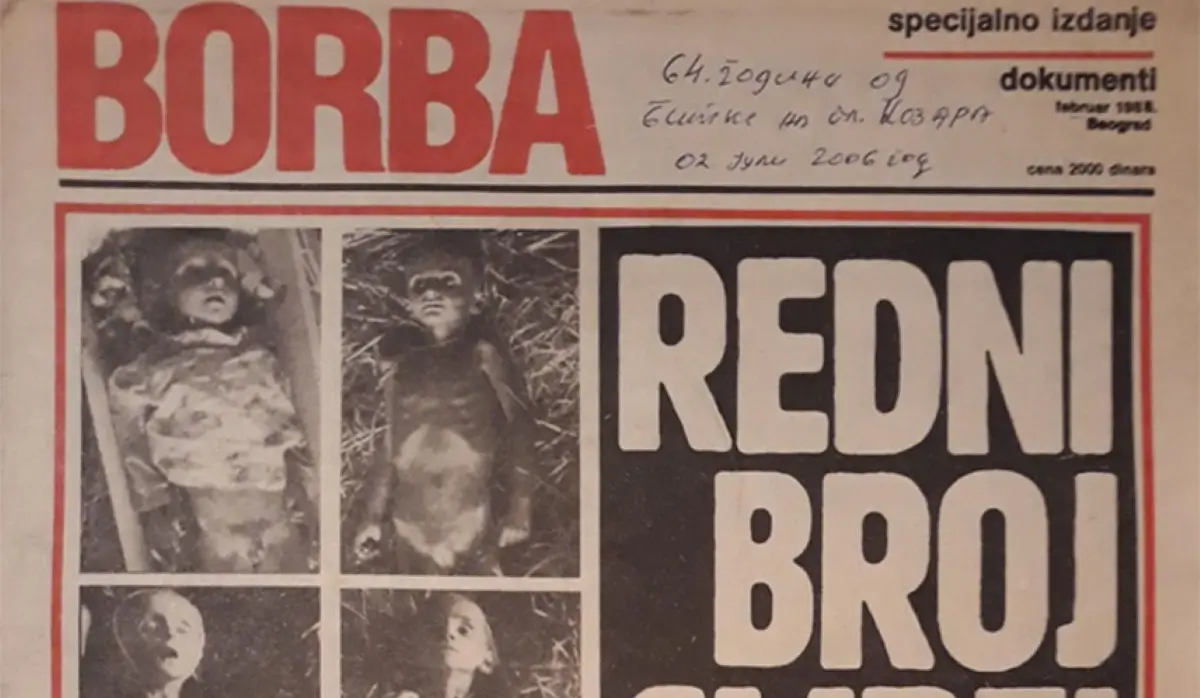
BELGRADE, MAY 19 /SRNA/ - A phototype edition of the historical document "Register of Names of 11,219 Kozara Children" was presented in Belgrade, a testimony to the suffering of Serb children during World War II that was first published in 1988 in a special edition of the newspaper Borba under the title "Serial Number of Death".
The edition was prepared, with the blessing of His Holiness Serbian Patriarch Porfirije, by the Association Jadovno 1941 from Belgrade in cooperation with the publishing house Prometej. It is dedicated to the prayerful remembrance of more than 11,000 children from Kozara whose lives were taken by Ustashe and Nazi forces between 1941 and 1945.
The research was collected over decades and preserved from oblivion by the late Dragoje Lukić, according to the website of the Serbian Orthodox Church /SOC/.
His Grace Bishop Sava stressed during yesterday's presentation at the Saint Sava Media and Cultural Centre in Zemun that the suffering of Serb children in the Independent State of Croatia /NDH/ is the most horrifying testimony to how deep evil can sink when it renounces God and humanity. He also recalled the children's camps in Jastrebarsko, Sisak, and the Jasenovac concentration camp system.
"Only through faith in Christ's Resurrection can remembrance of our Kozara children give hope that evil can never completely prevail and subjugate all of God’s creation, including man," Bishop Sava said.
Speaking about the suffering in the Potkozarje region, the bishop also recalled the tragedy of the village of Veliko Palančište near Prijedor, where around 460 people were killed in October 1942, including 220 children under the age of 14.
"Even if we gathered all the suffering in this world into one place, it could not compare to the suffering of even a single innocent child. That is a loss no one can make up for," Bishop Sava said.
The bishop stressed that, to their executioners, the children of Kozara were merely numbers, while for the Serbian people, they are an inextinguishable flame of candles before the throne of God. He added that the culture of remembrance and prayerful commemoration of the victims is one of the fundamental missions of the Serbian Orthodox Church in the Potkozarje region.
Bishop Sava said that many villages in Potkozarje never recovered from the suffering during the Kozara Offensive in the Second World War and that numerous families were completely wiped out.
"It is truly a miracle that we still exist today as a people in Potkozarje," the bishop said, recalling that children from Kozara died and were killed in various ways — in camps, villages, cities, and during the Kozara Offensive. He stressed that the number of child victims would have been far greater had it not been for the humanitarian mission of Diana Budisavljević.
Bishop Sava stressed that many mothers did not even have time to give names to their babies, and that cries, wailing, and pain echoed across the areas where Orthodox Serbs had lived for centuries. He added that children were often killed by their own neighbours, fathers, and older brothers of the peers with whom they had lived and grown up together until 1941.
"These painful wounds will never heal or be forgotten in the consciousness of the Orthodox Serbian people," Bishop Sava said.
The bishop recalled that during the Second World War, more than 40 churches were destroyed in the Kozara and Potkozarje areas, most of which have since been rebuilt, while new ones are also being constructed, such as the Church of the Holy Martyrs of Jasenovac concentration camp system in Međuvođe, at the site from which the population was taken to Jasenovac.
“This monumental work, printed in Serbian, Russian, and English, bears witness to the truth about the suffering of our people and reminds us of the eternal truth that the Church of Christ is not destroyed by blood, but built through it,” Bishop Sava said.
President of the Association Jadovno 1941 Momčilo Mirić said that the book is dedicated to the "little new martyrs of Kozara".
He noted that the research continued according to the same fundamental principles used by Dragoje Lukić and that the children were given back their names, faces, families, childhoods, and place in the memory of the people.
Editor of the publishing house Prometej Zoran Kolundžija stressed that it is the duty of present generations to preserve the truth and the memory of the victims, adding that one of the main messages of the book is that evil is not only a historical fact to be recorded, but also a warning that carries an obligation.