BRATIĆ: CROATIAN CRIMES ON THE PETROVAC ROAD AND PRIJEDOR ROAD WERE FINAL ACT OF ETHNIC CLEANSING OF SERBS
Croatia - war crime
08/07/2026
12:09
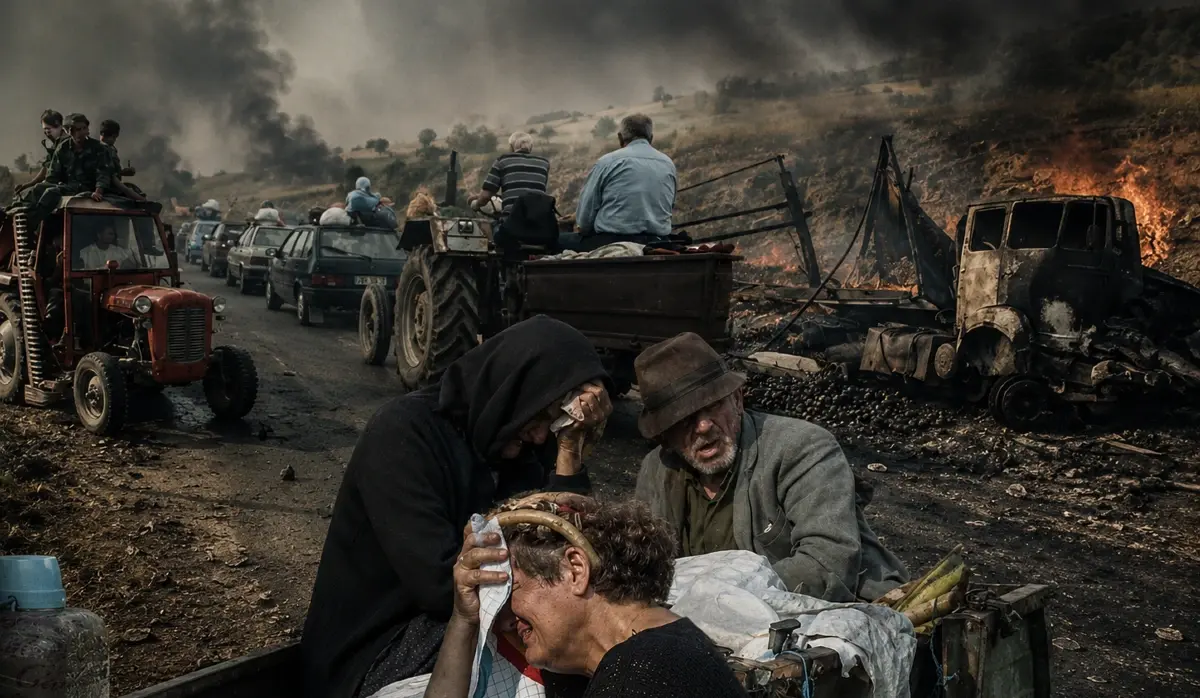
BELGRADE, AUGUST 7 /SRNA/ - The Croatian rocket attacks on civilian convoys on the Petrovac Road and the Prijedor Road in 1995 were the final act of the last phase of the ethnic cleansing carried out by Croatia against Serbs during the military-police operation Storm, lawyer Dušan Bratić, legal representative of the families whose members were killed in those attacks, told SRNA.
Bratić stressed that a series of facts demonstrate that, apart from the intent to carry out ethnic cleansing, there was no military justification whatsoever for this crime.
He says that this is the only possible conclusion, given that military operations on the territory of Croatia had practically ended the previous day, on August 6, because the units of the Army of the Republic of Serbian Krajina had been broken up, and that Croatian Army units had reached the state border with BiH, both in Banija and Kordun, that is, in the area of Dvor na Uni, as well as along the Srb–Donji Lapac–Kulen Vakuf route.
Bratić states that there was no military reason for the rocket attack on the Serb refugee convoy, especially considering that the bulk of the refugee convoys had already reached the Banja Luka area long before and were located on the territory of Republika Srpska, and that Operation Storm had ended following a decision by the Croatian defense minister.
"There was no military justification whatsoever, nor any military, strategic, operational or tactical objective for carrying out such attacks, especially using airborne weapons designed to destroy enemy personnel, not to neutralise fortifications and armoured units," Bratić said.
He noted that Croatian forces carried out attacks in the area where civilians were moving along the Bosanski Petrovac–Ključ route, and especially the following day on the Dvor na Uni route, that is, the Novi Grad–Prijedor–Banja Luka route.
Taking all of this into account, Bratić stresses that, from the standpoint of achieving military objectives, the only logical conclusion is that these attacks were ordered and carried out as a specific form of psychological and propaganda warfare, to establish so-called "psychological contact" with the civilian population and produce certain effects among them.
"In this particular case, the message was supposed to be symbolic in nature: 'Go and do not return, because when we can strike you like this here, on the territory of another country, deep inside foreign territory - 50 kilometres inside the territory around Bosanski Petrovac and Ključ, and 12 kilometres past Dvor na Uni, on the route towards Banja Luka - what will happen if you return?'" Bratić stressed.
He states that the only conclusion that can be drawn is that this was the final act of the last phase of the ethnic cleansing carried out during the so-called military-police operation Storm.
Bratić says that the political framework for this ethnic cleansing was established at the Brijuni meeting, while the events on the Petrovac road and the Prijedor road were elements of a single plan whose outcome was the mass exodus of the Serb population and a permanent change in Croatia's ethnic composition.
According to data from the Documentation and Verification Centre Veritas, those killed on the Petrovac road and in Svodna near Novi Grad were Darinka Drča /68/, Mika Kovačević /83/, Krstan Vuković /45/, Branko Stijelja /72/, Mirko Stijelja /34/, pregnant woman Mirjana Dubajić /21/, Jovica Drča /6/, Darko Vuković /13/, Nevenka Rajić /12/, Žarko Rajić /10/, Marta Galogaža /60/, Rade Galogaža /40/ and Mile Malobabić /42/.
Those wounded were Josipa Drča, Dušan Drča, Duško Ivaneža, Milica Ivaneža, Jovica Piplica, Ante Vitas, Dušan Beslać, Mara Beslać, pregnant woman Vedrana Stijelja, Obrenko Vuković, Dušan Drakulić, Vida Galogaža, Zorka Galogaža, Soka Malobabić, Suzana Ljubišić, Smilja Lajšić, as well as children Željko Drča /13/, Duška Drča /9/, Zorica Beslać /8/, Rajko Galogaža /10/, Goran Galogaža /12/, Miloš Malobabić /14/ and Nikolina Krajčinović /11/.
The indictment charges Croatian pilots Željko Jelenić, Danijel Borović, Vladimir Mikac and Zdenko Radulj with ordering the shelling of a refugee convoy on the Petrovac road on August 7 and 8, 1995.
Their trial began in March this year before the War Crimes Department of the Higher Court in Belgrade.