SOC PROPERTY IS NOT PRIVATE FIEF BUT CORNERSTONE OF SERB SURVIVAL
FBiH - seizure of Serb property
02/08/2026
09:55
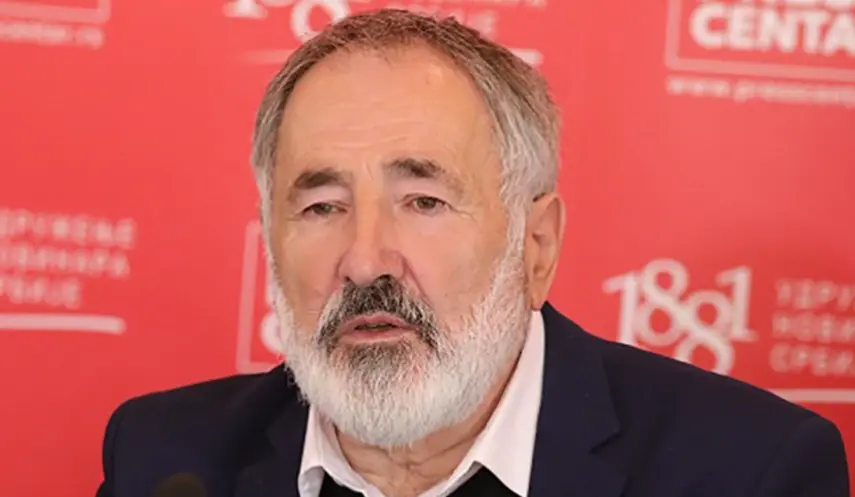
ISTOČNO SARAJEVO, FEBRUARY 8 /SRNA/ – The authorities of Serbia and Republika Srpska should immediately provide material and moral support to Serbs in the Federation of BiH /FBiH/ in order to stop the devastation, theft and renaming of Serbian Orthodox holy sites, Dušan Šehovac, president of the Citizens’ Association "Truth and Justice", told SRNA.
He points out that, after wartime destruction, the second act in erasing traces of Serb existence in FBiH consists of actions by that entity’s authorities registering Orthodox religious facilities as "state property."
"The third act is a media narrative in which Serbian Orthodox cemeteries are labeled as 'Bosnian Orthodox cemeteries,' with the intention that tomorrow Orthodox churches in FBiH be turned into new Hagia Sophias, into new 'Bosnian Orthodox churches'," Šehovac warned.
He notes that, as a person who has visited and filmed all Orthodox religious sites in the area of the former city of Sarajevo and spoken with Orthodox Serbs, he is aware of the importance of preserving and presenting Serbian religious heritage in FBiH.
KING FAHD MOSQUE ON ESTATE OF THE SERB MLAĐEN FAMILY
Šehovac asks the authorities of Sarajevo Canton whether the land on which the King Fahd Mosque in Nedžarići, that is, Alipašino Polje, was built is registered to the mosque or as "state property" of BiH.
At one time, the Serbian Orthodox Church /SOC/ insisted that this land be returned to it.
According to available documentation, the land belonged to the Serb Mlađen family, was illegally confiscated from them and never returned, but was instead unlawfully gifted to Saudi Arabia, which built a mosque on it.
That very land of the Mlađen family was arbitrarily and without anyone’s consent illegally gifted to Saudi Arabia by Bakir Izetbegović at the time when he was director of the Sarajevo Canton Construction Institute.
When Serb media once asked Izetbegović whether this was true, he replied only that he did not remember.
It is alarming that the mosque and its entire complex are owned by Saudi Arabia, that is, by a foreign state.
Documentation held by the Sarajevo municipality of Novi Grad states that the Sarajevo Canton Construction Institute granted Saudi Arabia ownership of the plot in Alipašino Polje, with no compensation whatsoever. The authorities of that country officially requested the position of the Tax Administration on whether they were obliged to pay tax, and were told that they did not need to pay anything.
After that, Saudi Arabia registered the land as its property and built the mosque, along with several facilities owned by the High Saudi Committee. That organization, incidentally, has been banned because it is suspected of involvement in activities related to terrorism, and it is known that a Wahhabi movement is present and developing there.
SOC PROPERTY – A PILLAR OF COLLECTIVE MEMORY
Šehovac notes that in Serbian tradition cemeteries and religious sites are not merely spaces of worship, but key pillars of collective memory, continuity and identity of the Serbian people.
"Especially in areas where Serbs throughout history were exposed to wars, migrations and violent interruptions of community life. Orthodox cemeteries testify to the centuries-long presence of Serbs in a given area. Tombstones with Cyrillic inscriptions, names, surnames, crosses and dates of birth and death are a silent but undeniable proof of the historical reality of a community," he emphasized.
Šehovac says that a cemetery, in that sense, is an archive of a people and speaks of where someone lived, how long they were there, and what identity they nurtured.
"Churches and monasteries in Serbian tradition have a dual role - spiritual /liturgy, baptisms, weddings, funerals/ and identity-based /language, script, historical memory, customs/. Through centuries without statehood, it was precisely the church and the cemetery that preserved the people. Villages, clans and family lines formed around them. That is why an attack on a church or cemetery has always been perceived as an attack on the very survival of the community, not just material damage," Šehovac pointed out.
He notes that in Serbian identity religious sites are inseparably linked to the family patron saint’s day, the family protector, and a sense of belonging.
"A cemetery where ancestors rest and a church where they were baptized become part of personal and collective identity, a kind of sacred geography of a people. Respect for graves and religious sites represents the minimum civilizational standard. For Serbs, the right to ancestral graves means the right to memory, identity and dignity. Where there is no grave - there is no recognition that someone ever existed," he stressed.
He says that cemeteries and religious sites for Serbs are living history in stone and prayer.
"They preserve memory, confirm presence and connect generations. Their preservation is not only a matter of faith, but of culture, identity and elementary justice. The historical experience of Serbs in the 20th and 21st centuries shows that the destruction of churches and desecration of cemeteries often accompanied persecution and ethnic cleansing. The goal of such acts is not mere vandalism, but the erasure of traces of a people’s existence and the message - `you never belonged here`," Šehovac warned.
SERBS CANNOT REMAIN SILENT WHEN THEIR CORE VALUES ARE ATTACKED
Sociologist Vladimir Vasić told SRNA that there are red lines that cannot be crossed, emphasizing that SOC property is not anyone’s private fiefdom, but the cornerstone on which Serbs have survived here for centuries.
"SPC property is not anyone’s private fiefdom or some cadastral parcel in dusty urban planning backrooms, but the cornerstone on which we have, despite everything, remained and survived in these lands, defying various brazen conquerors. It will be so now as well!" Vasić said.
He said that, at the very least, it is unwise to strike at the fundamental values of any people and then expect them to remain silent.
"It is politically immature to advocate for the functionality of the country while simultaneously, through exclusively confrontational actions, calling into question the position of one of the constituent peoples whose historical and cultural continuity is inseparable from the very existence of this community, whether someone likes it or not. It is justified and well-founded to ask – are loud promoters of Bosnian statehood, through such deeds, actually promoting its future or its disintegration?" Vasić asked.
Vasić notes that regional experience clearly shows that issues of religious institutions and their property cannot be treated as ordinary administrative matters, because the church, sociologically speaking, represents an institution of collective memory, identity and historical continuity of a community.
He stressed that in every civilized society based on the rule of law, property issues remain within legal frameworks.
"However, in communities like BiH, such issues very often go beyond legal frameworks and become identity-based, historical and essentially societal," Vasić said.
Just when it seems that BiH has the potential to function as a complex democratic country based on institutions and rules, he says, moves emerge that remind the public of periods when the law of the stronger applied, rather than the rule of law.
"Is someone really so unintelligent that they can expect the Serb people not to react to attempts at revitalizing Ottoman oppression in these areas, and that today in the 21st century?!" Vasić asked.
He says he understands that someone may have sympathies for history, but should know that the era of imperialism, at least the centuries-long kind, is deep in the past in these regions.
"In a society already historically burdened by divisions, such moves will certainly produce deep tensions and further divisions among ordinary people, who, I believe, do not want this. These and similar disputes are not mere legal-political issues, but potential triggers of serious social divisions in an already strained society," Vasić assessed.
He says he nevertheless hopes there will be reason to stop all this. "In the spirit of the faith I profess and the God I believe in, as well as the holy sites I protect, above all I hope and pray that someone sensible will emerge and stop all this in time, " Vasić stressed.