SARAJEVO - IMPORTANT ORTHODOX CENTER
FBiH - Sarajevo - property of Serbs and the SOC /2/
07/12/2026
10:19
SARAJEVO, JULY 12 /SRNA/ - Publicist Dragan Mijović told SRNA that since the 18th century, a very wealthy bourgeois class of Serbs has lived in Sarajevo, so the city in Miljacka was known as an important Orthodox center, and its church community as one of the strongest and best organized in Serbian territory.
BY: Željka DOMAZET
Mijović states that since the 18th century, there have been very wealthy Serbs in Sarajevo from the ranks of silversmiths, merchants, goldsmiths, furriers, and innkeepers.
"They were very patriarchal and pious people, often pilgrims, travelers to the Holy Land, so Sarajevo was considered an important Orthodox center, and its church community was considered one of the strongest and best organized in the Serbian region," Mijović points out.
Mijović reveals that for centuries it sent rich contributions from outside its diocese, even to Mount Athos and Constantinople, and Greek bishops vied for the throne of the Dabar-Bosnia Diocese.
"This economic power was also seen in the construction of the magnificent Cathedral Church and the Bishop's Palace, but also in numerous very expensive tombstones in the finest craftsmanship made of the best stone. Such were the Jeftanović family's tombstones made of expensive colorful marble, then the Besarović, Jelić, Despić, Ristić, Petrović, Vuković families with beautiful, often Byzantine ornaments," notes Mijović.
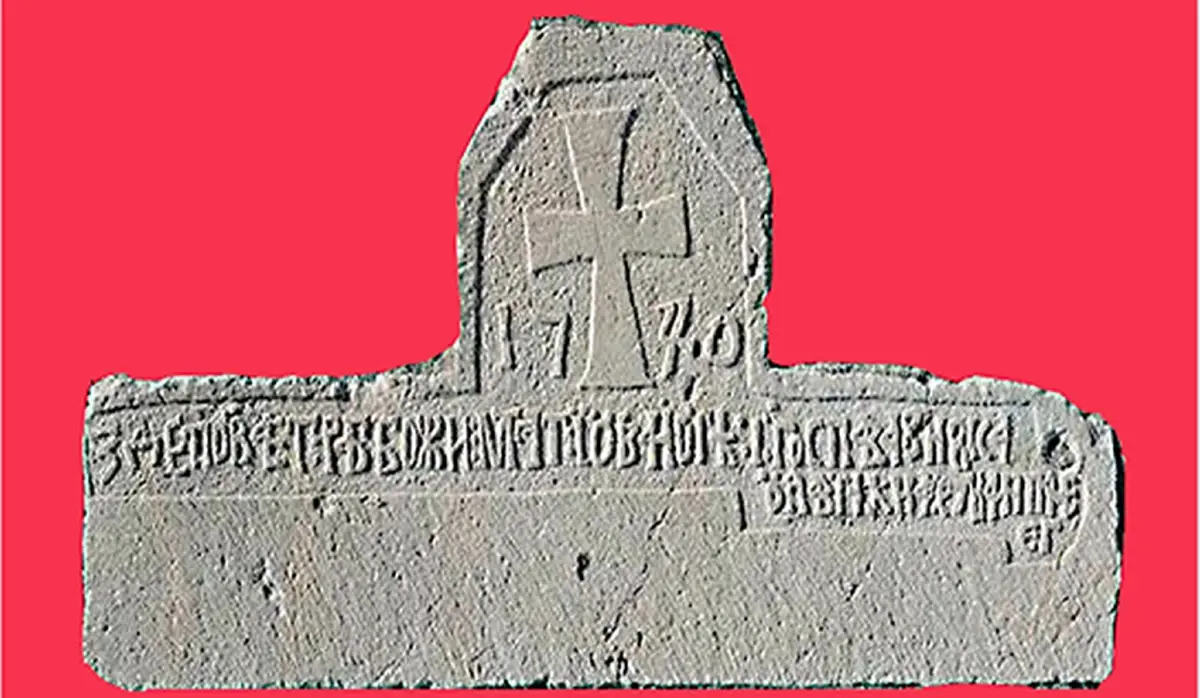
Mijović recalls that many beautiful crosses date back to the late 18th and early 19th centuries, which are decorated with fine reliefs on the edges, often with a carved angel's head above which were intertwined wings.
"The monuments of Milutin and Milica from 1745 and 1769 /last name illegible/, Risto Petrović from 1807, Risto Bijelić, and the monuments of the Tanasićs, the Đuričićs and others stood out for their beauty. Many striking monuments from that time were made, in addition to stone, from white saltpeter," Mijović points out.
He says that Sarajevo was characterized by the very frequent creation of "three-pointed" monuments, such as a cross without a central part.
"The craftsmanship of the stonemasons of the time, called smiths, is also evidenced by the ornate letters that were not cut into the stone but were carved as if they were raised, and many were decorated with a pattern that began with the initials of the old gospels and represented real small works of art. On one cross, the following is masterfully carved: `Here lies Jela, the servant of God, wife of Vojin Joanović, who died on March 28, 1761,`" Mijović said.
Even during the Ottoman cultural darkness, a spark of art still smoldered among Christians. Travel writers claimed that there were no such beautiful monuments anywhere in Serbia during the 18th century," Mijović stated.
EPITAPHS
Mijović points out that there were various, even longer, carved epitaphs on the monuments, such as: "Oh, you wretched death who rules over human destiny, when it is your principle that you do not even look at the young in order, while you spare the old, and you icy grave, receive me into yourself, and I will rest in you for eternity until the general resurrection."
One of the epitaphs reads: "And now I have become dust and ashes. Farewell, dear relatives, I have parted with you forever and gone to join my ancestors."
"The names Jeftan, Pavle, Joka, Risto, Jovo, Gospava, Trifko, Simeun, Dosta were common... Jovo Kreštalica and Jovanka Sudarević are mentioned as victims of cholera in 1857/58," says Mijović.
Mijović says that in the Serbian part of the cemetery at Carina, there are graves of a few Greeks, a Russian and a few Bulgarians, who worked as gardeners on the bey's estates.
"A high-quality monument to the merchant Đorđe Marinović was erected in 1867 by his son, a Parisian student Jovan Marinović, a distinguished statesman and diplomat, Prime Minister of the Principality of Serbia, who remained attached to his native Sarajevo until his death, where he helped the national movement, the church and the education of the local Serbs. A worthy monument to his parents was also erected there by the director of the Gymnasium, Dr. Kosta Krsmanović," said Mijović.
SERBS BURIED AT NIGHT
Mijović says that Sarajevo Serbs went to the cemetery to light candles and incense their loved ones, most often on the feast of St. Constantine, for summer, or on All Souls' Day.
"During the Turkish occupation, a Christian procession with a deceased person was allowed to move through the city only at dusk and at night, and even then without the public carrying of a cross. The first funeral of a Serb in broad daylight, with a prominent cross in front of the procession, took place on February 3, 1857, in the Serbian cemetery in Carina. It was the funeral of the Austrian consul Dimitrije Atanacković, a Serb born in Sremski Karlovci. The Turkish authorities could not apply this ban to a great power, their ally Austria," explains Mijović.
He points out that from that time on, Serbs began to dig during the day and with a cross.
"By the way, Atanacković rested in the burial chapel, which was maintained by the distinguished Serb Risto Perinović, as a friend of the family. When the consul's bones were later transferred, that Orthodox chapel began to be used by the Catholic family of Mato Pekić from Imotski, but it is not known whether it was used with the approval of the Consulate or the family of the deceased," says Mijović.
Mijović says that another Austrian consul, Ferdinand Haas, died in Busovača on the way from Brod to Sarajevo.
"He was buried on January 12, 1868, also, in the cemetery at Carina, and the funeral was led by the famous old Serbian archpriest Stefan Baković, together with Fra Grgo Martić on behalf of the Catholic community. Four years later, the secretary of the German consulate, Hieronymus, died in Sarajevo, and he was also buried at Carina, according to the Orthodox rite. The deceased was an Evangelical, so the Catholic Church refused to perform the funeral service, which was performed by Archpriest Baković, with the concelebration of younger priests," Mijović points out.
Mijović says that, according to Ivan Kolarić's testimony, between the two world wars, the Catholic part of the cemetery barely occupied a quarter of the total plot, and the oldest monument dates back to the mid-nineteenth century and was erected by a woman from Vienna.
"Austrian officers from the time of the occupation were buried there, and later several Italians, English, Germans, Czechs, Hungarians, Poles, French and various others also found their eternal resting place there," says Mijović.